
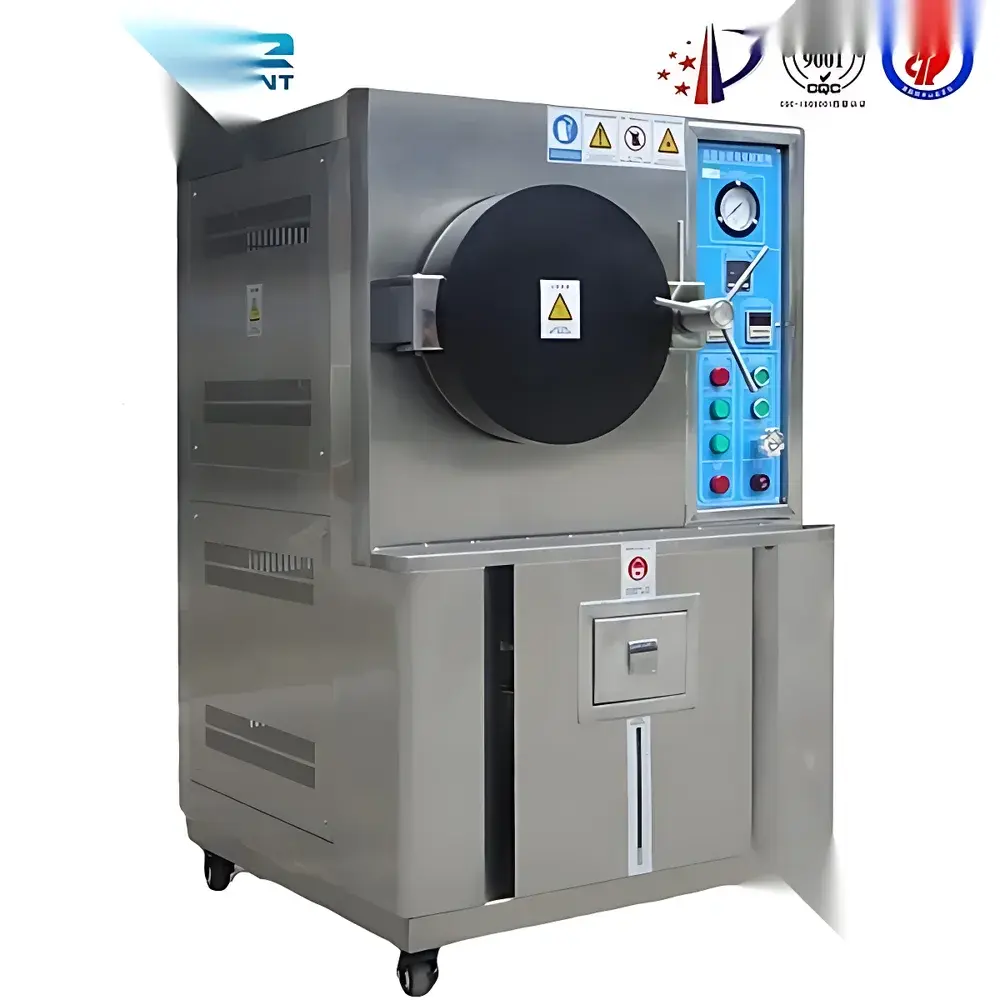
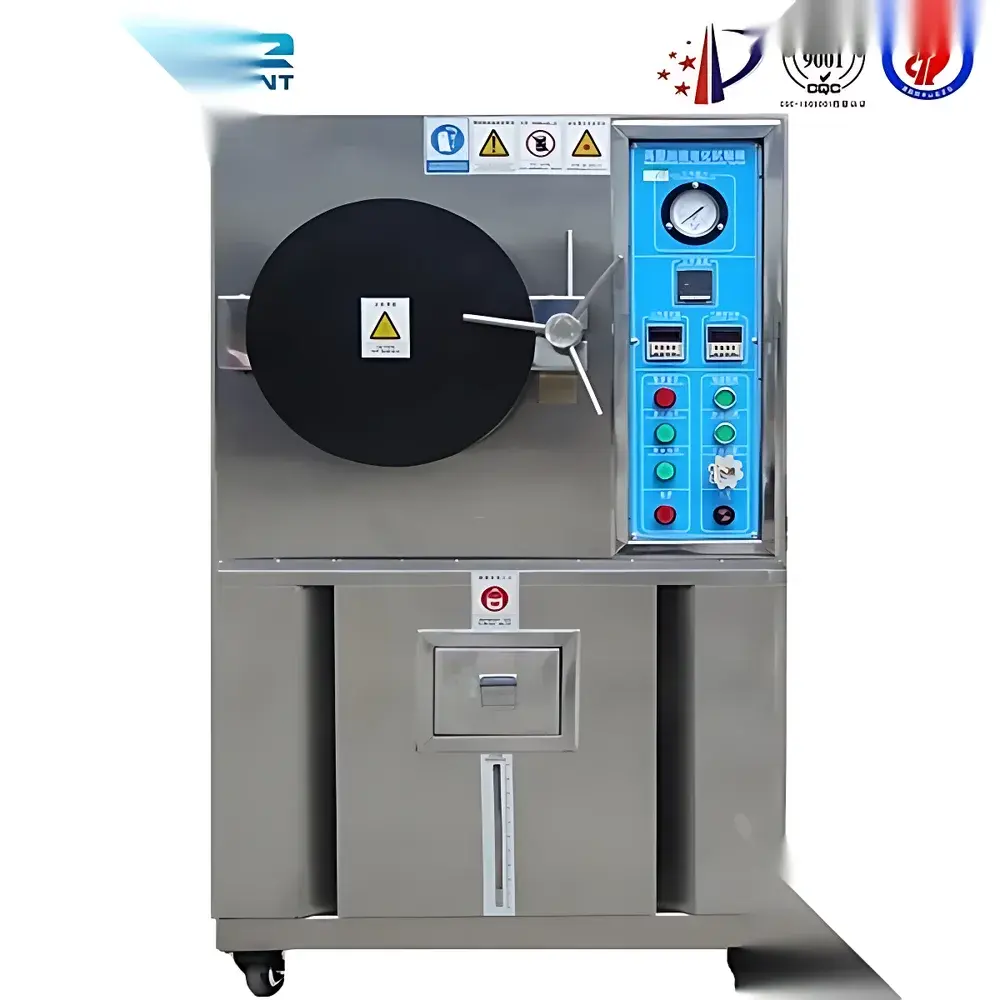
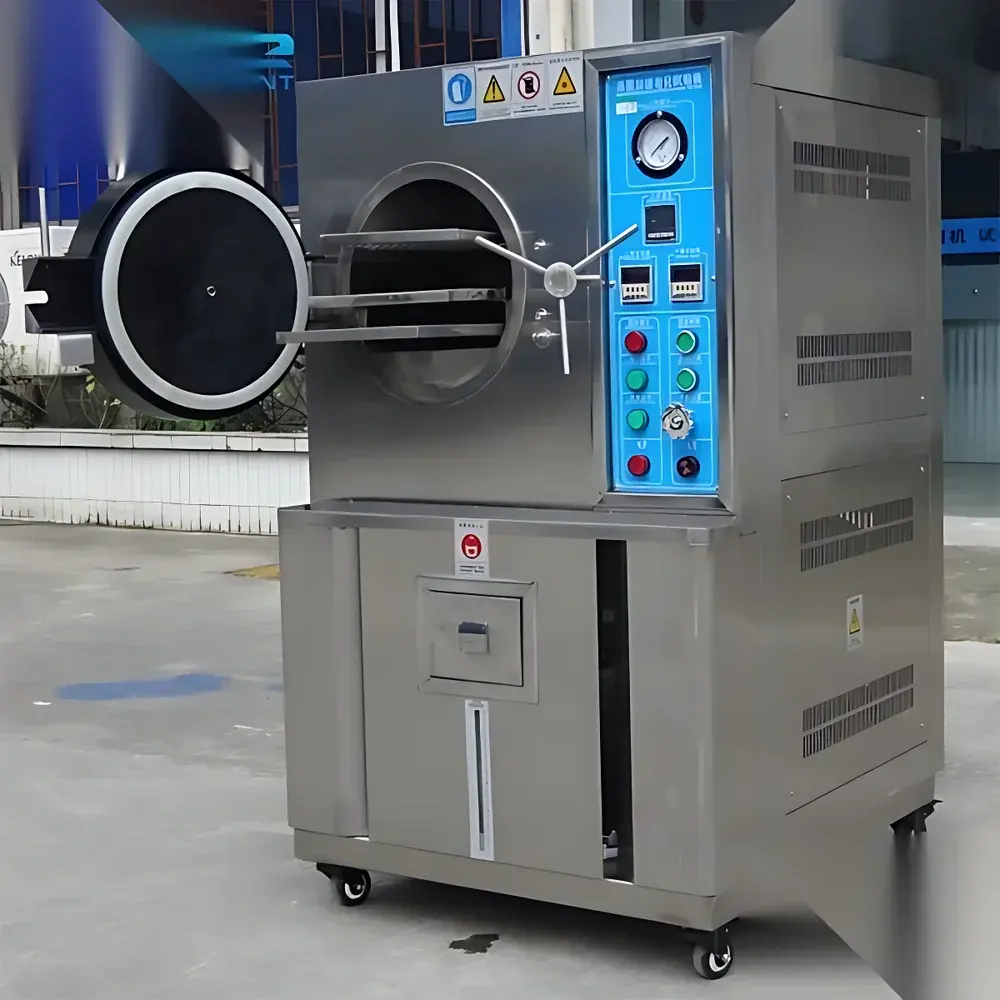
High-Pressure Accelerated Life Aging Test Chamber
| Key | Temperature Range: +100 °C to +132 °C (saturated steam temperature) |
|---|---|
| Humidity Range | 75–100% RH (steam-saturated) |
| Operating Pressure | 1.5–3.2 kg/cm² (absolute) |
| Vessel Design Pressure | 4.0 kg/cm² |
| Time Setting Range | 000–999 hours |
| Pressurization Time | ~45 min to reach 1.04 kg/cm² |
| Temperature Uniformity | ±0.5 °C |
| Temperature Display Resolution | 0.1 °C |
| Pressure Uniformity | ±0.2 kg/cm² |
| Chamber Dimensions | Ø300 mm × L500 mm (cylindrical) |
| Inner Vessel Material | SUS316 stainless steel, 3 mm thick |
| Outer Shell Material | SUS316 stainless steel, 1 mm thick |
| Insulation | Rockwool + rigid polyurethane foam |
| Heating Element | Finned seamless steel tube heater with platinum-coated surface |
| Control System | Taiwan-made microprocessor-based PID controller with PT100 sensor, LED time display, analog pressure gauge, auto-water replenishment valve |
| Safety Features | Dual-circuit high-temp electromagnetic safety valve, overpressure/overtemperature cut-off, manual & emergency pressure release, interlocked pressure-retention door |
Overview
The High-Pressure Accelerated Life Aging Test Chamber is an engineered environmental stress test system designed for accelerated reliability evaluation of materials and components under saturated steam conditions at elevated temperature and pressure. It operates on the principle of accelerated hydrothermal aging—leveraging the Arrhenius relationship between reaction kinetics and temperature, combined with enhanced moisture diffusion under pressurized saturated steam—to significantly reduce time-to-failure for failure modes such as polymer hydrolysis, metal corrosion, seal degradation, and dielectric breakdown. Unlike ambient-pressure humidity chambers, this system maintains precise control over absolute pressure (1.5–3.2 kg/cm²), enabling reproducible exposure to steam temperatures up to +132 °C—well above the atmospheric boiling point of water. Its cylindrical SUS316 inner vessel, rated to 4.0 kg/cm² design pressure, ensures long-term structural integrity in aggressive steam environments, making it suitable for qualification testing per IEC 60068-2-66, MIL-STD-810H Method 507.5, and JIS C 60068-2-66 standards.
Key Features
- Cylindrical test chamber (Ø300 mm × L500 mm) with full SUS316 stainless steel construction (3 mm inner wall, 1 mm outer shell) for superior corrosion resistance and pressure containment.
- Robust thermal insulation combining rockwool and rigid polyurethane foam to minimize heat loss and stabilize internal conditions during extended test cycles.
- Fin-tube electric heating element with platinum-coated surface for uniform steam generation and extended service life in high-humidity operation.
- Microprocessor-based PID temperature controller (Taiwan-made) using PT100 platinum RTD sensors, delivering ±0.5 °C temperature uniformity and 0.1 °C display resolution.
- Dual-circuit electromagnetic safety valve and mechanical pressure relief system, compliant with ASME BPVC Section VIII requirements for pressure equipment.
- Interlocked door mechanism that physically prevents opening while internal pressure exceeds 0.1 kg/cm²—ensuring operator safety during active pressurization.
- Auto-replenishment water inlet valve enables uninterrupted multi-day testing without manual intervention or cycle interruption.
Sample Compatibility & Compliance
This chamber accommodates a broad range of non-volatile, non-explosive test specimens—including printed circuit boards (PCBs), encapsulated semiconductors, medical device housings, automotive gaskets, pharmaceutical packaging, and aerospace composite laminates. Samples must be placed on non-reactive stainless steel trays or fixtures; no organic solvents or volatile compounds may be introduced. The system meets functional safety requirements outlined in ISO 13849-1 (PL d, Category 3) for pressure-related hazards. Its operational envelope supports validation protocols aligned with IPC-J-STD-020 (moisture sensitivity level testing), AEC-Q200 (passive component stress testing), and ASTM F1980 (accelerated aging of sterile barrier systems). All pressure instrumentation is traceable to NIST standards via third-party calibration documentation.
Software & Data Management
While the base configuration utilizes a dedicated LED-based timer and analog pressure gauge for manual operation, optional RS-485 Modbus RTU interface enables integration with laboratory-wide SCADA or MES platforms. When paired with compatible data acquisition software, users can log timestamped records of chamber temperature, absolute pressure, elapsed time, and cycle status—supporting audit-ready electronic records compliant with FDA 21 CFR Part 11 (when deployed with appropriate user authentication and electronic signature modules). All test logs include automatic event tagging for safety interventions (e.g., overpressure trip, door interlock activation), facilitating root-cause analysis during failure review sessions.
Applications
- Early-stage design validation of plastic enclosures and elastomeric seals exposed to humid tropical environments.
- Qualification of conformal coatings and underfill materials used in automotive ECUs subjected to thermal cycling and moisture ingress.
- Reliability screening of Class III medical device assemblies prior to biocompatibility retesting.
- Accelerated corrosion assessment of solder joints and PCB surface finishes under high-humidity stress.
- Stability testing of drug product packaging (e.g., blister foil lamination integrity) per ICH Q5C guidelines.
- Process capability studies for vapor-phase reflow soldering and steam-assisted curing of adhesives.
FAQ
What is the maximum allowable test duration?
The chamber supports continuous operation up to 999 hours (approximately 41.6 days) per test cycle, limited only by water supply and maintenance intervals.
Can the chamber operate at sub-atmospheric pressure?
No—it is engineered exclusively for positive-pressure saturated steam operation; vacuum or depressurized modes are not supported.
Is calibration certification included with shipment?
Factory calibration certificates for temperature (PT100) and pressure (Bourdon tube gauge) sensors are provided; ISO/IEC 17025-accredited field calibration services are available upon request.
How is condensate managed during depressurization?
A dedicated drain port with manual valve allows controlled removal of residual condensate after each cycle; no automatic condensate pump is integrated in the standard configuration.
Does the system comply with CE or UKCA marking requirements?
The unit conforms to the essential health and safety requirements of the EU Machinery Directive 2006/42/EC and Pressure Equipment Directive 2014/68/EU when installed and operated per manufacturer instructions; CE marking is applied following notified body assessment (Module H).



