
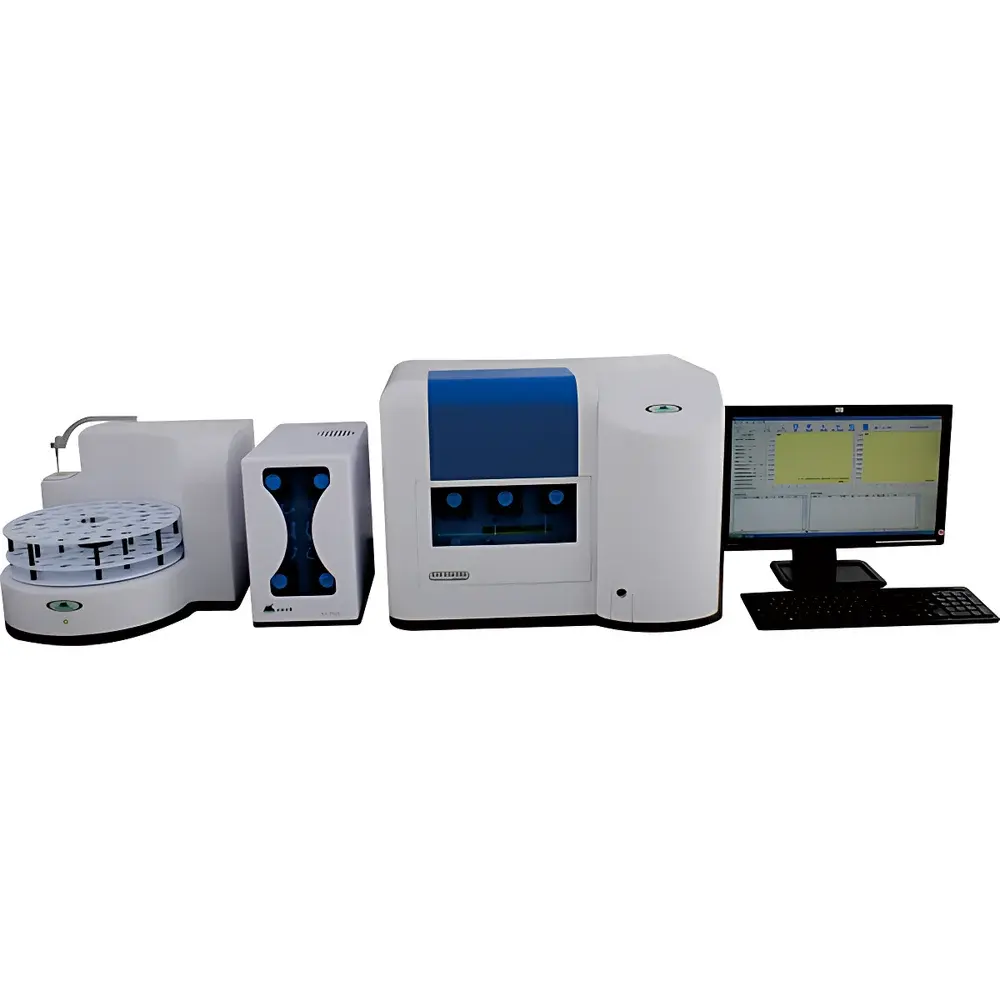
BEIYU GMA3386 Gas Phase Molecular Absorption Spectrometer
| Brand | BEIYU TECHNOLOGIES |
|---|---|
| Origin | Shanghai, China |
| Manufacturer Type | Direct Manufacturer |
| Product Origin | Domestic (China) |
| Model | GMA3386 |
| Pricing | Upon Request |
Overview
The BEIYU GMA3386 Gas Phase Molecular Absorption Spectrometer is a dedicated analytical instrument engineered for the quantitative determination of nitrogen- and sulfur-containing species in aqueous environmental samples—primarily wastewater, surface water, groundwater, and drinking water. It operates on the fundamental principle of gas-phase molecular absorption spectroscopy (GPMAS), wherein target analytes (e.g., nitrite, nitrate, total nitrogen, ammonia nitrogen, sulfide, mercury, and亚硫酸盐) are chemically converted into volatile gaseous molecules—such as NO, NO₂, N₂, H₂S, or Hg⁰—under controlled reaction conditions. These gaseous species are then swept by an inert carrier gas into an optical absorption cell, where their concentration is determined via Beer–Lambert law-based UV-Vis absorbance measurement at characteristic wavelengths. Unlike conventional liquid-phase spectrophotometry, GPMAS eliminates matrix interferences from turbidity, color, suspended solids, and ionic background—enabling direct analysis of highly contaminated, odorous, or dark-colored samples without filtration, digestion, or dilution. The GMA3386 integrates an optional UV online digestion module, enabling fully automated total nitrogen quantification per standardized protocols issued by China’s Ministry of Ecology and Environment (MEE), including HJ/T 199–2005 (nitrite), HJ 484–2009 (cyanide), HJ 485–2009 (copper), and HJ 636–2012 (total nitrogen).
Key Features
- Computer-controlled wavelength selection with ≤0.2 nm accuracy and ≤0.1 nm repeatability across the 190–400 nm spectral range.
- Automated lamp turret supporting up to four hollow cathode lamps (HCLs); three active lamps plus one hot-spare—each precisely aligned and focused via motorized positioning.
- Four-step adjustable spectral slit width (0.1, 0.2, 0.4, and 1.0 nm), enabling optimization of resolution vs. signal-to-noise ratio for diverse analyte concentrations and spectral overlap scenarios.
- High-stability optical platform with >24-hour baseline drift < ±0.002 AU after thermal equilibration; critical for unattended batch analysis.
- Imported Hamamatsu photomultiplier tube (PMT) detector ensuring low-noise, high-gain signal acquisition and long-term gain stability.
- Integrated online heating system: sample stream is preheated during transport, eliminating external water baths and reducing total analysis time for thermally dependent reactions (e.g., nitrite and total nitrogen) by 20–30 minutes.
- 2.4 mm ID PTFE-coated sampling tubing ensures representative aspiration of heterogeneous or particulate-laden samples.
- Membrane-based gas–liquid separation using imported hydrophobic polymer membranes (>99.99% separation efficiency); non-contact design eliminates membrane fouling and replacement requirements.
- Sealed, pressurized reaction manifold with automated reagent/sample metering—no manual pipetting, no open vessels, full containment of volatile analytes and hazardous reagents.
Sample Compatibility & Compliance
The GMA3386 is validated for use with raw and pretreated aqueous matrices compliant with national standard methods promulgated by China’s Ministry of Ecology and Environment (MEE). Its interference-free operation satisfies stringent regulatory expectations for wastewater monitoring under GB 3838–2002 (Surface Water Quality Standards) and GB 8978–1996 (Comprehensive Wastewater Discharge Standard). While not certified to ISO/IEC 17025 or EPA methods out-of-the-box, its architecture supports method validation per ISO 11929 (evaluation of measurement uncertainty) and ASTM D5176 (standard test method for total nitrogen in water by persulfate digestion). The instrument’s sealed fluidic path and audit-ready software log structure align with GLP principles for environmental testing laboratories.
Software & Data Management
The embedded Windows-compatible control software provides full instrument orchestration—including lamp selection, wavelength scanning, slit adjustment, heating control, and pneumatic sequencing. All analytical parameters (wavelength, slit, lamp current, integration time, calibration curves) are stored as method templates; users select and launch predefined methods without manual configuration. Real-time absorbance spectra are generated during each analysis and archived alongside quantitative results in a timestamped, searchable database. Sample IDs accept Unicode input (Chinese/English), and all data entries are write-protected—manual result editing is disabled to preserve data integrity. Audit trails record operator login, method execution, calibration events, and error logs. Re-analysis of stored samples is supported via “re-read” functionality, allowing retrospective verification without physical sample handling.
Applications
The GMA3386 delivers trace-level quantification of environmentally relevant species across multiple regulatory and research domains: nitrite and nitrate in agricultural runoff and drinking water distribution systems; total nitrogen in municipal wastewater effluents prior to discharge; ammonia nitrogen in industrial process streams and aquaculture facilities; sulfide in anaerobic digesters and landfill leachate; mercury in mining-impacted surface waters; and Kjeldahl nitrogen in food and soil extracts. Its speed (42 seconds per analysis), robustness against complex matrices, and minimal consumables (no desiccants, no filters, no columns) make it particularly suitable for high-throughput environmental monitoring labs, municipal water quality centers, and third-party testing facilities operating under tight turnaround constraints.
FAQ
Does the GMA3386 comply with international standards such as ISO or EPA methods?
The instrument implements MEE-standardized wet chemistry protocols. While not pre-certified to EPA SW-846 or ISO 15681, its performance characteristics (detection limits, precision, linearity) are consistent with those required by ISO 15681-1 (water quality — determination of phosphorus — part 1: orthophosphate) and ISO 11929 (uncertainty evaluation), and can be validated accordingly.
Is the UV online digestion module mandatory for total nitrogen analysis?
Yes—the UV/persulfate digestion module is required to oxidize organic nitrogen and ammonium to nitrate prior to GPMAS detection. It is integrated into the flow path and controlled synchronously with the spectrometer.
Can the GMA3386 be connected to a LIMS?
Raw data export is supported in CSV and XML formats; API integration requires custom middleware development. The software includes ODBC-compliant database access for enterprise-level reporting tools.
What maintenance is required for the gas–liquid separator membrane?
None—the hydrophobic polymer membrane is non-consumable and requires no periodic replacement due to its non-wetted, pressure-driven separation mechanism.
Is operator training necessary to achieve reproducible results?
Minimal training is required. The system’s automation—covering aspiration, reagent addition, reaction timing, gas transfer, and spectral acquisition—reduces dependency on analyst technique, making it accessible to entry-level technicians following documented SOPs.




