
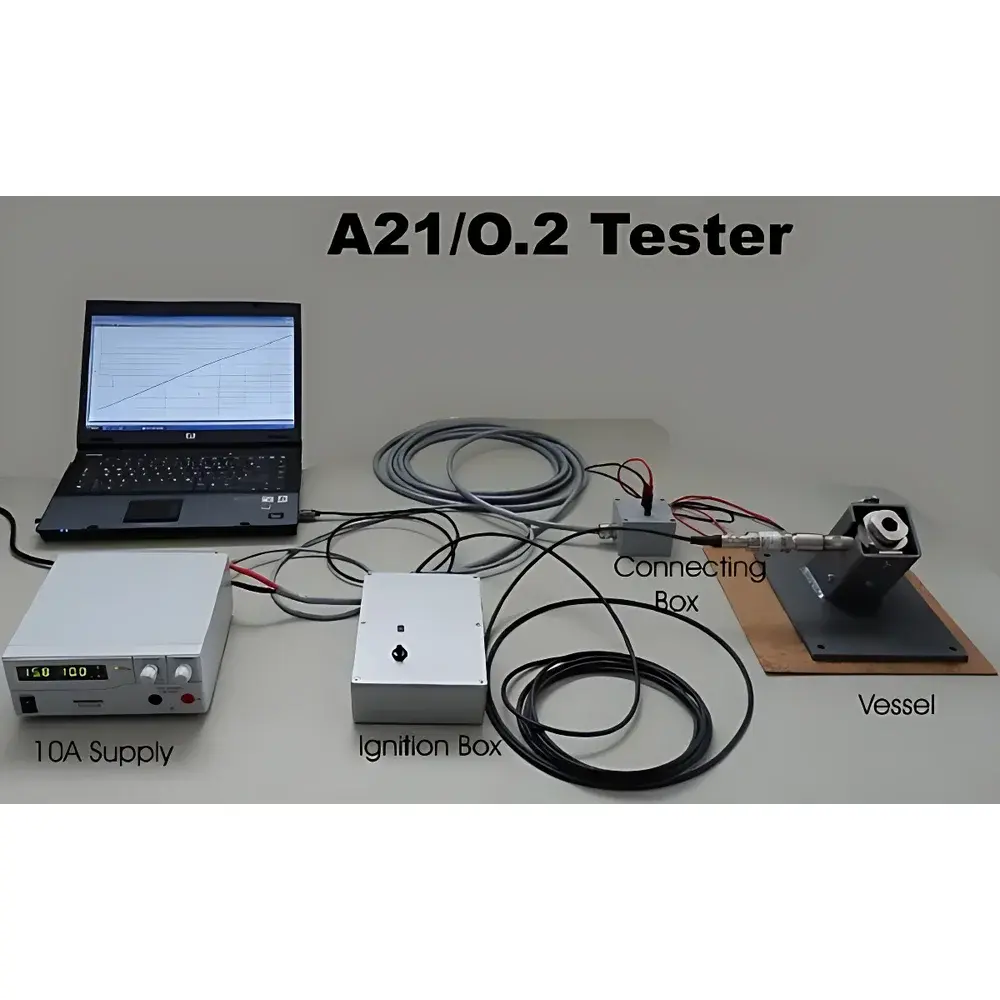
R&P A.21/O2 Time-Pressure Test Apparatus
| Brand | R&P |
|---|---|
| Origin | Germany |
| Model | A.21/O2 |
| Pressure Measurement Range | 690–2070 kPa (0–500 psi) |
| Response Time | ≤5 ms |
| Pressure Sensor Accuracy | ±0.2 ms timing resolution |
| Ignition Wire | NiCr, 25 cm length, Ø0.6 mm, 3.85 Ω/m |
| Burst Disc | Aluminum, 0.2 mm thickness, nominal burst pressure ≈ 320 psi |
| Ignition Power Supply | 10 A / 16 V constant current |
| Data Acquisition | Digital storage oscilloscope with PC interface and printer output |
| Remote Ignition Distance | ≥2 m (separate control box) |
| Compliance | UN Manual of Tests and Criteria, Rev. 7, Test 2(c)(i).2 |
Overview
The R&P A.21/O2 Time-Pressure Test Apparatus is a precision-engineered instrument designed to evaluate the ignition behavior and pressure development characteristics of hazardous substances under confined, adiabatic conditions. It implements the standardized A.21/O2 test protocol defined in the United Nations *Manual of Tests and Criteria*, Seventh Revised Edition, Section 2(c)(i).2 — a critical regulatory requirement for classification and transport hazard assessment of explosives, oxidizing liquids, and thermally unstable materials. The apparatus measures the time-resolved pressure rise following electrically initiated ignition within a sealed stainless-steel test vessel, enabling quantitative determination of combustion violence, deflagration propensity, and spontaneous ignition potential when mixed with combustible substrates. Its core measurement principle relies on high-speed dynamic pressure transduction coupled with sub-millisecond temporal resolution, ensuring reproducible detection of rapid exothermic events characteristic of energetic material decomposition or oxidation-driven combustion acceleration.
Key Features
- High-fidelity pressure monitoring system featuring a ruggedized stainless-steel pressure vessel with side-arm configuration, optimized for consistent thermal and mechanical boundary conditions during closed-vessel ignition.
- Ultra-fast response pressure transducer capable of capturing transient pressure profiles within ≤5 ms, calibrated across 690–2070 kPa (0–500 psi), with timing resolution better than ±0.2 ms — unaffected by hot gas exposure or corrosive decomposition products.
- Dedicated constant-current ignition module (10 A / 16 V) powering a precisely specified NiCr ignition wire (Ø0.6 mm, 25 cm, 3.85 Ω/m), ensuring repeatable energy deposition independent of contact resistance variations.
- Remotely operated ignition control unit physically isolated from the reaction chamber by ≥2 meters, integrated with fail-safe interlocks and visual/audible status indicators to comply with IEC 61508 SIL-2 functional safety expectations for laboratory-scale explosive testing.
- Replaceable aluminum burst disc (0.2 mm thick, nominal burst pressure ~320 psi) providing controlled overpressure relief while maintaining test integrity up to threshold limits defined in UN Test 2(c)(i).2.
- Modular mechanical architecture allowing reconfiguration for supplementary test protocols, including UN Test O.2 (oxidizing liquids) via validated accessory kits and procedural adaptations.
Sample Compatibility & Compliance
The A.21/O2 apparatus supports solid, liquid, and paste-like samples with defined mass loading protocols per UN guidance. It is routinely employed for UN hazard class assignment (Class 1 explosives, Class 5.1 oxidizers) and GHS Category 1–3 flammability/combustibility evaluation. All operational procedures, calibration records, and raw data outputs align with GLP principles and support audit readiness for regulatory submissions to ECHA, US DOT PHMSA, and Transport Canada. The system meets essential requirements of ISO/IEC 17025:2017 for test method validation, including documented uncertainty budgets for pressure and time measurements. Optional firmware upgrades enable traceable timestamping compliant with FDA 21 CFR Part 11 electronic record requirements when paired with validated software configurations.
Software & Data Management
Data acquisition is performed using a synchronized digital storage oscilloscope with real-time waveform capture, configurable trigger thresholds, and lossless binary export (.bin or .csv). The included PC-based application provides synchronized visualization of pressure vs. time curves, automated peak detection, first-derivative (dP/dt) calculation, and comparative overlay of replicate runs. All acquired datasets are stored with embedded metadata (operator ID, sample ID, ambient T/P, calibration certificate ID, and instrument serial number), supporting full chain-of-custody documentation. Export formats include PDF reports with embedded digital signatures, Excel-compatible spreadsheets, and ASCII logs suitable for LIMS integration. Audit trails log all user actions, parameter modifications, and file exports in accordance with ALCOA+ data integrity principles.
Applications
- Determination of explosive sensitivity to thermal initiation in transport-relevant confinement scenarios.
- Assessment of oxidizing liquid potency per UN Test O.2 when configured with optional accessories.
- Quantification of combustion rate enhancement in fuel–oxidizer mixtures, including nitrate ester–hydrocarbon blends and peroxide–organic solvent systems.
- Screening of pyrophoric tendencies in metal hydrides, alkylaluminums, and other air-sensitive compounds upon rapid heating.
- Supporting R&D for safer formulation design in pharmaceutical intermediates, battery electrolyte additives, and specialty polymer precursors subject to thermal runaway risk.
- Providing evidentiary data for SDS Section 9 (Physical and chemical properties) and Section 14 (Transport information) under CLP/GHS frameworks.
FAQ
What UN test standards does the A.21/O2 apparatus directly support?
It is fully configured for UN Test 2(c)(i).2 (Time/Pressure Test) and can be adapted for UN Test O.2 (Oxidizing Liquids) with certified hardware modifications.
Is the pressure sensor intrinsically safe for use with reactive decomposition gases?
Yes — the transducer employs hermetically sealed piezoresistive sensing elements with chemically inert diaphragm coatings, validated for exposure to NOx, Cl2, and acidic fumes generated during energetic material decomposition.
Can raw oscilloscope data be exported for third-party analysis?
Absolutely — binary waveform files (.bin) and time-stamped CSV exports are supported, preserving full sampling fidelity (≥1 MHz equivalent bandwidth) without interpolation or compression.
Does the system include calibration documentation traceable to national metrology institutes?
Each unit ships with a UKAS-accredited calibration certificate for the pressure transducer and ignition current source, valid for 12 months under standard operating conditions.
What safety certifications apply to the remote ignition control cabinet?
The enclosure conforms to IP65 ingress protection, EN 61000-6-4 EMC emission limits, and carries CE marking under the EU Machinery Directive 2006/42/EC for laboratory equipment.




