
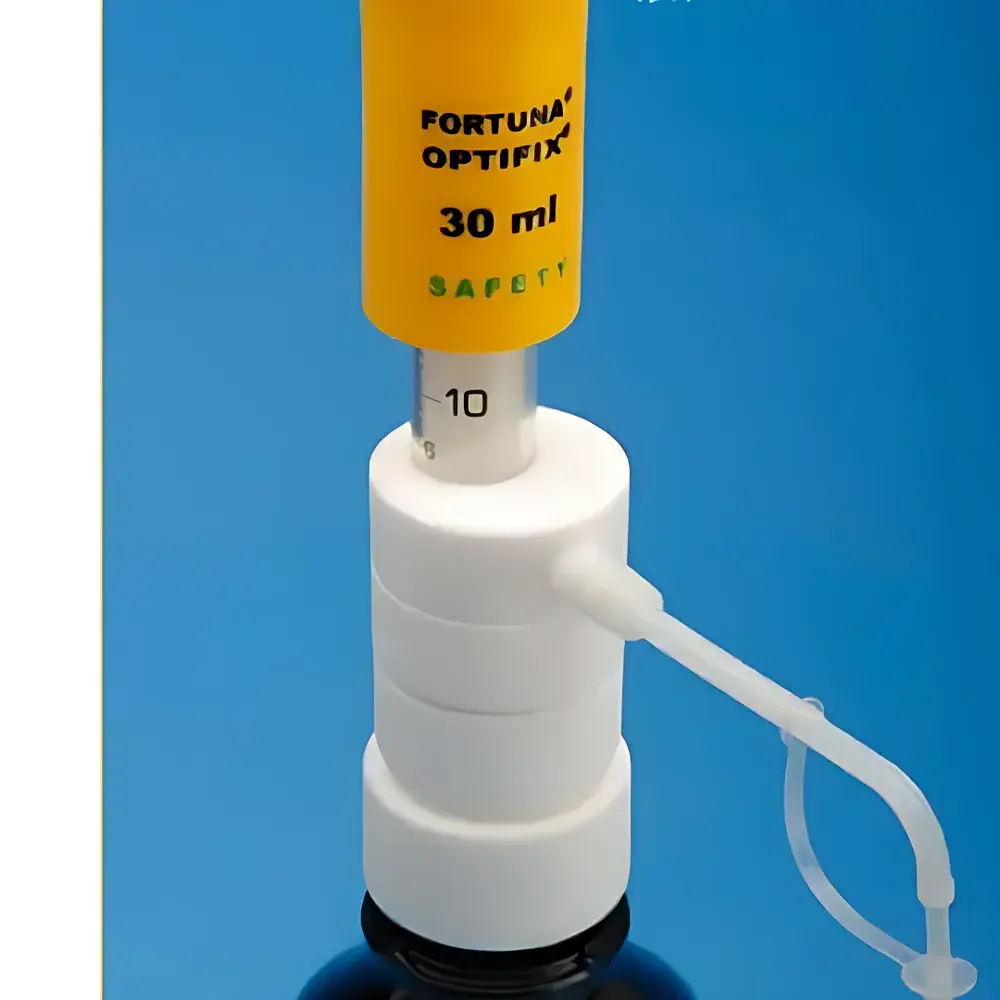
FORTUNA OPTIFIX SAFETY Bottle Top Dispenser, Germany
| Brand | FORTUNA |
|---|---|
| Origin | Germany |
| Model | FORTUNA® OPTIFIX® SAFETY |
| Type | Manual Bottle Top Dispenser |
| Volume Range | 0.4–100 mL |
| Minimum Increment | 0.1 / 0.5 / 1.0 / 2.0 mL |
| Accuracy | ±1% |
| Error | ±1% |
| Compliance | DIN EN ISO 9001, German Calibration Standard (H-Quality Certification) |
| Materials | PTFE-coated piston, borosilicate glass cylinder, PTFE valve block and adapters (GL32, 40 mm & 45 mm), PP finger guard with laser-etched scale |
| Sealing | 100% metal-spring-free, fully chemically inert construction |
Overview
The FORTUNA® OPTIFIX® SAFETY Bottle Top Dispenser is a precision-engineered, manually operated liquid handling instrument designed specifically for safe and accurate dispensing of aggressive reagents—including concentrated mineral acids (e.g., HCl, HNO₃, H₂SO₄), hydrofluoric acid (HF), strong alkalis, oxidizers, and other highly corrosive or reactive liquids. Built upon the principles of positive displacement volumetric delivery, it employs a chemically inert PTFE-coated piston moving within a calibrated borosilicate glass cylinder to ensure repeatable volume transfer without contamination or degradation. Its spring-free, all-polymer valve architecture eliminates metallic components susceptible to corrosion or passivation failure—making it uniquely suited for GLP/GMP-compliant laboratories where long-term reliability, traceability, and chemical compatibility are non-negotiable.
Key Features
- Full chemical inertness: All fluid-contact parts—including piston, valve block, adapters (GL32, 40 mm, 45 mm), suction tube, and sealing elements—are constructed from high-purity PTFE or borosilicate glass; no stainless steel springs or elastomers exposed to reagents.
- Laser-etched, permanent scale: High-contrast, abrasion-resistant volume markings on the PP finger guard remain legible over decades of use; calibrated per German H-Quality certification standards.
- Ergonomic dual-hand operation: Symmetrical lever design and low actuation force enable consistent dispensing by both left- and right-handed users—even while wearing thick chemical-resistant gloves.
- Optical process monitoring: Transparent glass cylinder allows real-time visual verification of piston position, liquid level, and bubble formation—critical for verifying complete aspiration and preventing air entrapment.
- Modular adapter system: Includes three PTFE adapters (GL32, 40 mm, 45 mm) and one PTFE suction tube, enabling secure mounting on standard reagent bottles across multiple neck sizes without thread adaptation kits.
- Traceable metrological compliance: Each unit is individually calibrated and certified to DIN EN ISO 9001 quality management requirements; accuracy specifications (±0.2% to ±0.6% depending on range) are validated per ISO 8655-3 for piston-operated dispensers.
Sample Compatibility & Compliance
The OPTIFIX® SAFETY dispenser is validated for continuous use with Class I–IV corrosive substances under ISO 15190:2020 laboratory safety guidelines. It meets the material compatibility requirements of ASTM D543-20 (resistance to chemical reagents) and complies with EU Regulation (EC) No 1907/2006 (REACH) for fluoropolymer-based components. Its absence of metal springs satisfies USP analytical instrument qualification criteria for “non-reactive fluid paths” in regulated QC environments. The device supports audit-ready documentation: calibration certificates include serial-numbered traceability to national metrology institutes (PTB-accredited), and batch-specific test reports verify leak-tightness (<1 × 10⁻⁶ mbar·L/s He) and pressure stability at 1.5 bar over 120 min.
Software & Data Management
As a manual mechanical dispenser, the OPTIFIX® SAFETY requires no firmware, drivers, or software integration. However, its design inherently supports digital lab infrastructure: volume settings are physically fixed via laser-etched scales—eliminating configuration drift—and each unit ships with a QR-coded calibration certificate linking to downloadable PDF reports (including uncertainty budgets per GUM). For LIMS integration, users may log dispenser ID, calibration date, and assigned operator directly into electronic lab notebooks (ELN) such as LabArchives or Benchling. The absence of electronics ensures full compatibility with electromagnetic-sensitive environments (e.g., NMR suites) and avoids 21 CFR Part 11 compliance overhead—while still enabling full ALCOA+ data integrity through paper-trail-equivalent physical records.
Applications
- Preparation of standardized acid digestions in environmental testing (EPA Method 3050B, 3051A).
- Accurate dosing of HF-containing etchants in semiconductor wafer cleaning protocols.
- Reagent dispensing in pharmaceutical stability studies involving oxidative stress agents (e.g., peroxides, chlorinated solvents).
- Calibration solution preparation for ICP-MS and AAS where trace metal contamination must be minimized (achieved via PTFE/glass-only path).
- Teaching labs requiring robust, maintenance-free dispensers for undergraduate chemistry courses involving concentrated acids.
FAQ
Is the OPTIFIX® SAFETY dispenser compatible with hydrofluoric acid (HF)?
Yes—its entire fluid path is composed of PTFE and borosilicate glass, both of which exhibit exceptional resistance to HF up to 48% concentration at ambient temperature. No metal or silicone components are present.
Does it require recalibration after repeated exposure to strong acids?
No. The laser-etched scale and PTFE piston geometry are dimensionally stable under chemical stress; periodic verification (e.g., gravimetric check per ISO 8655-6) is recommended annually—but factory calibration remains valid for the service life of the unit.
Can it be sterilized in an autoclave?
No. While PTFE and glass tolerate high temperatures, the PP finger guard and O-rings are not autoclavable. For decontamination, rinse thoroughly with deionized water followed by IPA, then air-dry.
What bottle neck sizes does it support out-of-the-box?
Three PTFE adapters are included: GL32 (standard for 1–4 L reagent bottles), 40 mm (common for 2.5 L HDPE carboys), and 45 mm (used with many European solvent containers).
How is accuracy verified across different volume ranges?
Each range (e.g., 0.4–2 mL, 2–10 mL, etc.) is independently calibrated using Class A volumetric flasks and analytical balances traceable to NIST standards; uncertainty values are reported per ISO/IEC 17025:2017 Annex A.



