
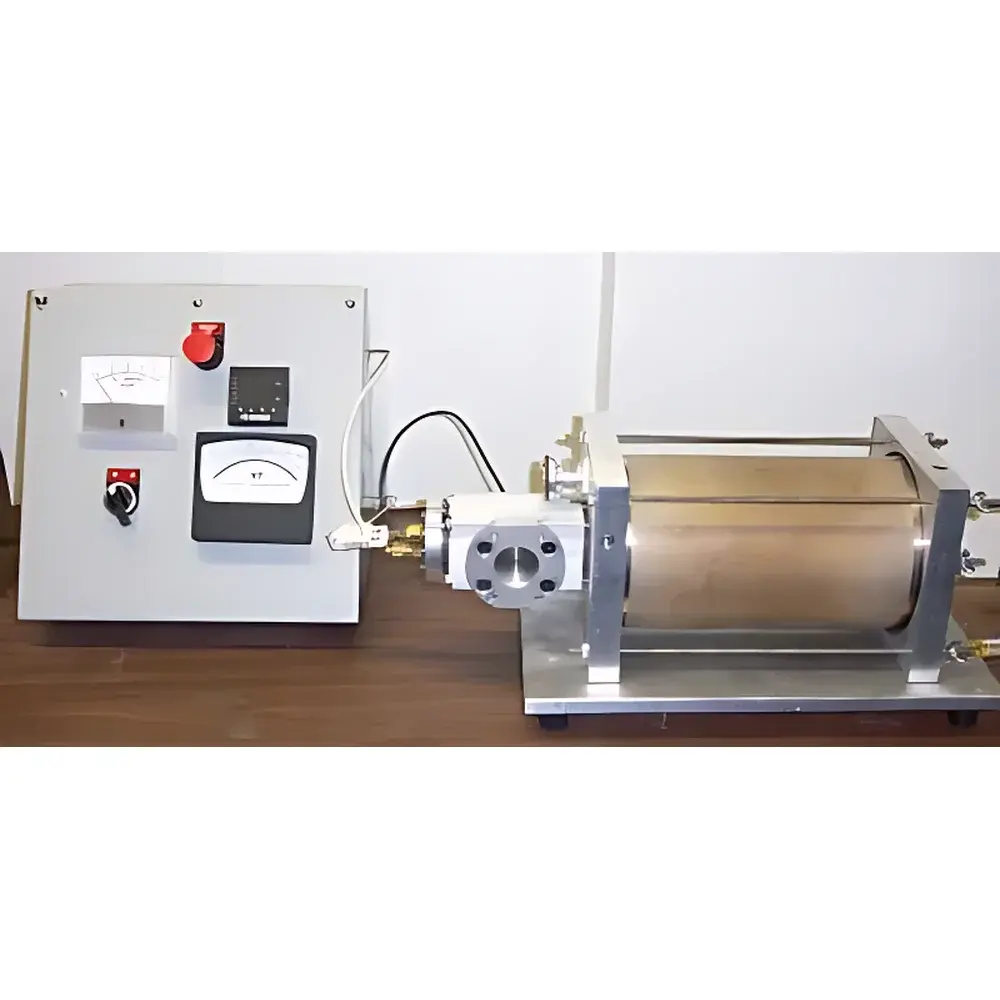
HTVF1P5 High-Temperature Vacuum Tube Muffle Furnace
| Origin | USA |
|---|---|
| Manufacturer Type | Authorized Distributor |
| Origin Category | Imported |
| Model | HTVF1P5 |
| Quotation | Upon Request |
| Max Temperature | 2500 °C |
| Heating Zone Dimensions | Ø15 mm × 150 mm |
| Thermocouple Type | Type C (W–Re 5/26) |
| Heating Element | Tungsten Filament |
| Chamber Material | Proprietary High-Purity Refractory Composite |
| Power Supply | 220 V, 50 Hz, 30 A |
| Max Power Consumption | ~2 kW at 2500 °C |
| Control System | PID-Based SCR Power Controller |
| Cooling Method | Integrated Water-Cooling Jacket |
| Mass | ~1 kg |
| External Dimensions (Furnace) | 400 × 180 × 180 mm (L×W×H) |
| Controller Dimensions | 300 × 250 × 300 mm (L×W×H) |
| Temperature Uniformity | ±1 °C within ±10 mm radial/axial center zone (Type C thermocouple referenced) |
Overview
The HTVF1P5 High-Temperature Vacuum Tube Muffle Furnace is an engineered thermal platform designed for ultra-high-temperature processing under controlled vacuum or inert gas environments. It employs resistive heating via tungsten filament elements housed within a proprietary refractory composite tube, enabling stable operation up to 2500 °C — a regime where conventional ceramic or molybdenum-based systems fail due to creep, oxidation, or thermal decomposition. The furnace operates on the principle of radiant and conductive heat transfer within a sealed quartz or high-purity alumina tube (user-supplied or optional), with precise thermal confinement achieved through optimized filament geometry and axial thermal zoning. Its compact footprint (400 × 180 × 180 mm) and lightweight construction (~1 kg furnace body) make it suitable for integration into glovebox systems, vacuum manifold setups, or benchtop high-temperature synthesis workflows. Unlike standard muffle furnaces, the HTVF1P5 eliminates external radiation loss through active water-cooled jacketing and tight vacuum sealing (≤10−3 mbar typical), ensuring reproducible thermal profiles essential for sintering refractory carbides, graphitization of carbon precursors, or high-temperature phase transformation studies.
Key Features
- Ultra-high temperature capability: Continuous operation up to 2500 °C with thermal stability <±1 °C in the central 20 mm zone (monitored by calibrated Type C thermocouple)
- Vacuum-compatible architecture: Sealed tube configuration rated for base pressures ≤10−3 mbar; optional flange kits support ISO-KF or CF connections
- Precision temperature control: Digital PID controller with SCR-based power modulation, enabling ramp rates from 0.1 to 50 °C/min and soak accuracy within ±2 °C over 24-hour cycles
- Robust heating core: Tungsten filament wound on high-density refractory mandrel; chamber lining composed of proprietary low-outgassing composite resistant to thermal shock and metal vapor corrosion
- Integrated thermal management: Dual-path water cooling circuit maintains outer shell temperature <60 °C during 2500 °C operation, minimizing ambient heat load and extending component service life
- Modular scalability: Standard Ø15 mm × 150 mm hot zone; custom configurations available (e.g., Ø25 mm × 200 mm, multi-zone variants with independent thermocouple feedback)
Sample Compatibility & Compliance
The HTVF1P5 accommodates samples in sealed quartz, graphite, or high-purity alumina crucibles compatible with vacuum or inert gas (Ar, N2) environments. It supports powder metallurgy sintering, ceramic densification, thin-film annealing, and high-temperature calibration artifact preparation. The system complies with IEC 61000-6-3 (EMC emission limits) and UL 61010-1 safety requirements for laboratory electrical equipment. While not intrinsically rated for explosive atmospheres, it may be operated inside certified Class 1000 cleanroom enclosures or nitrogen-purged gloveboxes meeting ISO 14644-1 specifications. All electrical interfaces meet CE marking directives; thermocouple wiring conforms to ASTM E230/E230M for Type C sensor traceability.
Software & Data Management
The integrated PID controller includes RS-485 Modbus RTU output for third-party SCADA or LabVIEW integration. Optional firmware upgrade enables CSV export of time-stamped temperature, power, and setpoint logs (1 Hz resolution). Audit trails include operator ID tagging, parameter change history, and thermal cycle timestamps — supporting GLP-compliant documentation per FDA 21 CFR Part 11 when paired with validated electronic lab notebook (ELN) systems. No cloud connectivity or proprietary software installation is required; configuration remains accessible via front-panel keypad and LCD interface.
Applications
- Sintering of ultra-refractory ceramics (e.g., ZrB2, HfC, TaC) and MAX-phase compounds
- High-temperature annealing of graphene oxide films and carbon nanotube arrays
- Thermal calibration of blackbody sources and radiation thermometers (ITS-90 traceable)
- Controlled pyrolysis of polymer-derived ceramics under dynamic vacuum
- Phase equilibria studies in ternary metal systems (e.g., Ni–Cr–Al, Co–Re–W) using quench-and-analyze protocols
- Preparation of high-purity reference materials for XRD and SEM-EDS quantification
FAQ
What vacuum level is required for stable 2500 °C operation?
A base pressure ≤10−3 mbar is recommended to suppress tungsten oxidation and minimize radiative losses; higher vacuum (<10−5 mbar) improves temperature uniformity but is not mandatory.
Can the HTVF1P5 operate under flowing argon?
Yes — it supports continuous inert gas purging via standard Swagelok fittings; flow rates >50 sccm are advised to maintain reducing conditions around the hot zone.
Is Type C thermocouple calibration included?
Each unit ships with NIST-traceable calibration certificate for the installed Type C sensor, valid for 12 months under normal use conditions.
What maintenance intervals are specified for the tungsten heating element?
Under nominal cycling (≤5 cycles/week to 2500 °C), the filament exhibits >2000 hours MTBF; visual inspection and resistance measurement are recommended every 500 operating hours.
Does the water cooling system require deionized water?
Yes — conductivity <1 µS/cm is required to prevent electrolytic corrosion of copper manifolds; closed-loop chillers with 0.5 µm filtration are strongly recommended.



