
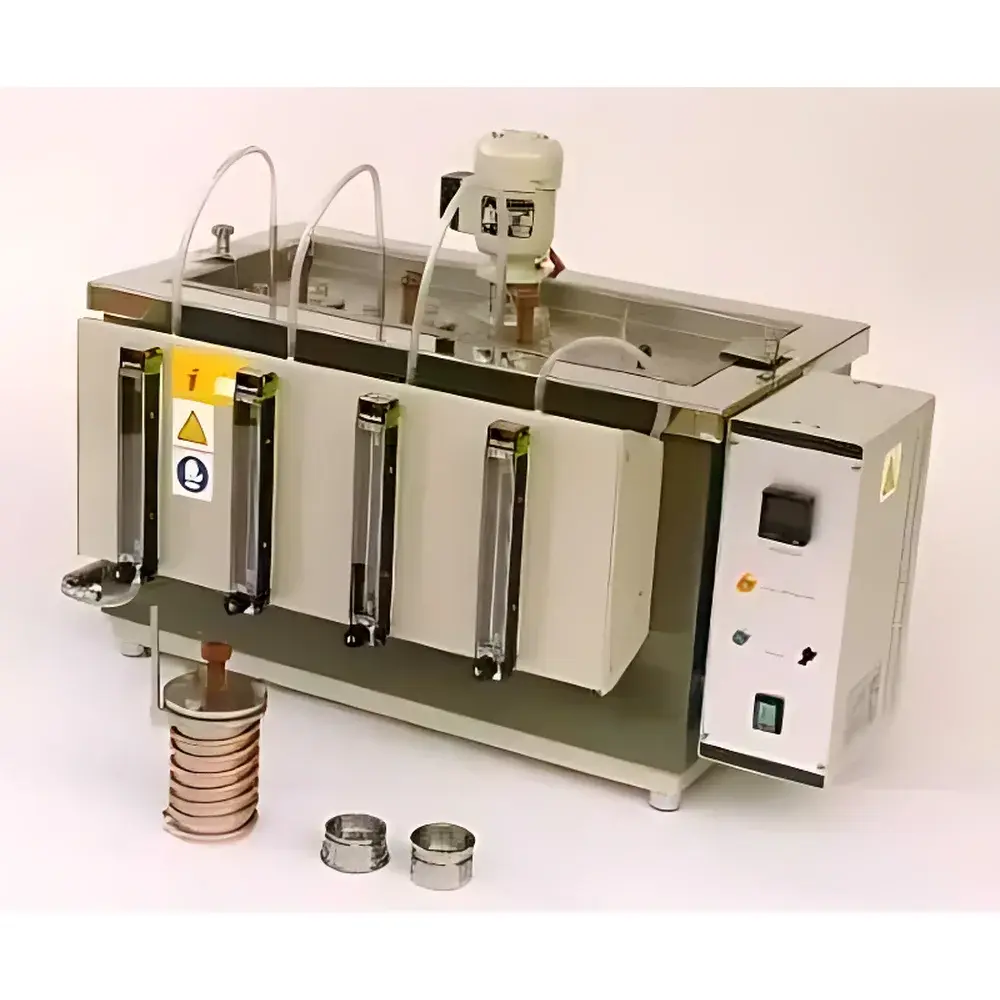
ASTM D972/IP183 Lubricating Grease and Oil Evaporation Loss Tester AD0972-100
| Origin | Imported |
|---|---|
| Manufacturer Type | Authorized Distributor |
| Model | AD0972-100 |
| Pricing | Available Upon Request |
Overview
The ASTM D972/IP183 Lubricating Grease and Oil Evaporation Loss Tester AD0972-100 is a precision-engineered benchtop instrument designed to quantify volatile loss from lubricating greases and oils under controlled, standardized thermal and airflow conditions. It operates on the principle of gravimetric mass loss measurement: a pre-weighed sample is heated in a defined air stream for a specified duration (typically 22 hours at 160 °C per ASTM D972), after which the residual mass is determined and percent evaporation loss calculated. This method directly assesses volatility—a critical parameter influencing long-term lubricant stability, oxidation resistance, and service life—particularly in high-temperature applications such as automotive wheel bearings, industrial gearboxes, and electric motor lubrication systems. The system complies strictly with the procedural and apparatus requirements outlined in ASTM D972 (“Standard Test Method for Evaporation Loss of Lubricating Greases”) and IP 183 (“Determination of Evaporation Loss of Lubricating Greases”), ensuring regulatory acceptability for QC/QA reporting and third-party certification.
Key Features
- Benchtop design with corrosion-resistant ceramic-coated stainless steel frame and bath vessel, engineered for durability in continuous laboratory use
- Stainless steel heating bath equipped with integrated drain valve and high-efficiency thermal insulation to minimize ambient heat loss and improve energy efficiency
- Precision air delivery subsystem: calibrated flowmeter (0–2 L/min) with fine-adjustment needle valve and NIST-traceable calibration certificate; includes glass wool–filled particulate air filter upstream of sample zone
- Dual-hole configuration (AD0972-100) enables parallel testing of two samples under identical thermal and aerodynamic conditions, enhancing throughput and inter-sample comparability
- Microprocessor-based PID temperature controller with Pt100 RTD sensor, providing ±0.1 °C setpoint accuracy across the full operating range (ambient to 160 °C)
- Digital front-panel display of real-time bath temperature, with intuitive keypad interface for setpoint entry and system status monitoring
- Integrated electronic stirrer with stainless steel shaft and impeller ensures uniform thermal distribution within the bath medium (typically silicone oil or heat-transfer fluid)
- Stainless steel lid with precisely machined apertures for secure insertion of standardized sample cups (grease or oil variants), minimizing convective disturbance and maintaining laminar airflow profile
Sample Compatibility & Compliance
The AD0972-100 accommodates both lubricating greases and mineral/synthetic base oils using application-specific sample cups: AD0972-A01 (for oils) and AD0972-A02 (for greases), each conforming to dimensional and material specifications in ASTM D972 Annex A1. Optional AD0972-A00 cup sleeves—fitted with copper heating coils—enable auxiliary air preheating to reduce thermal lag during transient operation. All wetted components are constructed from 316 stainless steel or ceramic-coated equivalents to prevent catalytic degradation of sensitive formulations. The instrument meets essential requirements for GLP-compliant laboratories, including stable thermal control, documented calibration traceability (via CAL001/CAL002 PT100 simulators), and repeatable airflow delivery—enabling full audit readiness per ISO/IEC 17025 and supporting FDA 21 CFR Part 11 data integrity frameworks when paired with compliant LIMS integration.
Software & Data Management
While the AD0972-100 operates as a stand-alone hardware platform without embedded PC software, its analog and digital interfaces support seamless integration into modern laboratory data ecosystems. The Pt100 RTD output and optional analog airflow signal (0–10 V or 4–20 mA) can be logged via external DAQ systems compliant with ASTM E2655 guidelines for digital data acquisition. Temperature stability logs, run timestamps, and operator IDs may be recorded manually or via barcode-scanned test protocols. Calibration records—including flowmeter certification and RTD verification using CAL002—are maintained in accordance with ISO 9001 Clause 7.1.5 and ASTM E177 Practice for Use of the Terms Precision and Bias, facilitating internal audits and external accreditation reviews.
Applications
- Quality control of finished lubricating greases per OEM specifications (e.g., SKF, FAG, Timken)
- Formulation development for high-temperature NLGI Grade 2 and 3 greases used in EV traction motors and wind turbine pitch bearings
- Comparative volatility screening of synthetic ester vs. polyalphaolefin (PAO) base stocks
- Regulatory submission testing for API SL/SP and ACEA A3/B4 certified lubricants
- Root-cause analysis of field failures linked to excessive thinning or consistency loss in service
- Validation of antioxidant package efficacy under accelerated evaporation stress
FAQ
What standards does the AD0972-100 comply with?
It fully satisfies the apparatus and procedural requirements of ASTM D972 and IP 183 for gravimetric evaporation loss determination.
Can the instrument be upgraded from 2-hole to 4-hole configuration?
No—the AD0972-100 (2-hole) and AD0972-110 (4-hole) are distinct mechanical assemblies; conversion requires replacement of the bath lid, airflow manifold, and mounting hardware.
Is the flowmeter calibrated for compressed air or ambient air?
Calibration is performed using dry, filtered ambient air at standard temperature and pressure (STP); corrections for compressed or humidified air streams must be applied externally per ISO 8573-1.
What maintenance is required for long-term accuracy?
Annual verification of Pt100 sensor drift and flowmeter linearity is recommended; cleaning of glass wool filters and inspection of stainless steel bath seals should occur after every 50 test cycles.
Are sample cups included with the base unit?
No—AD0972-A01 (oil cups) and AD0972-A02 (grease cups) are ordered separately to ensure correct geometry and material compliance for each test matrix.





