
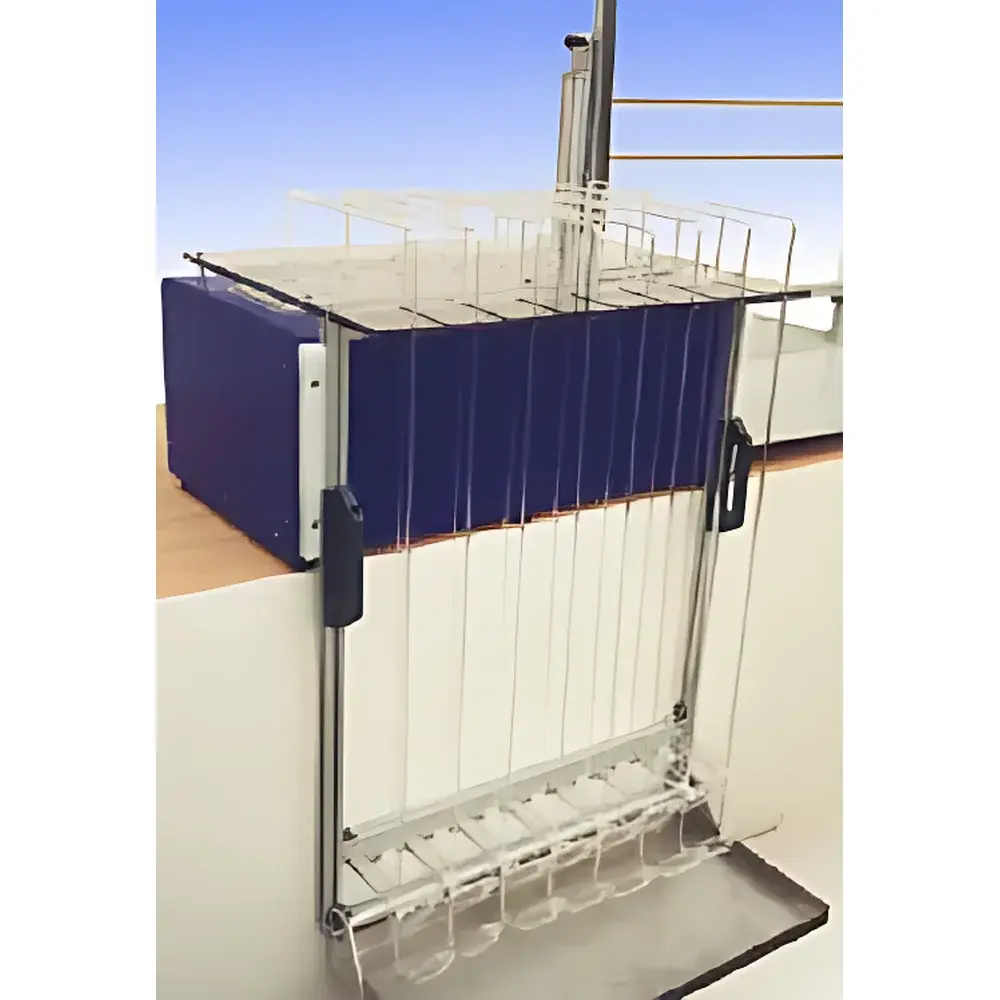
Talliani Vacuum Stability Analyzer
| Brand | R&P |
|---|---|
| Origin | Germany |
| Manufacturer Type | Authorized Distributor |
| Product Origin | Imported |
| Model | Talliani Vacuum Stability Analyzer |
| Pricing | Upon Request |
Overview
The Talliani Vacuum Stability Analyzer is a precision-engineered instrument designed for quantitative thermal decomposition assessment of energetic materials under controlled vacuum conditions. It operates on the fundamental principle of vacuum stability testing—measuring gas evolution pressure from a fixed-mass sample heated at constant temperature in a sealed, evacuated system. As per ASTM D1873 (equivalent to MIL-STD-286C and NATO AEP-57 Annex C), the analyzer quantifies gaseous decomposition products via mercury manometry, converting measured pressure rise into standardized gas volume (mL/48 h/g) at STP (0 °C, 101.325 kPa). This metric serves as a primary indicator of chemical stability, compatibility between propellant constituents, and long-term storage safety for nitrocellulose, nitroguanidine, double-base and single-base propellants, and other nitro-organic compounds used in defense and aerospace applications.
Key Features
- Aluminum heating block with embedded resistive elements, enabling uniform thermal distribution across all sample positions
- 15-position sample holder with precisely machined bores (Ø15.75 mm × 125 mm depth) for consistent thermal contact and mechanical alignment
- High-accuracy PT100 platinum resistance thermometer integrated into each heating zone, traceable to national standards
- Dedicated PID temperature controller housed in a separate enclosure, supporting ramp-hold programming and real-time deviation monitoring
- Overtemperature safety cutoff set at 150 °C—hardware-limited, independent of controller logic
- Dual digital display showing both setpoint and actual block temperature with ±0.1 °C control stability over the full operating range (ambient to 135 °C)
- Stainless-steel and borosilicate glass manifold assembly, including calibrated capillary mercury manometer (with mercury cup and vertical capillary column) and mercury-sealed sample tubes
- Sample tube dimensions: Ø15 mm × 155 mm, cylindrical, fitted with integrated mercury piston for gas displacement measurement
- Modular support frame engineered to stabilize glass components and mercury reservoirs during extended test cycles (up to 48 h)
- Power specification: 230 V AC / 50 Hz, 1800 VA maximum load; supplied with 2 m industrial-grade power cable
Sample Compatibility & Compliance
The analyzer accommodates standard 15 mm diameter cylindrical specimens—including solvent-cast nitrocellulose films, pressed propellant grains, and blended energetic formulations—as specified in MIL-STD-286C Section 4.1 and ISO 11927-2. All wetted surfaces are chemically inert toward nitric ester vapors and decomposition byproducts. The system supports GLP-compliant operation when paired with validated vacuum pumps and documented calibration procedures. Mercury manometer calibration is performed per ISO 5725 (accuracy verification) and NIST SP 250-93 (manometric pressure standards). Instrument design conforms to IEC 61010-1 for electrical safety in laboratory environments.
Software & Data Management
While the base configuration operates as a stand-alone analog-manometer system, optional digital data acquisition modules enable time-stamped pressure logging (via pressure transducer retrofit), automated temperature ramping, and CSV export. When integrated with LIMS or ELN platforms, the system supports audit-trail generation compliant with FDA 21 CFR Part 11 requirements—including electronic signatures, user access controls, and immutable raw data archiving. Calibration records, maintenance logs, and test reports may be linked to unique sample IDs for full traceability throughout the product lifecycle.
Applications
- Evaluation of thermal stability of nitrocellulose-based lacquers and coatings in ammunition primers
- Compatibility screening of oxidizers (e.g., ammonium perchlorate) with binders and plasticizers in solid rocket propellants
- Batch release testing of double-base propellants per NATO AQAP-2110 and MIL-PRF-22077
- Accelerated aging studies for shelf-life prediction of insensitive munitions (IM) formulations
- Research-grade decomposition kinetics analysis using multi-temperature isothermal protocols
- Regulatory submission support for UN Class 1 hazard classification (Test Series 3(c))
FAQ
What standards does the Talliani Vacuum Stability Analyzer comply with?
It meets the procedural and apparatus requirements of MIL-STD-286C, ASTM D1873, ISO 11927-2, and NATO AEP-57 Annex C for vacuum stability testing.
Is mercury handling support included with the system?
Yes—the instrument includes mercury containment trays, spill kits, and detailed SOPs aligned with OSHA 29 CFR 1910.1200 and EU Directive 2017/852 for elemental mercury use in laboratories.
Can the system be upgraded for automated data capture?
Absolutely. Optional pressure transducers, USB-connected DAQ modules, and PC software enable real-time graphing, alarm thresholds, and PDF report generation.
What vacuum pump options are certified for use with this analyzer?
The recommended IP44-rated diaphragm pump (4-stage, ≤0.6 mbar ultimate vacuum, 13 L/min flow) complies with ISO 8573-1 Class 0 for oil-free, particle-free vacuum generation essential for reproducible mercury column response.
How often must the mercury manometer be recalibrated?
Annual calibration against NIST-traceable deadweight testers is recommended; interim verification using reference gas volumes (per ISO 6145-1) should be conducted before each critical test series.



