
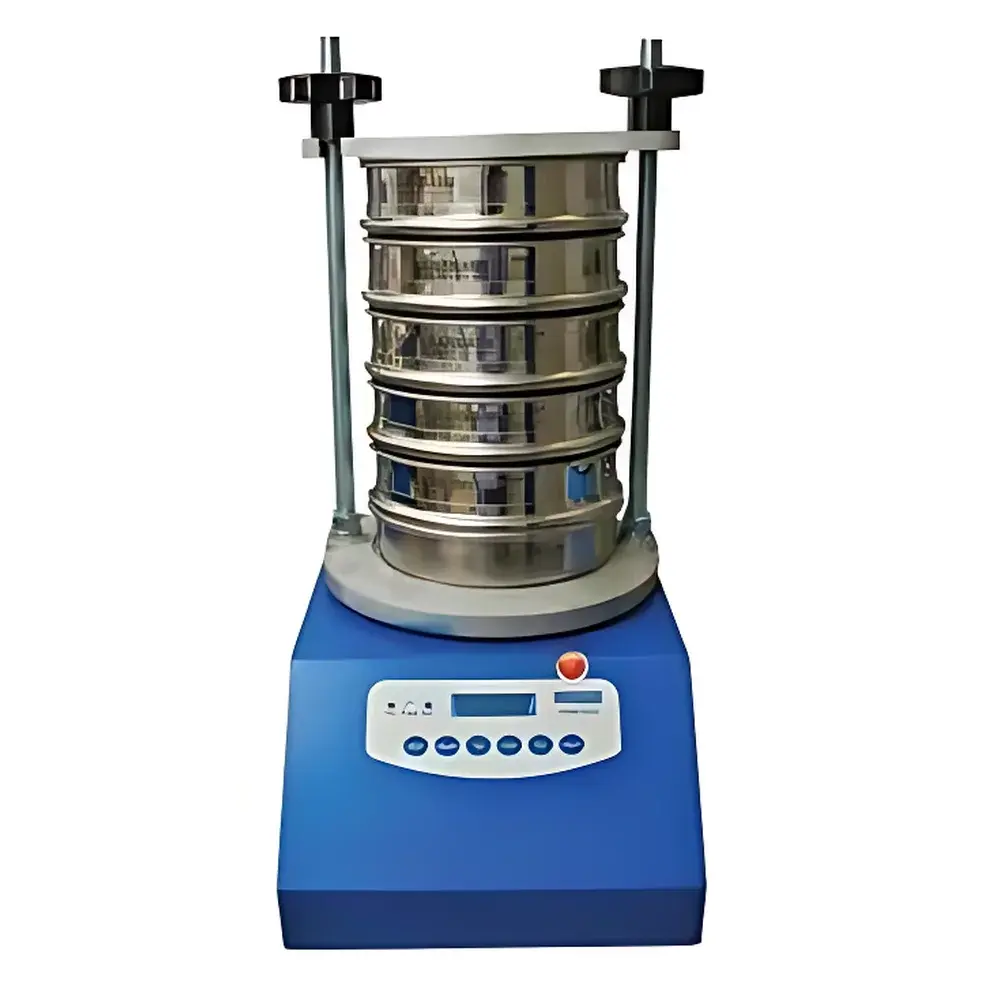
Leyman LMSM300/450 Electromagnetic Digital Sieve Shaker
| Origin | Netherlands |
|---|---|
| Manufacturer Type | Authorized Distributor |
| Origin Category | Imported |
| Model | LMSM300/450 |
| Price Range | USD 6,800 – 13,600 |
| Measurement Range | 20 µm – 125 mm |
| Max Sample Capacity | 25 kg |
| Max Sieve Stack Levels | 9 (standard) / 17 (with extension kit) |
| Adjustable Base Acceleration | 1.0 – >10.0 g |
| Timer Range | 1–99 min |
| Intermittent Drive Interval | 10–99 s |
| Preset Method Storage | 9 profiles |
| Max Amplitude | 2.50 mm |
| Sieve Diameter Compatibility | 45, 75, 100, 150, 200, 203, 250, 315, 390, 400, 450 mm |
| Drive Principle | Electromagnetic resonance generating combined circular and vertical 3D throwing motion |
| Compliance | DIN EN ISO 9001 calibration support, CE certified |
| Power Supply | 230 V, 50 Hz, 300 VA |
| Net Weight (instrument only) | 40 kg |
Overview
The Leyman LMSM300/450 Electromagnetic Digital Sieve Shaker is a precision-engineered laboratory instrument designed for standardized particle size distribution analysis via mechanical dry or wet sieving. It operates on electromagnetic resonance drive technology—distinct from conventional eccentric or gyratory mechanisms—generating a controlled, three-dimensional throwing motion that combines rotational and vertical acceleration components. This motion ensures uniform particle stratification and efficient separation across the full analytical range of 20 µm to 125 mm. The system is optimized for reproducible, operator-independent results in compliance with international standards including ISO 2591-1, ASTM E11, and DIN EN ISO 9001 traceability requirements. Its robust architecture supports high-mass loads up to 25 kg per run, making it suitable for both R&D laboratories and quality control environments in materials science, geotechnical engineering, pharmaceutical manufacturing, and industrial mineral processing.
Key Features
- Electromagnetic resonance drive delivering precise, low-noise 3D motion (circular + vertical), eliminating mechanical wear and resonance coupling with lab infrastructure
- Digital acceleration control (1.0–>10.0 g) with real-time feedback, enabling method optimization for fragile, cohesive, or high-density particulates
- Programmable intermittent shaking mode (10–99 s intervals) to prevent particle agglomeration or screen blinding during extended analyses
- Integrated digital timer (1–99 min) with automatic shutdown and audible/visual end-of-cycle alerts
- Quick-lock clamping system compatible with both dry-sieving frames and wet-sieving assemblies (including splash guards and liquid containment trays)
- CE-certified safety design featuring emergency stop, overload protection, and vibration-dampened base mounting
- Compact footprint (650 × 520 × 780 mm) and 40 kg net weight (excluding sieve stack), facilitating integration into regulated QC labs and ISO Class 5–8 cleanrooms
Sample Compatibility & Compliance
The LMSM300/450 accommodates a broad spectrum of granular and powdered materials—including silica sand, crushed granite, kaolin clay, limestone aggregates, coal fines, agricultural seeds, milled APIs, excipients, and metallurgical powders—without requiring sample pre-treatment beyond standard moisture conditioning. Its modular sieve diameter support (45 mm to 450 mm) allows seamless transition between fine-powder pharmaceutical testing (e.g., USP particle size for inhalables) and coarse aggregate grading per ASTM C136. Calibration verification follows DIN EN ISO 9001 procedures using certified reference sieves traceable to NIST or PTB standards. All operational parameters—including acceleration, duration, and rest intervals—are fully documented and exportable to satisfy GLP/GMP audit requirements under FDA 21 CFR Part 11 when paired with optional compliant software.
Software & Data Management
An optional PC-based control and analysis suite enables full remote operation, real-time parameter monitoring, and automated reporting. The software logs timestamped metadata for each run—including acceleration profile, total cycle time, sieve stack configuration, and ambient temperature/humidity (when interfaced with external sensors). Export formats include CSV, PDF, and XML for integration into LIMS platforms. Audit trails record user logins, method modifications, and result exports, supporting compliance with 21 CFR Part 11 electronic signature and data integrity requirements. Validation documentation (IQ/OQ/PQ protocols) is available upon request for regulated environments.
Applications
- Quality assurance of raw materials in cement, ceramics, and refractory production
- Particle size grading of construction aggregates per EN 933-1 and ASTM D6913
- Batch release testing of pharmaceutical granules and micronized active ingredients
- Soil texture classification (sand/silt/clay fractionation) in environmental and geotechnical labs
- R&D screening of battery cathode/anode powders and catalyst substrates
- Feedstock qualification for additive manufacturing (powder bed fusion processes)
FAQ
What sieve diameters are supported, and is custom sizing available?
Standard compatibility spans 45 mm to 450 mm in 11 discrete increments. Custom adapter plates for non-standard diameters (e.g., 300 mm or 500 mm) can be supplied upon technical review.
Can the instrument perform wet sieving without modification?
Yes—the base unit includes integrated drainage channels and optional stainless-steel wet-sieving kits with sealed motor housings and corrosion-resistant fasteners.
Is acceleration calibration traceable to national metrology institutes?
Acceleration sensors are factory-calibrated against PTB-traceable reference accelerometers; annual recalibration services include certificate of conformance to ISO/IEC 17025.
How does the intermittent drive mode improve resolution for fine particles?
By introducing programmable rest periods, the mode reduces particle re-agglomeration and screen clogging, particularly critical for sub-100 µm fractions where electrostatic or capillary forces dominate.
Does the system meet requirements for pharmaceutical GMP documentation?
When used with the validated software package and configured with audit trail logging, user access controls, and electronic signatures, it fulfills core data integrity criteria of EU Annex 11 and FDA guidance on computerized systems.
Related Products



