
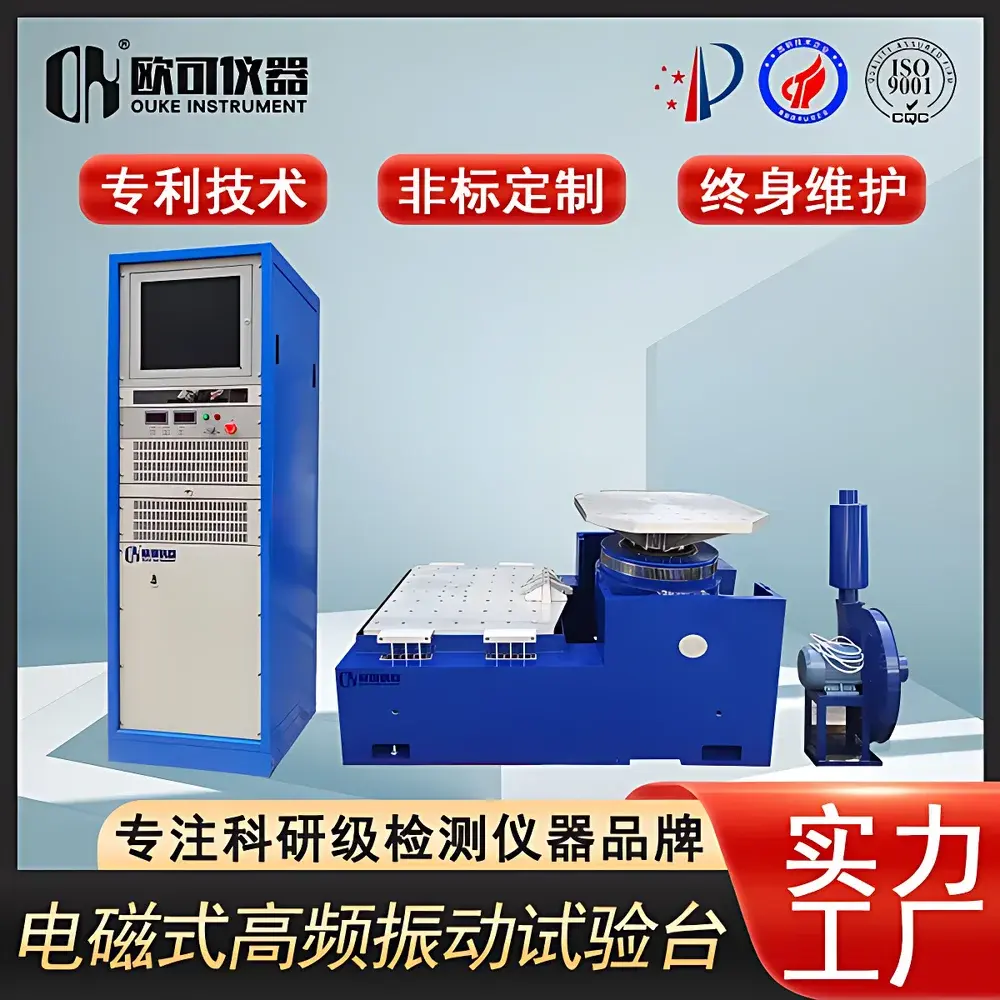
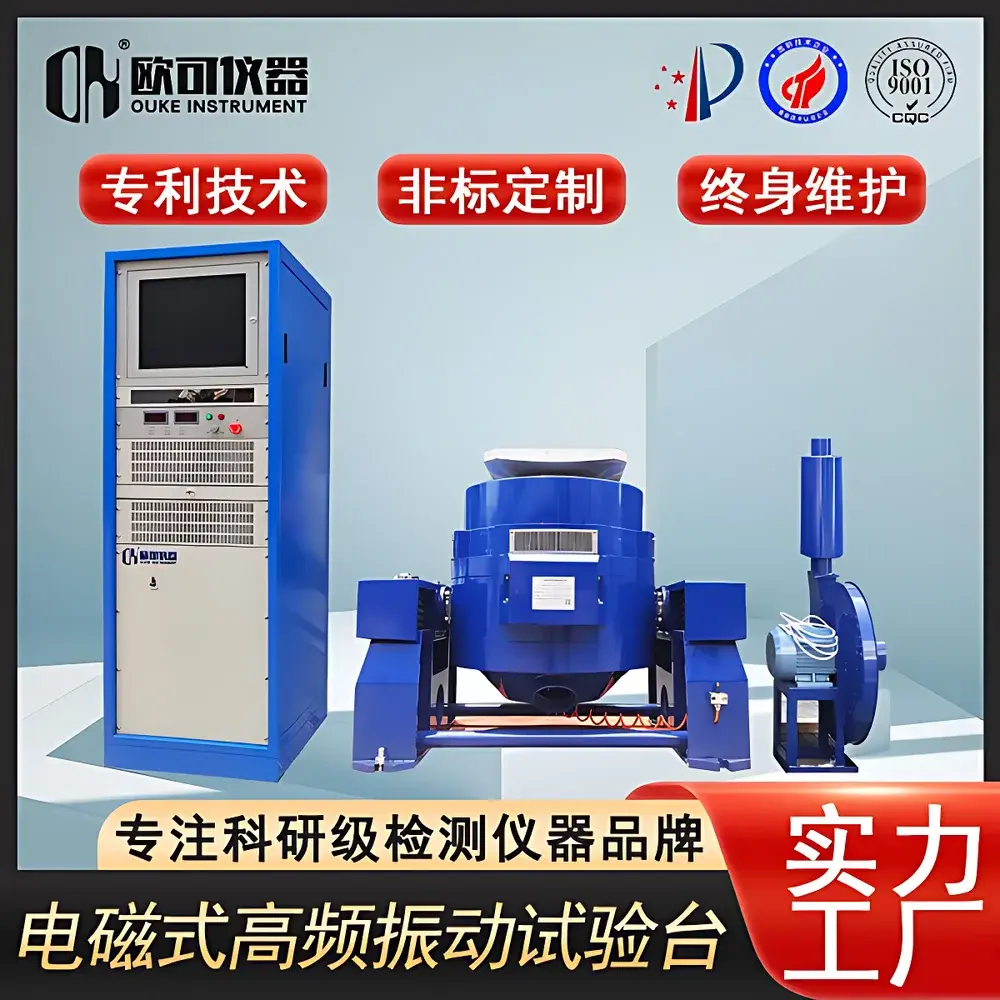
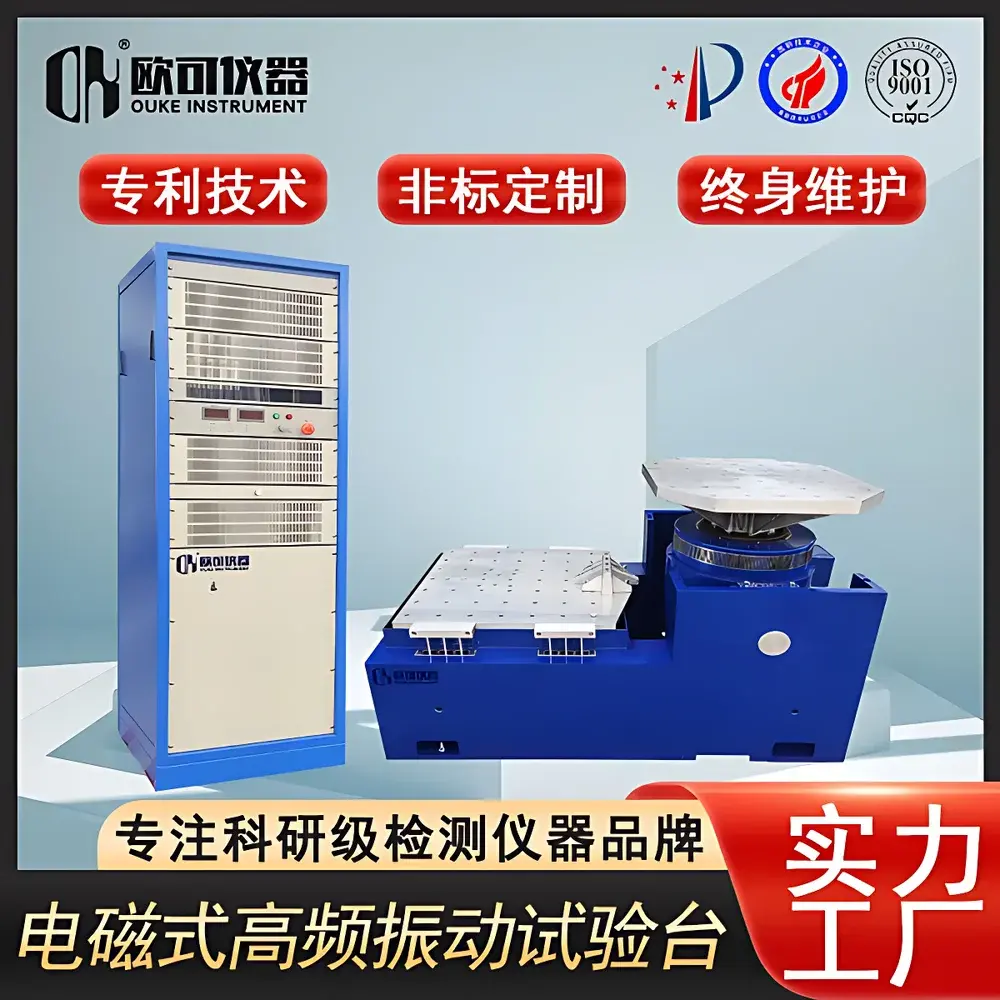
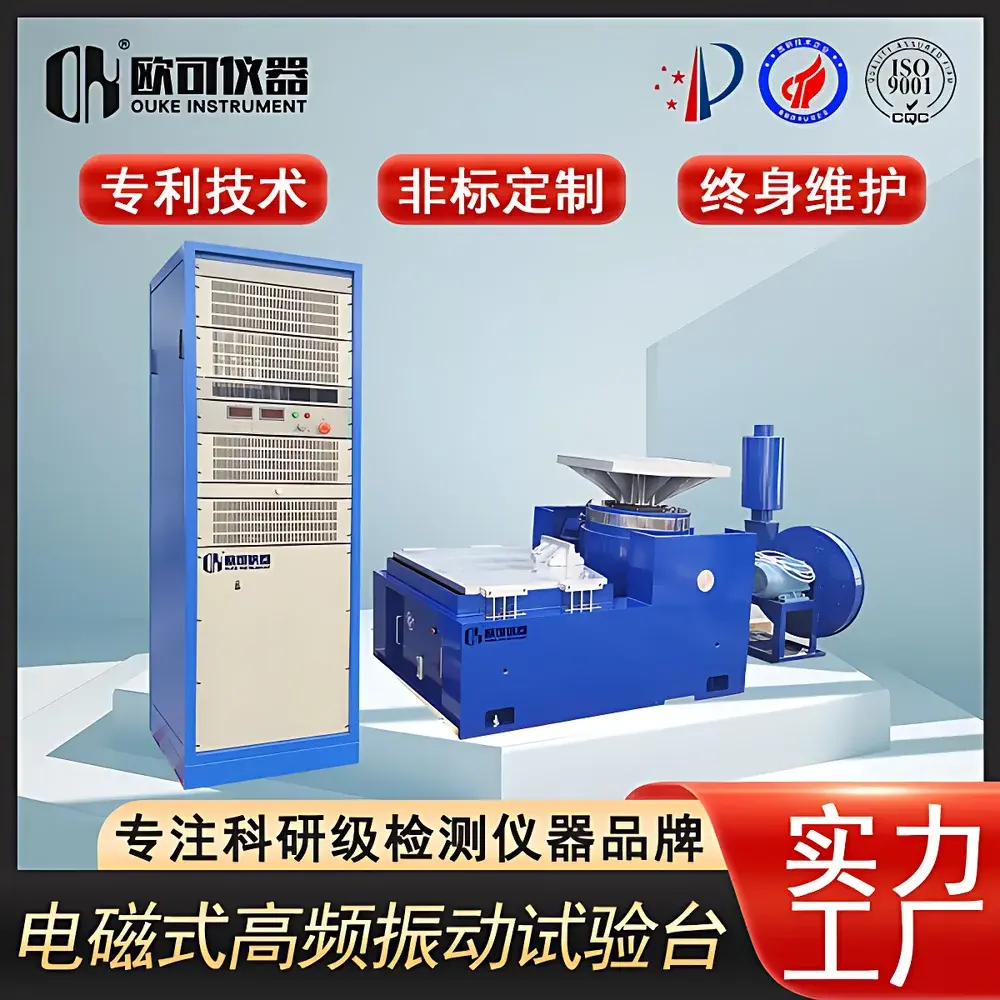
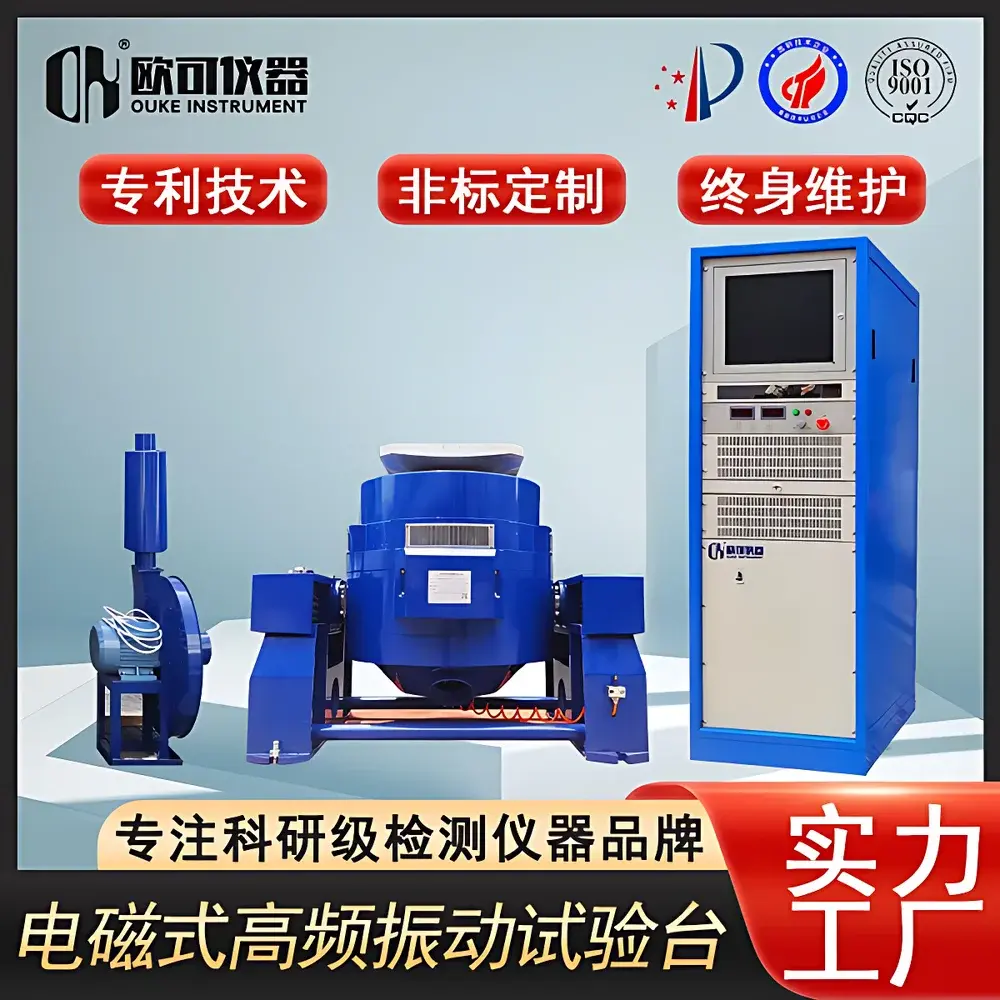
OK-ES-3.012 Triaxial Electromagnetic Vibration Shaker System (Vertical + Horizontal X + Horizontal Y)
| Brand | OK Instruments |
|---|---|
| Origin | Guangdong, China |
| Manufacturer Type | Direct Manufacturer |
| Instrument Type | Electromagnetic Vibration Shaker |
| Rated Thrust | 1.98 kN |
| Frequency Range | 5–5000 Hz |
| Maximum Test Load | 70 kg |
| Tabletop Dimensions | 300 × 300 × 30 mm |
| Maximum Acceleration | 10 g |
| Model | OK-ES-3.012 |
Overview
The OK-ES-3.012 is a high-fidelity triaxial electromagnetic vibration shaker system engineered for precision mechanical environmental simulation in R&D and quality assurance laboratories. It enables controlled excitation along three orthogonal axes—vertical (Z), longitudinal horizontal (X), and lateral horizontal (Y)—to replicate real-world dynamic loading conditions encountered during transportation, operation, or mission-critical service life. Unlike single-axis shakers, this system supports both sequential single-axis testing (repositionable tabletop configuration) and advanced synchronized triaxial excitation via integrated force coupling architecture. Its core actuation principle relies on Lorentz-force-driven electromagnetic transduction: a moving coil assembly suspended within a high-strength permanent magnetic field generates highly linear, low-distortion motion when energized by precisely regulated current from the power amplifier. This electromechanical design delivers superior frequency bandwidth, waveform fidelity, and phase coherence compared to hydraulic or electrodynamic alternatives—making it suitable for demanding test standards including MIL-STD-810H, ISO 16750-3, IEC 60068-2-64, and SAE J1211.
Key Features
- Triaxial excitation capability with configurable operational modes: time-multiplexed single-axis testing (Z → X → Y) and simultaneous multi-axis control (optional configuration with auxiliary actuators and dual-axis slip tables)
- High-thrust electromagnetic shaker with 1.98 kN rated force output, enabling rigorous acceleration-level testing up to 10 g RMS across the full 5–5000 Hz operational bandwidth
- Rigid 300 × 300 × 30 mm aluminum tabletop with T-slots and threaded mounting patterns compliant with ISO 5344 and ASTM D999 for universal fixture integration
- Digital closed-loop control architecture featuring real-time feedback from triaxial accelerometers, adaptive PID + feedforward algorithms, and spectral error minimization
- Integrated water-cooled power amplifier delivering stable high-current drive under sustained random and shock profiles without thermal derating
- Compliance-ready firmware supporting audit trails, user access levels, and electronic signature logging per FDA 21 CFR Part 11 and GLP/GMP requirements
Sample Compatibility & Compliance
The OK-ES-3.012 accommodates test specimens up to 70 kg—including automotive ECUs, avionics enclosures, battery modules, PCB assemblies, and packaged consumer electronics—with mechanical interface compatibility verified per ISO 13373-2 (vibration condition monitoring) and IEC 60721-3-2 (environmental classes). Its mechanical design conforms to ISO 10816-1 (vibration severity evaluation) and supports test execution per US Department of Defense standards (MIL-STD-810H Method 514.8), European automotive norms (VW 80101, GMW 3172), and railway applications (EN 61373). All control software logs include timestamped metadata, raw sensor traces, and spectral validation reports required for third-party certification audits.
Software & Data Management
The system operates under OK-VibControl™ v4.2—a Windows-based deterministic real-time control platform certified for deterministic latency < 100 µs. It supports standard test profiles (sine sweep, resonant dwell, random PSD, classical shock, transient synthesis) and allows import of field-recorded time histories (e.g., road load data, helicopter cabin spectra). Data export complies with ASAM MCD-2 MC (ASAM-ODS) and HDF5 formats. Built-in FFT analyzers, coherence checking, and auto-calibration routines ensure traceability to NIST-traceable reference accelerometers. Full data provenance—including operator ID, calibration certificate IDs, and hardware configuration snapshots—is embedded in every test report.
Applications
- Aerospace: Qualification testing of satellite subsystems, UAV components, and flight-critical sensors under combined-axis launch vibration spectra
- Automotive: Battery pack structural integrity assessment per UN GTR No. 20; ECU functional safety validation under road-simulated random vibration
- Electronics: HALT/HASS screening of high-density interconnects, MEMS devices, and flex-rigid PCBs
- Railway: EN 61373-compliant testing of signaling equipment, pantograph controllers, and onboard communication nodes
- Packaging: ISTA 3A/3E-compliant transport simulation for medical device packaging and e-commerce fulfillment units
- Academic Research: Experimental modal analysis, damping characterization of composite laminates, and nonlinear dynamic response studies
FAQ
What is the difference between sequential and simultaneous triaxial testing?
Sequential testing rotates the specimen or reconfigures the tabletop to isolate each axis (Z, then X, then Y), minimizing cross-axis coupling but requiring manual setup. Simultaneous testing uses decoupled force inputs per axis—achievable only with specialized multi-actuator configurations—and reproduces true vector-sum vibration environments.
Does the OK-ES-3.012 support closed-loop control for displacement-limited tests at low frequencies?
Yes—the digital controller dynamically switches between acceleration, velocity, and displacement feedback domains below 10 Hz to maintain linearity and prevent overstroke, adhering to ISO 5347-12 compliance for low-frequency displacement control.
Can the system be integrated into an existing environmental test chamber?
The shaker features a modular baseplate with standardized flange dimensions and optional thermal isolation mounts, enabling direct integration with climate chambers meeting IEC 60068-2-1/2/14 specifications.
Is remote operation and monitoring supported?
Yes—via secure TLS-encrypted Ethernet connection using OPC UA protocol; full SCADA integration is available through optional API license.
What calibration intervals are recommended for metrological traceability?
Annual calibration against ISO 17025-accredited reference standards is recommended; internal self-diagnostic routines verify transducer sensitivity and amplifier linearity before each test session.



