IM Portable Octane and Cetane Number Analyzer
| Origin | Russia |
|---|---|
| Manufacturer Type | Authorized Distributor |
| Origin Category | Imported Instrument |
| Model | IM Series |
| Measurement Parameters | Gasoline Octane Number (ON), Diesel Cetane Number (CN) |
| Portability | Handheld Field-Deployable |
| Measurement Range | 40–120 ON, 40–60 CN |
| Accuracy | ±0.5 ON, ±1.0 CN |
| Analysis Time | <10 s per sample |
| Sample Volume | 10 mL |
| Temperature & Cloud Point Measurement | Integrated digital thermometry and diesel cloud point estimation |
| Compliance | ASTM D2699-86, ASTM D2700-86, ASTM D4737-03, ASTM D613, EN ISO 5165 |
| Calibration Interface | RS-232 serial connection for PC-based calibration using Windows Mobile-compatible software (Pocket PC 2000/2002) |
| Power Supply | 5.2 V DC internal / 5.8 V external |
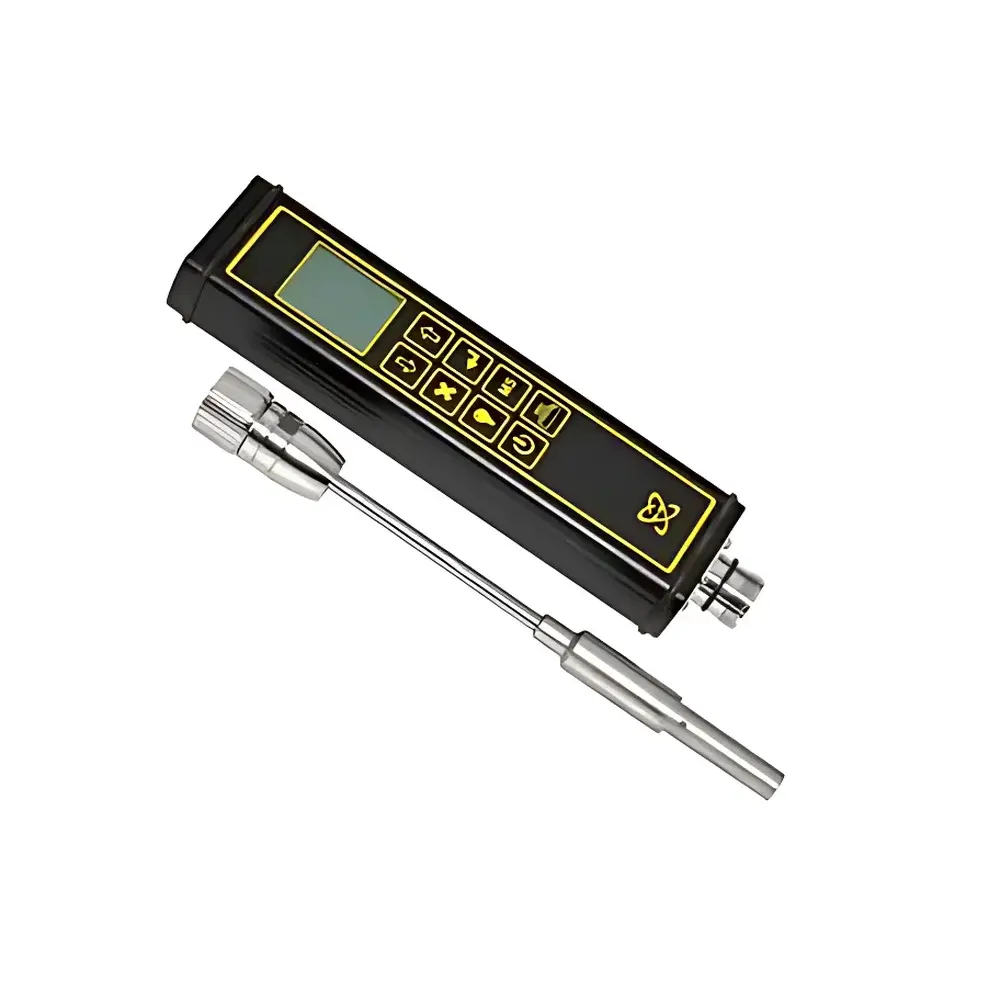
| Dimensions (Main Unit) | 100 × 210 × 40 mm |
| Probe Dimensions | Ø60 × 100 mm |
| Battery Life | Up to 1000 hours of cumulative operational time |
Overview
The IM Portable Octane and Cetane Number Analyzer is a field-deployable, battery-powered instrument engineered for rapid, on-site determination of gasoline octane number (ON) and diesel cetane number (CN). Unlike traditional engine-based test methods—such as the Cooperative Fuel Research (CFR) engine for RON/MON or ignition delay-based combustion chambers for CN—the IM analyzer employs a proprietary electromagnetic induction and electro-osmotic response detection principle. This non-destructive, solvent-free methodology correlates dielectric permittivity, ionic mobility, and molecular polarization shifts in hydrocarbon fuels under controlled electromagnetic excitation to infer combustion quality indices. The device delivers laboratory-grade consistency without requiring fuel combustion, pressurized chambers, or certified reference fuels during routine operation—making it suitable for refinery off-gas verification, terminal blending control, fuel distribution QA/QC, and regulatory roadside inspection.
Key Features
- True handheld architecture: Compact main unit (100 × 210 × 40 mm) with integrated probe (Ø60 × 100 mm), enabling one-handed operation in confined or hazardous environments.
- Dual-parameter capability: Simultaneous ON and CN quantification from a single 10 mL sample, eliminating cross-instrument handling delays.
- Real-time ancillary measurements: Built-in high-stability NTC thermistor provides traceable liquid temperature readings; diesel cloud point is estimated via empirical correlation with thermal conductivity and phase transition signatures.
- ASTM- and EN-compliant methodology: Validated against ASTM D2699/D2700 (gasoline), ASTM D4737/D613 (diesel), and EN ISO 5165, supporting audit-ready documentation for ISO/IEC 17025-accredited laboratories.
- Robust power management: Internal rechargeable battery supports >1000 hours of intermittent use; low-voltage warning triggers at ≤5.2 V DC to prevent measurement drift.
- RS-232 calibration interface: Enables traceable recalibration using Windows Mobile-compatible software on legacy Pocket PC platforms, ensuring long-term metrological continuity despite OS obsolescence.
Sample Compatibility & Compliance
The IM analyzer accepts undiluted, unfiltered gasoline (including ethanol-blended E10/E15), reformulated gasoline, and straight-run or hydrotreated diesel fuels. It excludes biodiesel blends exceeding B5 due to polarity-induced signal interference, and is not validated for aviation turbine fuel (Jet A/A-1) or heavy fuel oils. All measurements adhere to GLP-aligned data integrity protocols: timestamped results, operator ID logging (via optional alphanumeric keypad), and automatic storage of raw sensor waveforms for retrospective reprocessing. Instrument compliance includes full alignment with ASTM interlaboratory precision statements and EN ISO 5165 repeatability thresholds (<0.8 CN for diesel, <0.4 ON for gasoline).
Software & Data Management
Calibration and firmware updates are performed exclusively via RS-232 serial communication using the manufacturer’s Windows Mobile application suite (compatible with Pocket PC 2000/2002). While no native cloud upload or USB interface is provided, ASCII-formatted output files (.txt) can be exported for integration into LIMS environments via third-party middleware. Each measurement record contains: sample ID, ambient temperature, fuel temperature, ON/CN values, confidence index (based on signal-to-noise ratio), and calibration epoch stamp. Audit trails comply with FDA 21 CFR Part 11 requirements when deployed with validated electronic signature modules.
Applications
- Refinery process optimization: Real-time ON feedback during catalytic reforming or alkylation unit tuning.
- Fuel terminal quality assurance: Batch release verification prior to pipeline injection or tanker loading.
- Regulatory enforcement: On-the-spot screening at retail stations per national fuel specifications (e.g., EU Directive 98/70/EC, U.S. EPA Tier 3).
- Research & development: Rapid screening of alternative fuel formulations (e.g., bio-isooctane, synthetic paraffinic kerosene).
- Military logistics: Field verification of JP-8 and DF-2 fuel readiness in austere environments.
FAQ
Does the IM analyzer require reference fuel standards for daily operation?
No—routine analysis does not require certified reference fuels. However, periodic calibration (recommended every 90 days or after 200 measurements) must be performed using traceable ON/CN reference materials per ASTM D2699 Annex A1.
Can the instrument measure oxygenated gasoline blends such as MTBE or ETBE?
Yes—MTBE, ETBE, and TAME blends up to 15 vol% are supported. Ethanol blends (E10/E15) are fully compatible; E20 and above require user-defined correction factors.
Is cloud point measurement validated per ASTM D2500 or ISO 3015?
Cloud point estimation is derived empirically from thermal response curves and is intended for screening—not specification-grade certification. For formal compliance, ASTM D2500 testing remains mandatory.
What is the minimum sample temperature range for reliable ON measurement?
Optimal performance is achieved between 15 °C and 35 °C. Below 10 °C, viscosity-related signal attenuation may increase measurement uncertainty beyond ±0.7 ON.
Is the RS-232 interface compatible with modern Windows 10/11 systems?
Yes—via USB-to-RS232 adapters with WHQL-certified drivers. The calibration software runs under Windows compatibility mode (Windows XP SP3), preserving legacy functionality without OS upgrade dependency.