
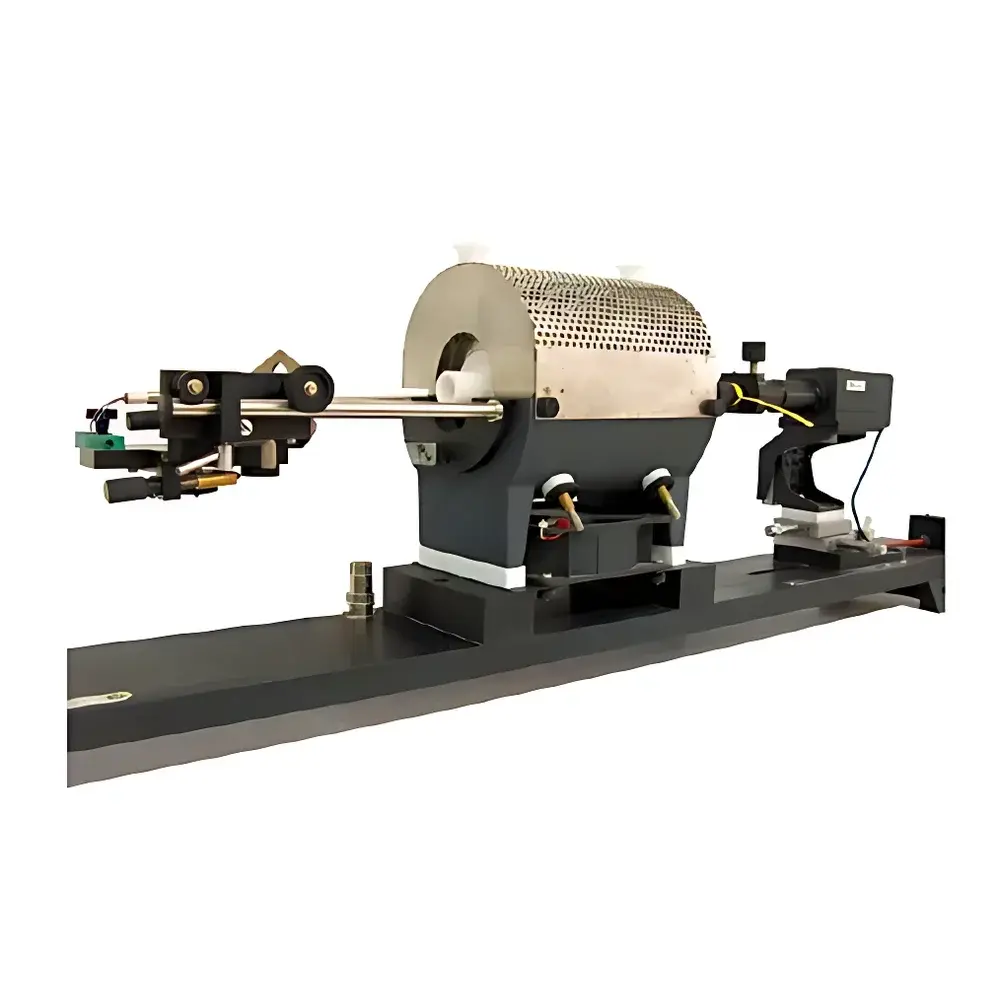
HTM1400 High-Temperature Microscope (Imported from Italy)
| Origin | Italy |
|---|---|
| Manufacturer Type | Authorized Distributor |
| Origin Category | Imported Instrument |
| Model | HTM1400 |
| Pricing | Upon Request |
Overview
The HTM1400 High-Temperature Microscope is an engineered optical-thermal analysis system designed for in-situ observation and quantitative characterization of solid-state phase transformations under controlled elevated temperatures. Utilizing a high-stability resistive heating furnace coupled with real-time video microscopy, the instrument enables direct visual monitoring of thermal events—including sintering onset, softening, hemispherical deformation, melting, and ash fusion behavior—while precisely correlating morphological changes with temperature. Its core measurement principle relies on standardized hot-stage imaging combined with calibrated thermal profiling, conforming to ISO 540:1995 for ash fusibility testing and supporting ASTM C720, ISO 3585 (borosilicate glass), and EN 12697-19 (bituminous binders) methodologies. The system operates up to 1400 °C with a nominal working temperature of 1350 °C, delivering stable thermal gradients and high spatial resolution across repeated thermal cycles.
Key Features
- High-precision dual-furnace configuration (A-type high-temperature furnace) with maximum operating temperature of 1400 °C and sustained stability at 1350 °C
- Controlled heating rate up to 80 °C/min below 1000 °C; optimized thermal uniformity across sample zone
- Integrated color CCD camera with spectral filtering capability for enhanced contrast in molten-phase boundary detection
- Real-time image acquisition and frame-by-frame morphological tracking synchronized with thermocouple-derived temperature data
- No calibration or geometric correction required due to fixed optical path and factory-aligned thermal–optical axis registration
- Automated event detection algorithms for sintering start, spherical point, hemispherical point, and fluid temperature identification per ISO 540
- Manual measurement tools for contact angle quantification and qualitative viscosity estimation via droplet shape analysis
- Robust mechanical design with ceramic insulation, water-cooled base plate, and inert atmosphere compatibility (N₂, Ar)
Sample Compatibility & Compliance
The HTM1400 accommodates cylindrical or prismatic specimens up to Ø12 mm × 10 mm height, suitable for powdered compacts, pressed pellets, vitreous shards, refractory bricks, and coal/ash samples. It supports standardized sample preparation per ISO 540, ASTM D1857, and IEC 60693. Temperature reproducibility is maintained within ±2–5 °C across repeated runs under identical thermal protocols. Dimensional repeatability—measured as relative deviation in sample height and width—is ≤0.3%; contact angle measurement uncertainty is ≤±2°. The system meets GLP documentation requirements and supports audit-ready data export for regulatory submissions under FDA 21 CFR Part 11 when integrated with compliant software modules.
Software & Data Management
The proprietary Windows-based application provides full control over furnace ramping, camera exposure, frame rate (up to 30 fps), and real-time overlay of temperature vs. time. Image sequences are timestamped and geotagged with thermocouple readings, enabling synchronized playback and frame-accurate event annotation. Each captured image is saved with embedded EXIF metadata including furnace setpoint, actual thermocouple value, shutter speed, and gain. Batch processing allows comparative analysis across multiple runs; statistical summaries (e.g., onset temperature distribution, deformation kinetics) are exportable to CSV or PDF. Software architecture complies with ISO/IEC 17025 traceability standards and supports electronic signature workflows for QA/QC environments.
Applications
- Determination of ash fusibility characteristics (initial deformation, softening, hemispherical, and flow temperatures) for coal, biomass, and industrial slags
- Thermal behavior analysis of ceramic glazes, frits, and enamel coatings during firing cycles
- Sintering kinetics and densification onset evaluation in advanced ceramics and powder metallurgy feedstocks
- Melting point and glass transition observation in optical glasses, borosilicates, and low-expansion materials
- Thermal expansion and shape retention assessment of refractory linings and insulating bricks
- Process validation of industrial ignition cycles in cement kiln feed, waste-to-energy residues, and metallurgical fluxes
FAQ
What temperature standards does the HTM1400 comply with for ash fusibility testing?
It fully implements ISO 540:1995 and supports parallel execution of ASTM D1857 and DIN 51730 procedures.
Can the system operate under reducing atmospheres?
Yes—when equipped with optional gas inlet ports and quartz viewing windows, it supports N₂, Ar, CO/CO₂ mixtures, and controlled O₂ partial pressures.
Is remote operation supported?
The software includes TCP/IP-enabled remote desktop access and API hooks for integration into automated lab management systems (LIMS).
What is the typical lifetime of the heating element at 1350 °C?
Under continuous use with proper cooling cycles and inert gas purging, the SiC heating elements maintain specification compliance for ≥1,200 operational hours.
Does the system include validation documentation for GMP environments?
Factory-installed IQ/OQ protocols are provided; PQ templates and 21 CFR Part 11-compliant electronic log modules are available as optional add-ons.





