
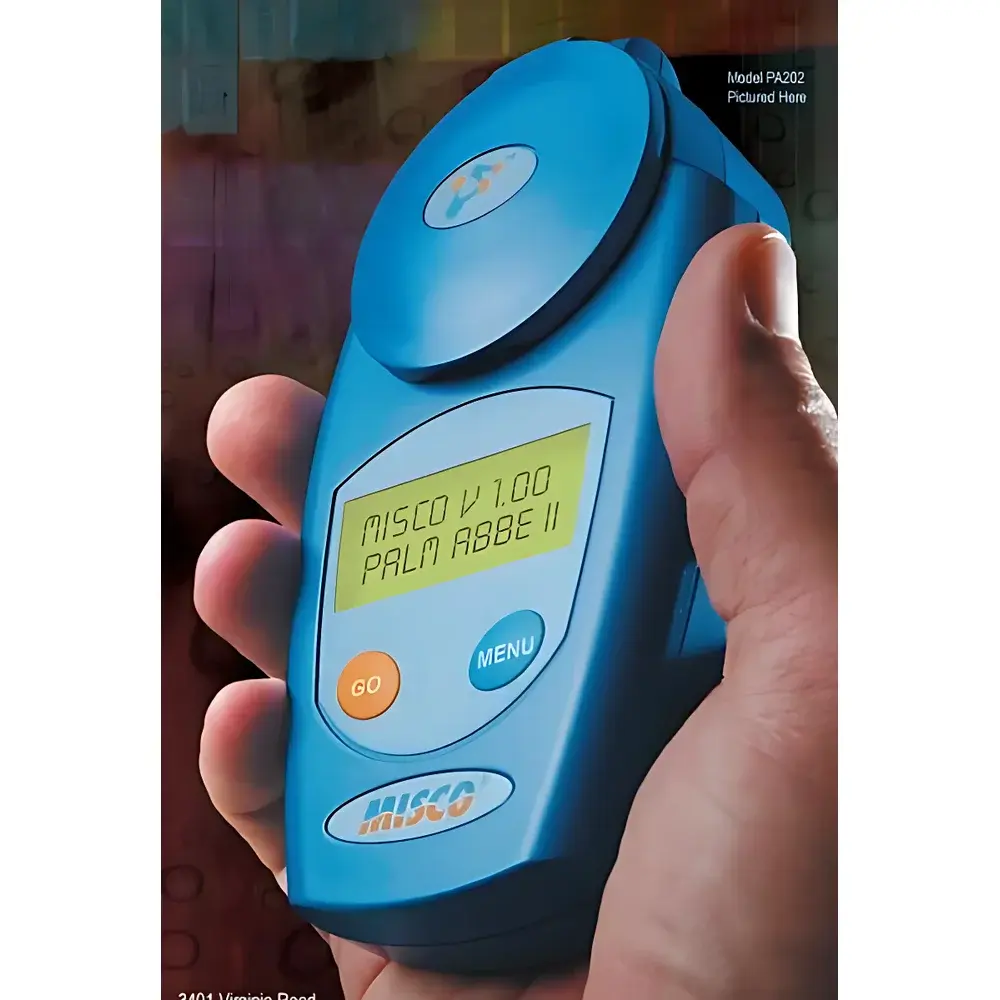
MISCO PA202 Palm Abbe Digital Handheld Refractometer
| Origin | USA |
|---|---|
| Manufacturer Type | Authorized Distributor |
| Origin Category | Imported |
| Model | PA202 |
| Product Type | Handheld Refractometer |
| Temperature Compensation | Automatic Nonlinear (0–50 °C) |
| Display | Digital LCD |
| Measurement Range | Refractive Index 1.3330–1.5040 nD |
| Brix | 0.0–85.0% |
| Accuracy | ±0.1 Brix |
| Resolution | 0.1 Brix |
| Sample Volume | 0.3 mL |
| Measurement Time | <5 s |
| Prism Material | Sapphire |
| Sample Cell Material | Stainless Steel |
| Power | 2×AAA batteries (5000+ readings) |
| Dimensions | 145×75×37 mm |
| Weight | 250 g |
| Language Support | English, French, Spanish, German, Russian |
Overview
The MISCO PA202 Palm Abbe Digital Handheld Refractometer is a fourth-generation precision optical instrument engineered for rapid, field-deployable refractive index and Brix measurements in industrial, food & beverage, chemical, and laboratory environments. It operates on the fundamental principle of total internal reflection at the interface between a high-refractive-index sapphire prism and the sample liquid. Light incident at varying angles undergoes critical angle shift proportional to the sample’s refractive index — a physical property directly correlated with solute concentration (e.g., sucrose in aqueous solutions). Unlike analog or temperature-uncompensated instruments, the PA202 integrates a high-stability thermistor array and proprietary nonlinear temperature compensation algorithm compliant with the ICUMSA and AOAC reference models for sucrose solutions. This enables traceable accuracy across a broad operational range of 0–50 °C (32–122 °F), eliminating manual correction tables and minimizing operator-induced variability.
Key Features
- High-precision sapphire prism — chemically inert, scratch-resistant, and thermally stable; ensures long-term calibration integrity and resistance to aggressive solvents, acids, and caustics.
- Nonlinear automatic temperature compensation (ATC) — dynamically adjusts readings in real time using dual-point thermal modeling, meeting ASTM D115 and ISO 21746 requirements for refractometric quantification.
- Dual-parameter digital display — simultaneously or independently shows refractive index (nD) and Brix (% w/w), with selectable resolution of 0.0001 nD or 0.1 Brix.
- Ergonomic, IP65-rated housing — impact-resistant polymer enclosure with sealed button interface and integrated prism cover that blocks ambient light interference and prevents sample evaporation during measurement.
- Low sample volume requirement (0.3 mL) — enables analysis of precious, viscous, or heat-sensitive samples without dilution or heating.
- Multi-language firmware support — English, French, Spanish, German, and Russian — facilitating global deployment in multinational QA/QC labs and production floors.
- Battery life exceeding 5,000 measurements per set of AAA cells — optimized power management supports extended field use without recharging infrastructure.
Sample Compatibility & Compliance
The PA202 is validated for aqueous and non-aqueous transparent to slightly turbid liquids, including sugar syrups, coolants, antifreeze (ethylene/propylene glycol), battery electrolytes, pharmaceutical excipients, and wine must. Its sapphire prism and stainless-steel sample well resist corrosion from chlorides, organic acids, and alcohols. The instrument complies with ISO/IEC 17025 calibration traceability frameworks when used with NIST-traceable sucrose standards. While not inherently 21 CFR Part 11 compliant (as it lacks audit trail or electronic signature functionality), its measurement repeatability (RSD < 0.15% at 20 °C) and documented ATC performance support GLP and GMP-aligned routine testing where manual data transcription is permitted.
Software & Data Management
The PA202 operates as a standalone, embedded-system device with no external software dependency. All calibration, unit selection, language configuration, and ATC parameters are stored in non-volatile memory. While it does not feature Bluetooth, USB, or data logging capabilities, its consistent output format and high inter-unit reproducibility enable seamless integration into paper-based or LIMS-managed workflows. Users may document results manually with timestamped entries, satisfying basic FDA 21 CFR Part 11 Annex A expectations for “non-electronic records” when accompanied by defined SOPs and analyst training records.
Applications
- Food & Beverage: Rapid Brix verification in fruit juices, soft drinks, jams, and dairy concentrates — supporting HACCP critical control point monitoring.
- Automotive & Industrial Fluids: Glycol concentration assessment in engine coolants and hydraulic fluids to prevent freezing, boiling, or corrosion.
- Pharmaceutical Manufacturing: Excipient concentration checks (e.g., dextrose, sorbitol) in liquid dosage forms during batch release testing.
- Agriculture & Viticulture: Must sugar content evaluation pre-fermentation; post-harvest fruit maturity grading.
- Academic & Teaching Labs: Demonstrating optical principles, solution thermodynamics, and calibration methodology in undergraduate physical chemistry courses.
FAQ
Does the PA202 require periodic recalibration?
Yes — annual calibration against certified sucrose standards (e.g., NIST SRM 84d) is recommended. Field verification using distilled water (nD = 1.3330 at 20 °C) should be performed before each shift.
Can the PA202 measure non-sucrose solutions accurately?
It provides accurate nD values for all homogeneous liquids; however, Brix readouts assume sucrose-equivalent calibration. For other solutes (e.g., NaCl, ethylene glycol), users must apply published conversion factors or generate custom calibration curves.
Is the sapphire prism susceptible to thermal shock?
No — sapphire’s low coefficient of thermal expansion (5.3 × 10⁻⁶ /K) and high thermal conductivity ensure stability across rapid ambient transitions typical in warehouse or outdoor settings.
What maintenance is required beyond cleaning?
Wipe the prism surface with lens tissue and reagent-grade isopropanol after each use; avoid abrasive cleaners. Inspect the prism seal and cover hinge quarterly for mechanical integrity.
How does the PA202 compare to benchtop refractometers in metrological performance?
Its accuracy (±0.0001 nD) matches mid-tier benchtop units, though it lacks automated temperature control (±0.1 °C) and advanced data export. It trades absolute thermal stability for portability, making it optimal for in-process verification rather than primary standardization.



