
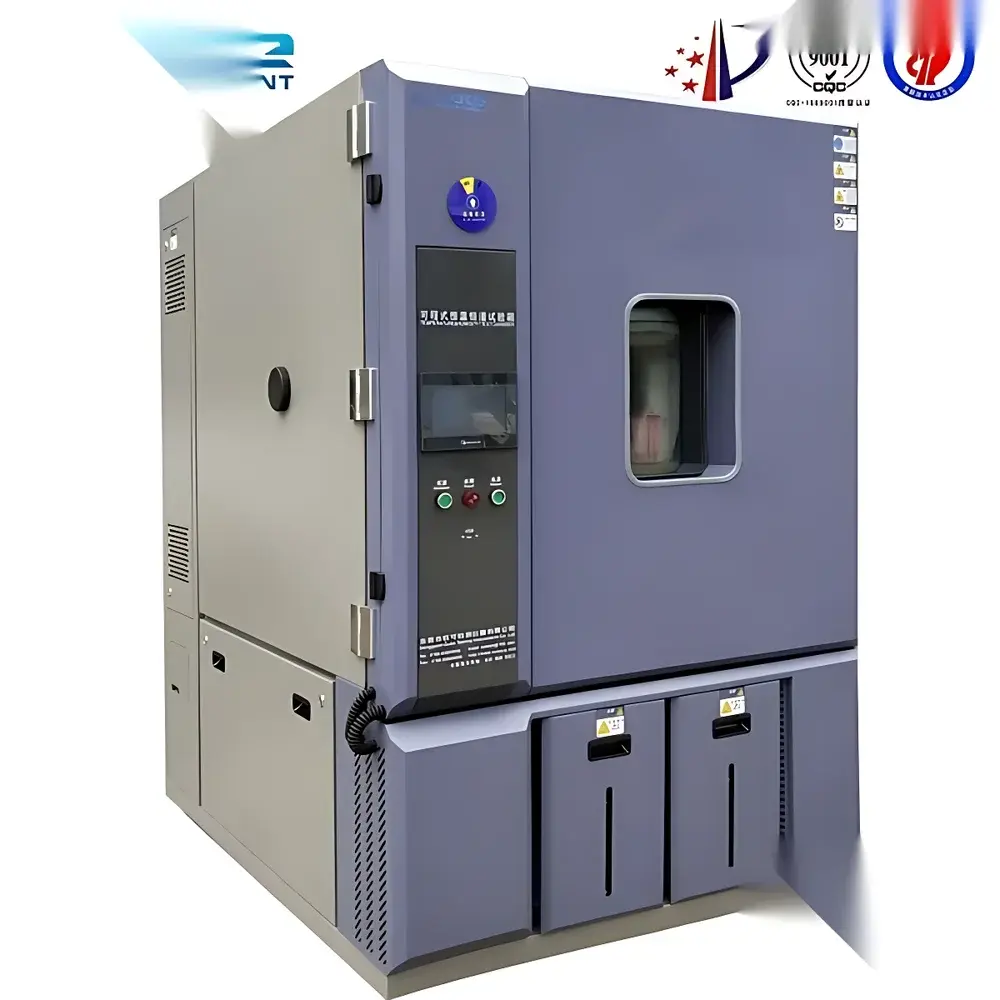
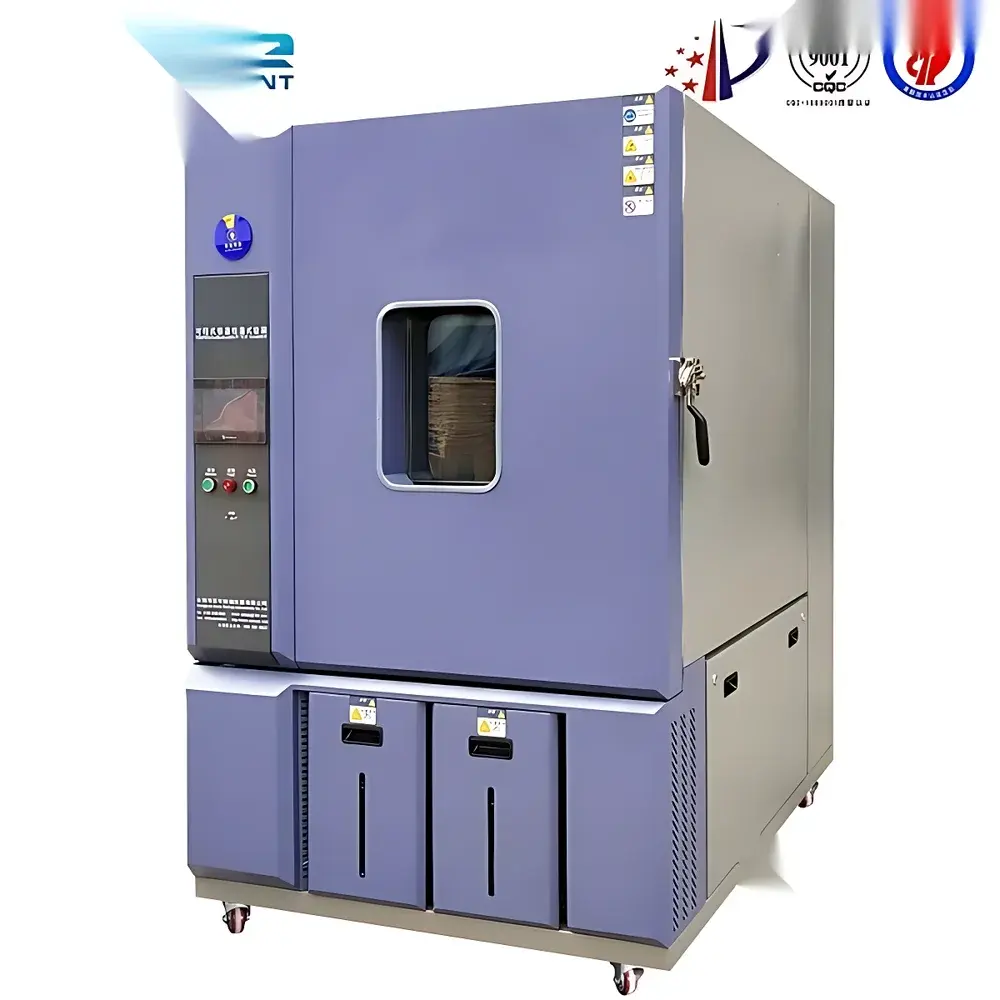
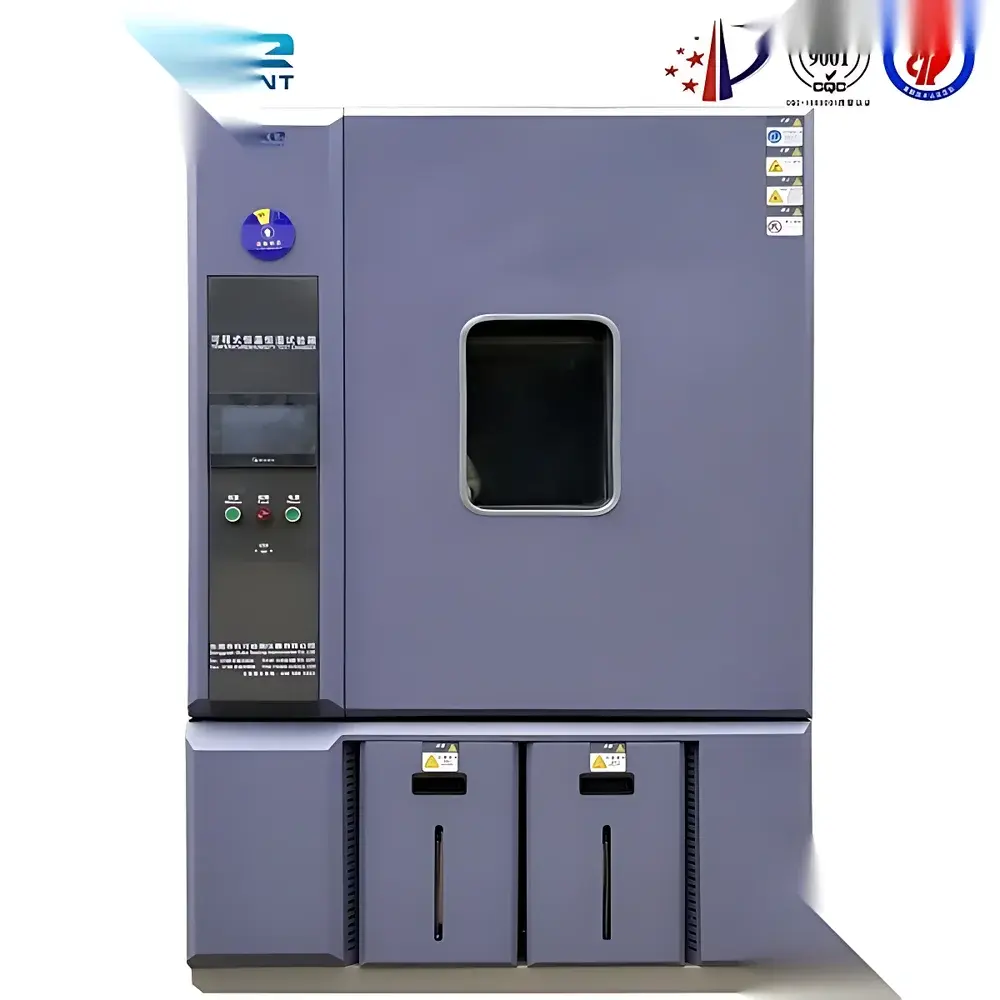
Other Brands TEMI880 Color LCD Touchscreen Temperature & Humidity Controlled Environmental Test Chamber
| Key | Temperature Range: –40 °C to +150 °C (optional down to –120 °C) |
|---|---|
| Humidity Range | 30–98% RH (optional 5–98% RH) |
| Temperature Resolution | 0.01 °C |
| Humidity Resolution | 0.1% RH |
| Temperature Uniformity | ±0.5 °C |
| Temperature Deviation | ≤±2 °C |
| Humidity Deviation | ≤±2.5% RH |
| Heating Rate | 2.0–3.0 °C/min |
| Cooling Rate | 0.7–1.0 °C/min |
| Control System | TEMI880 color LCD touchscreen controller |
| Power Supply | 380 V ±5%, 50 Hz, 3P+N+G (customizable to 220 V) |
| Interior Material | SUS304 stainless steel |
| Exterior Material | SUS304 stainless steel or A3 steel with electrostatic powder coating |
| Compliance | GB/T 5170.2–1996, GB/T 5170.5–1996, GB 2423.1–1989, GB 2423.2–1989, GB 2423.22–1987, GB 10589–1989, GB 10592–1989, GB 11158–1989 |
Overview
The TEMI880 Temperature and Humidity Controlled Environmental Test Chamber is an industrial-grade environmental simulation system engineered for precision stability, repeatability, and long-term reliability in accelerated reliability testing, quality assurance, and product validation workflows. Operating on a dual-refrigeration + electric heating + steam/humidification principle, the chamber delivers tightly regulated thermal and hygrothermal conditions across wide operational envelopes. Its core architecture integrates forced-air convection with multi-point sensor feedback, ensuring uniform temperature distribution and responsive humidity modulation—critical for evaluating material behavior, electronic component performance, and packaging integrity under controlled stress profiles. Designed for compliance-driven laboratories, it supports standardized test execution per major national and international environmental test protocols, including IEC 60068-2 series equivalents implemented in Chinese national standards (GB).
Key Features
- High-resolution dual-loop control: Independent PID algorithms for temperature and humidity, each with adaptive tuning and auto-compensation for load-induced drift.
- TEMI880 intelligent controller: 7-inch full-color LCD touchscreen interface with multilingual support (English, Chinese, Spanish), real-time graphing, programmable step/ramp/soak profiles, and USB data export capability.
- Robust thermal-hygric chamber construction: Seamless SUS304 stainless steel interior (corrosion-resistant, non-outgassing); exterior options include either polished SUS304 or A3 steel with epoxy-polyester powder coating for enhanced durability in industrial settings.
- Optimized air circulation system: Horizontal laminar airflow with adjustable vane diffusers ensures <±0.5 °C temperature uniformity and <±2.5% RH deviation across the working volume—even under dynamic ramp conditions.
- Modular refrigeration design: Twin-stage cascade refrigeration system (for sub-zero operation down to –120 °C) paired with high-efficiency PTC heaters and ultrasonic humidifier or electric steam generator (depending on RH range configuration).
- Comprehensive safety architecture: Over-temperature, over-humidity, compressor high-pressure, low coolant level, and door interlock protections—all logged with timestamped event history.
Sample Compatibility & Compliance
This chamber accommodates a broad spectrum of test specimens—from printed circuit boards (PCBs) and automotive ECUs to polymer films, pharmaceutical packaging, and lithium-ion battery modules—without compromising parameter fidelity. Its working volume and internal dimensions are fully customizable, supporting walk-in configurations upon request. All standard models are validated per GB/T 5170.2–1996 (temperature equipment calibration) and GB/T 5170.5–1996 (humidity equipment calibration), with traceable metrology documentation available. The system meets the technical requirements of GB 2423.1 (cold), GB 2423.2 (dry heat), GB 2423.22 (temperature cycling), and related clauses of GB 10589, GB 10592, and GB 11158. While not certified to ISO/IEC 17025, its performance characteristics align with GLP-compliant environmental test environments when operated within specified ambient conditions (25 °C ±6 °C, no-load).
Software & Data Management
The TEMI880 controller supports audit-ready data handling through built-in logging (up to 10,000 hours of 1-second interval data), password-protected user levels (operator, engineer, administrator), and optional Ethernet/WiFi connectivity for remote monitoring via browser-based HMI. Data export complies with CSV and Excel-compatible formats for downstream analysis in MATLAB, JMP, or Minitab. Optional software packages provide automated report generation—including test summary, deviation alerts, and pass/fail status against predefined limits—aligned with internal QA procedures. Though not natively 21 CFR Part 11 compliant, the system can be integrated into validated environments when paired with external electronic signature and audit trail solutions meeting FDA requirements.
Applications
- Environmental stress screening (ESS) of electronic assemblies prior to burn-in or field deployment.
- Accelerated aging studies of adhesives, sealants, and composite materials under combined thermal-hygric loading.
- Stability testing of medical device packaging per ISO 11607 and pharmaceutical secondary packaging per ICH Q1 guidelines.
- Validation of HVAC component performance under extreme ambient conditions.
- Qualification testing of aerospace avionics per MIL-STD-810G methods 502.5 (low temperature) and 507.5 (humidity).
- Research-grade climate simulation for material science labs investigating phase transitions, moisture diffusion kinetics, or hygroscopic expansion.
FAQ
What is the difference between “temperature fluctuation” and “temperature deviation”?
Temperature fluctuation refers to short-term variation around the setpoint (±0.5 °C), reflecting control stability; temperature deviation indicates spatial inconsistency across the chamber volume (≤±2 °C), measured at multiple points per GB/T 5170.2.
Can this chamber operate continuously at –70 °C?
Yes—models equipped with cascade refrigeration maintain continuous operation at –70 °C. Sustained operation below –80 °C requires dedicated low-temperature variants with enhanced insulation and compressor staging.
Is cooling water required for all operating ranges?
Cooling water (10–28 °C, 0.1–0.3 MPa) is mandatory for stable operation below –20 °C or during rapid cooling cycles to ensure condenser heat rejection efficiency.
How does load affect ramp rates?
Ramp rates (e.g., 2.0–3.0 °C/min heating) are specified under no-load conditions. Actual rates decrease proportionally with thermal mass, surface emissivity, and airflow obstruction introduced by test specimens.
Are calibration certificates included with shipment?
Factory calibration reports per GB/T 5170.2 and GB/T 5170.5 are provided. NIST-traceable third-party calibration is available as an optional service with lead-time planning.



