
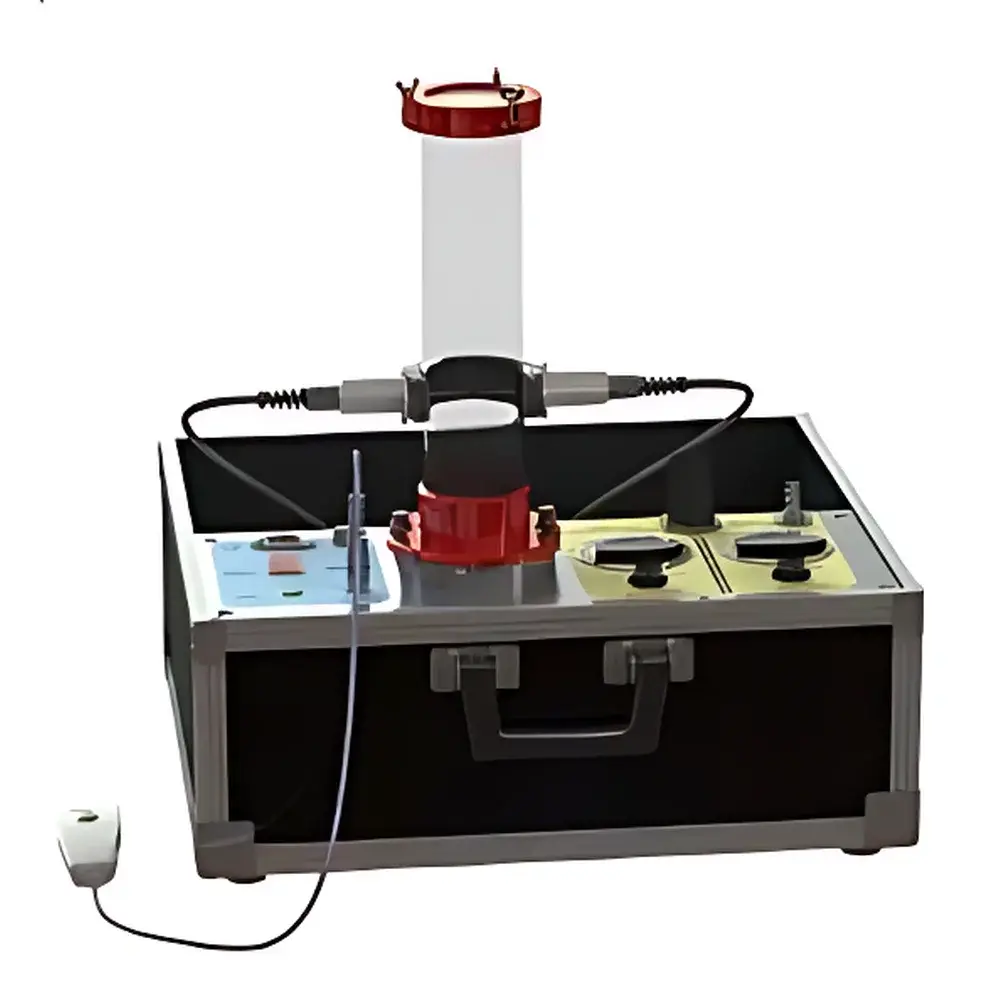
ANKO SC-2 Explosives Screening System
| Origin | Poland |
|---|---|
| Manufacturer Type | Authorized Distributor |
| Origin Category | Imported |
| Model | SC-2 |
| Price Range | USD 27,000 – 68,000 |
Overview
The ANKO SC-2 Explosives Screening System is a benchtop laboratory instrument engineered for standardized dust explosion hazard assessment in accordance with VDI 2263 Part 1, Section 2.1.1 — a widely recognized German guideline for the evaluation of combustible dusts. It operates on the Hartmann tube principle, a well-established method for determining the explosibility of airborne particulate materials via controlled electrostatic spark ignition under reproducible pneumatic dispersion conditions. The system integrates a calibrated arc ignition source, regulated compressed air delivery, and a geometrically defined test chamber to deliver consistent, traceable results suitable for preliminary screening, material classification, and comparative hazard ranking. Designed for use in safety laboratories, chemical R&D facilities, and regulatory testing centers, the SC-2 supports early-stage risk identification prior to full-scale explosion severity (KSt) or minimum ignition energy (MIE) characterization.
Key Features
- Modified Hartmann tube assembly fabricated from optical-grade polymethyl methacrylate (PMMA), ensuring high transparency, dimensional stability, and resistance to electrostatic charge accumulation during repeated testing.
- Integrated high-voltage ignition module delivering a stable, adjustable DC arc (up to 15 kV) with precise temporal control; electrode configuration includes 20 tungsten-alloy pins arranged in symmetrical radial pairs for uniform spark distribution.
- Dual-stage pneumatic system: a built-in compressed air reservoir (rated to 10 bar) coupled with an auxiliary air injection cell enables independent optimization of dispersion pressure and ignition timing—critical for achieving repeatable cloud formation kinetics.
- Manual foot-pedal actuator and handheld remote switch provide ergonomic, hands-free operation for simultaneous dust dispersion and spark initiation—minimizing operator exposure and enhancing procedural consistency.
- Regulated air pressure control valve and fine-tuning air injection valve allow stepwise adjustment across 0.1–5.0 bar range, facilitating method development for diverse particle morphologies (e.g., fibrous, agglomerated, or nanostructured powders).
- Self-contained high-voltage power supply eliminates dependency on external generators; internal circuitry incorporates overvoltage protection and automatic discharge sequencing post-test.
- Compact, modular architecture compliant with ISO/IEC 17025 laboratory space requirements; all high-pressure and high-voltage components housed within interlocked safety enclosures meeting IP54 ingress protection standards.
Sample Compatibility & Compliance
The SC-2 accommodates dry, free-flowing powders and granular solids with particle sizes ranging from <1 µm to 500 µm, including organic dusts (e.g., flour, sugar, cellulose), metal powders (Al, Mg, Ti), pharmaceutical intermediates, and polymer additives. Sample mass loading is configurable between 0.1 g and 5.0 g per test, supporting both qualitative screening and semi-quantitative threshold estimation. The system conforms to VDI 2263-1:2019 for preliminary explosibility screening and aligns with foundational principles referenced in EN 14034-1 (Explosion suppression), ASTM E1226 (Standard Test Method for Explosibility of Dust Clouds), and IEC 60079-20-2 (Explosive atmospheres – Material characteristics). While not a certified GLP/GMP platform, its mechanical repeatability and documented calibration traceability support data integrity requirements for internal safety audits and pre-submission technical dossiers.
Software & Data Management
The SC-2 operates as a standalone hardware platform without embedded digital control software. All operational parameters—including dispersion pressure, ignition delay, electrode gap, and sample mass—are manually recorded in accordance with laboratory SOPs. Users are expected to maintain paper-based or LIMS-integrated test logs compliant with ISO/IEC 17025 documentation requirements. Optional third-party high-speed imaging systems (e.g., Phantom v2512) may be synchronized via TTL trigger output for visual validation of cloud formation and flame propagation onset. For regulatory submissions, raw test records—including pressure transducer outputs (if externally interfaced), ignition event timestamps, and observed deflagration behavior—must be retained for minimum 10 years per standard industrial hygiene recordkeeping practices.
Applications
- Preliminary explosibility screening of new raw materials during process development and scale-up.
- Comparative assessment of dust hazard potential across batch variations or supplier changes.
- Verification of inerting efficacy by testing dust-air mixtures under nitrogen or CO2 atmospheres.
- Evaluation of anti-static additive performance in polymer compounding operations.
- Training and demonstration of fundamental dust explosion mechanics in occupational safety education programs.
- Supporting hazard analysis for Process Safety Management (PSM) compliance under OSHA 1910.119 and EU Seveso III Directive Annex I criteria.
FAQ
Does the SC-2 provide quantitative KSt or Pmax values?
No. The SC-2 is designed for qualitative/semi-quantitative screening only. Quantitative explosion severity parameters require a 20-L or 1-m³ spherical test vessel per EN 14034-1.
Is the Hartmann tube reusable after each test?
Yes. The PMMA tube is chemically resistant and mechanically robust; cleaning with isopropanol and lint-free wipes is sufficient between tests. Tube replacement is recommended after ~500 ignitions or upon visible pitting/scoring of electrodes.
Can the system be integrated into an automated test sequence?
Not natively. Automation requires external PLC control of the foot pedal and remote switch signals, plus integration of optional pressure sensors and high-speed cameras.
What electrical safety certifications does the unit hold?
The SC-2 carries CE marking per Machinery Directive 2006/42/EC and Low Voltage Directive 2014/35/EU. High-voltage sections comply with EN 61010-1:2010 for laboratory equipment.
Is training provided with purchase?
Yes. ANKO-authorized distributors deliver on-site operator training covering VDI 2263 methodology, safe handling of explosive dusts, maintenance protocols, and incident response procedures.






