
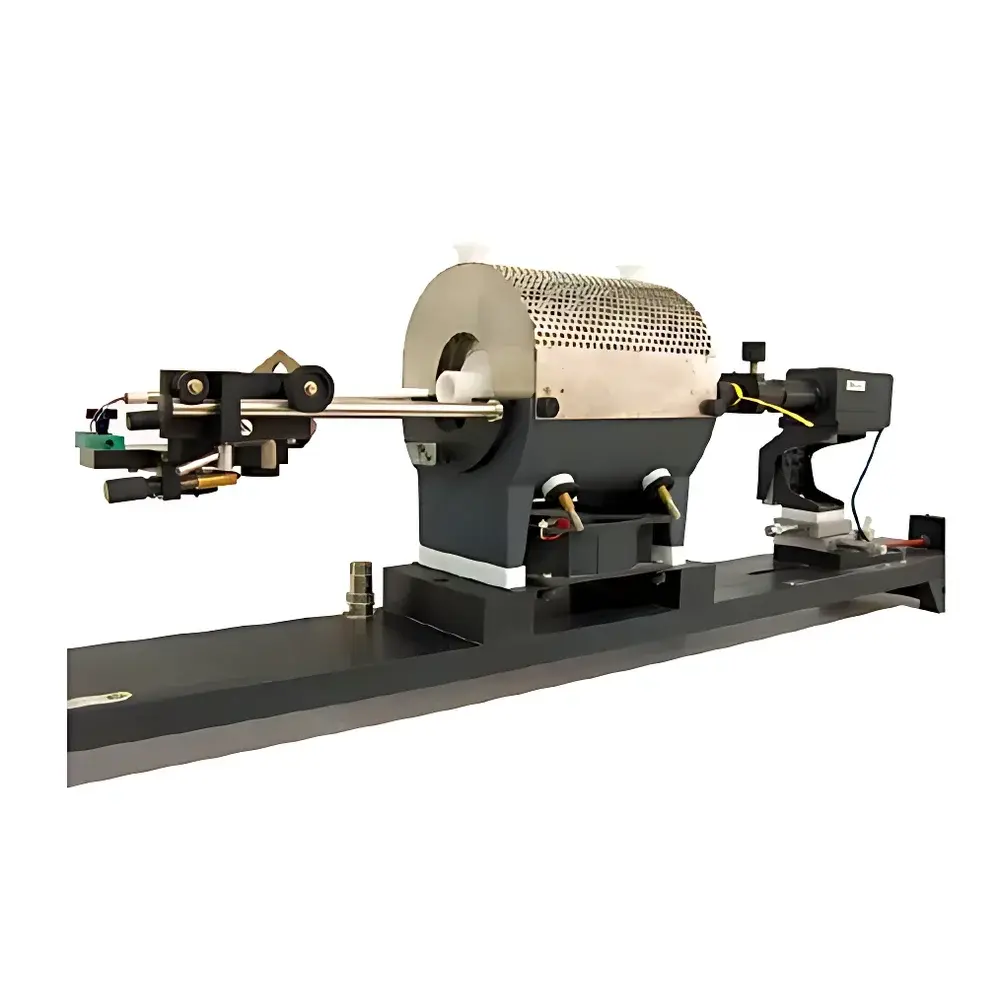
HTM1700 High-Temperature Microscope (Imported, Spain)
| Origin | Spain |
|---|---|
| Manufacturer Type | Authorized Distributor |
| Origin Category | Imported |
| Model | HTM1700 |
| Pricing | Available Upon Request |
Overview
The HTM1700 High-Temperature Microscope is a precision-engineered thermal analysis instrument designed for in-situ visual characterization of materials under controlled high-temperature conditions up to 1700 °C. Based on optical observation coupled with calibrated thermal profiling, it operates on the principle of real-time image-based morphological tracking during dynamic heating cycles. This enables quantitative determination of thermally induced phase transitions—including sintering onset, softening, sphere formation, hemispherical deformation, and full melting—using standardized geometric criteria defined in ISO 540:1995 for fusibility testing. The system integrates a C-type high-temperature furnace with optimized thermal uniformity and rapid ramp control (≤70 °C/min below 1000 °C), ensuring reproducible thermal histories critical for comparative material evaluation in glass science, refractory development, ceramic processing, and coal ash behavior analysis.
Key Features
- Maximum operating temperature of 1650 °C (furnace) with stable sample zone temperatures up to 1600–1650 °C
- Integrated C-type high-temperature furnace rated at 3 kW, featuring precise PID temperature control and thermal stability ≤±2 °C over extended dwell periods
- Dual-resolution imaging capability with color-filtered CCD camera enabling high-fidelity capture of subtle surface morphology changes
- Automated detection and temperature assignment of key thermal events: sintering point, softening point, sphere point, hemispherical point, and melting point
- Real-time contact angle measurement using dynamic droplet shape analysis; viscosity estimation derived from sessile drop geometry evolution
- Surface tension quantification for molten glasses via Young–Laplace equation fitting to axisymmetric liquid drop profiles
- No calibration or geometric correction required due to fixed optical path geometry and factory-aligned thermal–optical reference mapping
- Reduced sample preparation time enabled by standardized mounting fixtures compatible with ASTM C851 and ISO 540 specimen geometries
Sample Compatibility & Compliance
The HTM1700 accommodates cylindrical or prismatic specimens (typically 2–5 mm diameter × 5–10 mm height) fabricated from oxides, silicates, carbonaceous materials, slags, and industrial ashes. It supports both inert (Ar, N₂) and oxidizing (air) atmospheres through optional gas inlet modules. All thermal event definitions and measurement protocols conform to ISO 540:1995 (Determination of fusibility of coal and coke ash), with traceable temperature referencing aligned to ITS-90. Temperature repeatability is maintained within ±2–5 °C across repeated cycles, while dimensional reproducibility—measured as relative variation in sample height/width—is ≤0.3%, and contact angle measurement uncertainty remains ≤±2°. The system architecture supports GLP-compliant documentation workflows when integrated with validated software environments.
Software & Data Management
The HTM1700 runs on Windows-based acquisition and analysis software that provides synchronized thermal–optical data logging at user-defined intervals (down to 0.1 s). Image sequences are stored in lossless TIFF format with embedded metadata (timestamp, furnace setpoint, actual thermocouple reading, stage position). Quantitative analysis includes automated edge detection, contour extraction, curvature calculation, and temperature-correlated feature annotation. Software output complies with FDA 21 CFR Part 11 requirements when deployed with electronic signature modules and audit trail configuration. Export options include CSV (for statistical process control), PDF reports (with annotated images and thermal event tables), and XML (for LIMS integration).
Applications
- Characterization of glass transition and softening behavior in container, flat, and specialty glasses
- Fusibility assessment of coal ash, biomass ash, and municipal solid waste incineration residues
- Optimization of sintering profiles for advanced ceramics and powder metallurgy feedstocks
- Thermal stability evaluation of refractory linings used in metallurgical furnaces and cement kilns
- Surface energy modeling of molten oxide systems via contact angle–temperature dependence
- Development and validation of predictive models for slag viscosity and fluidity in blast furnace operations
FAQ
What is the maximum continuous operating temperature of the HTM1700 furnace?
The C-type furnace is rated for continuous operation at 1650 °C, with typical sample zone temperatures ranging between 1600 °C and 1650 °C depending on specimen emissivity and geometry.
Does the system support atmosphere control during heating?
Yes—optional gas inlet kits allow purging with inert (N₂, Ar) or oxidizing (air) atmospheres; custom configurations for reducing or vacuum environments are available upon request.
How is temperature accuracy verified and maintained?
Temperature calibration is performed using certified reference materials (e.g., high-purity metal melting points per ISO 17025-accredited procedures); real-time monitoring employs dual Pt/Rh thermocouples with cold-junction compensation.
Can the HTM1700 be integrated into an automated lab workflow?
Yes—the system supports TCP/IP and RS-232 communication protocols, enabling remote control, data streaming, and synchronization with external thermal analyzers or robotic sample handlers.
Is software validation documentation available for regulated industries?
Full IQ/OQ/PQ protocols, along with 21 CFR Part 11 compliance packages and audit trail configuration guides, are provided for pharmaceutical, nuclear, and aerospace QA/QC applications.




