
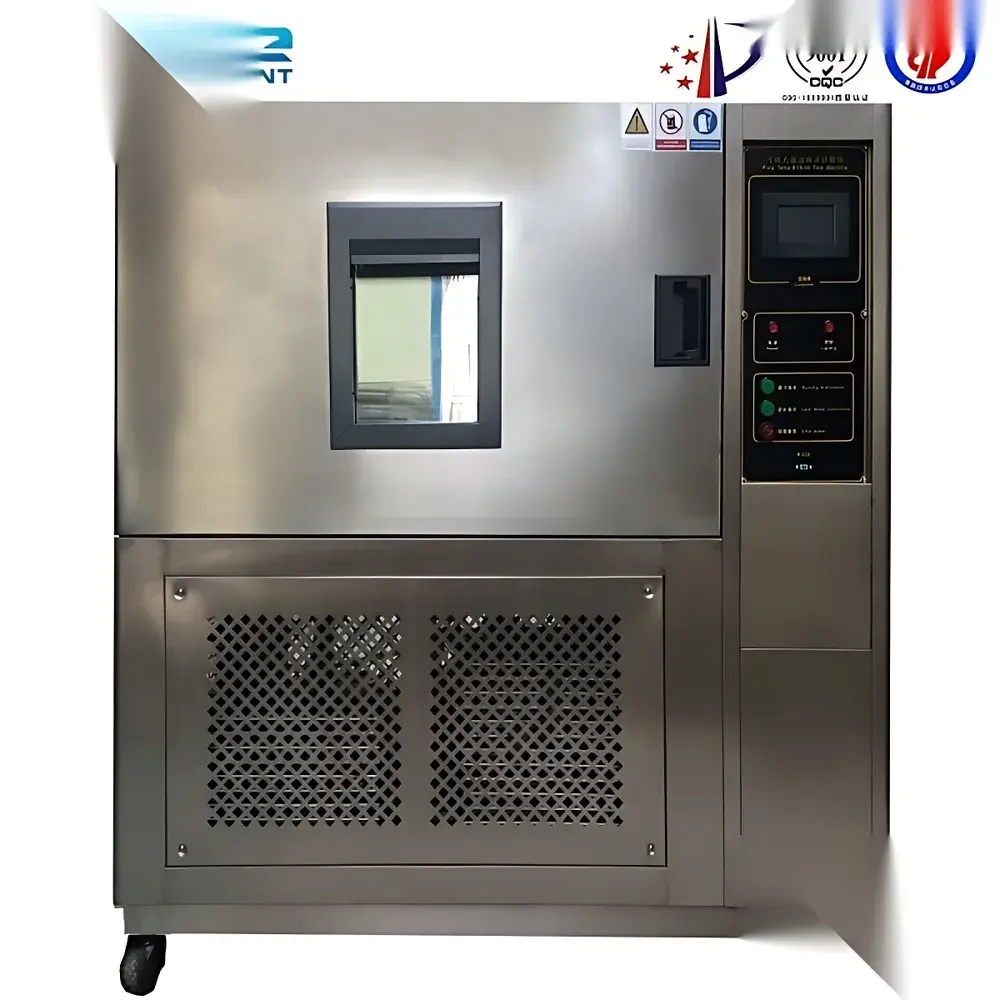
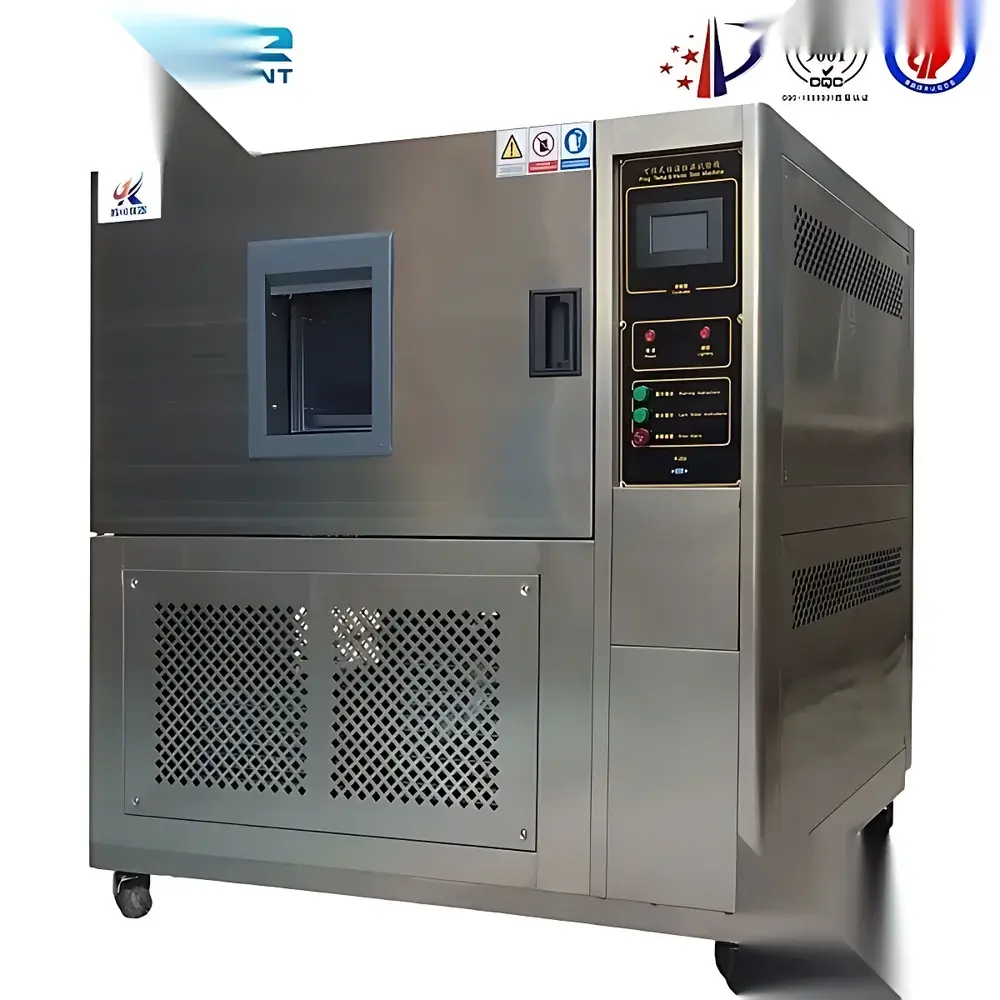
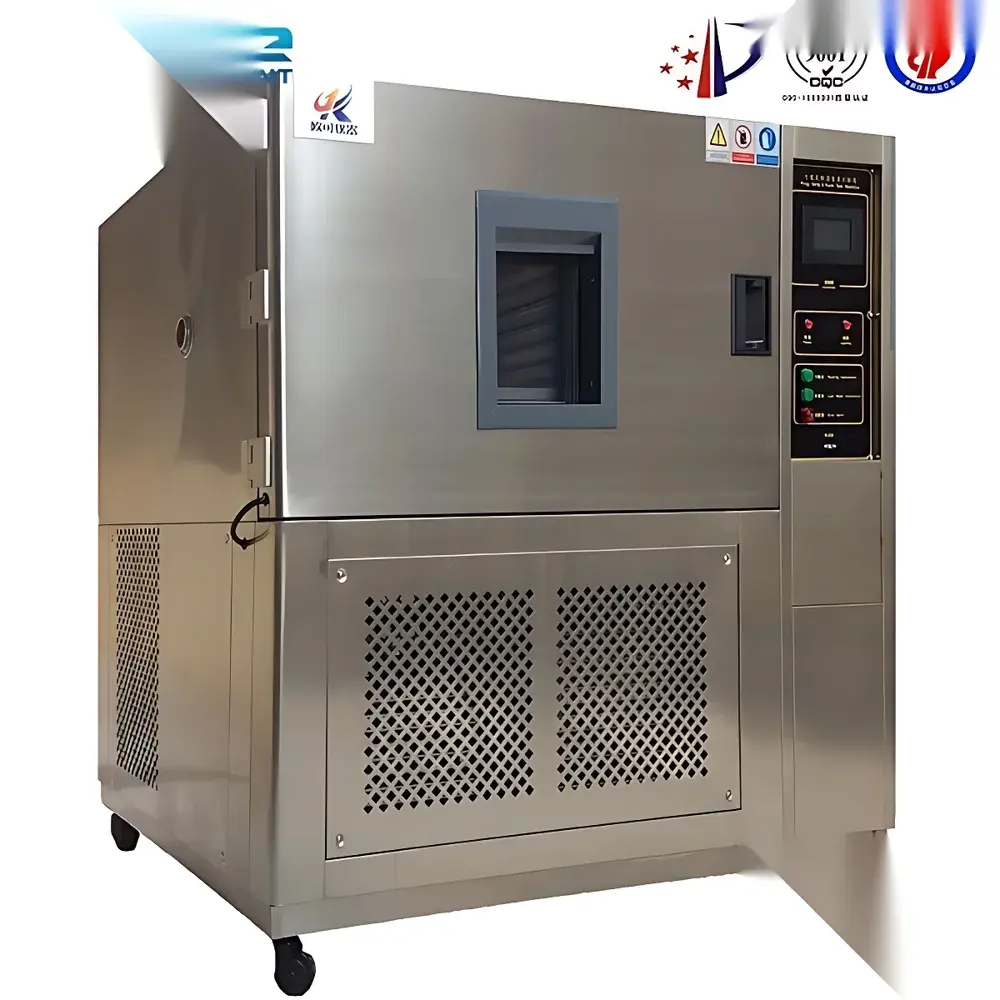
Environmental Test Chamber – Temperature and Humidity Controlled Chamber (Generic OEM Model)
| Key | Brand: Other Brands |
|---|---|
| Origin | Imported |
| Manufacturer Type | Authorized Distributor |
| Price | USD 2,650 (Reference Only) |
| Compliance | GB/T 2423.1–2023, GB/T 2423.2–2023, IEC 60068-2-1, IEC 60068-2-2, GJB 1032A–2021, MIL-STD-2164A |
| Operating Ambient | 25 °C ±6 °C, Unloaded |
| Cooling Water Requirement | 10–28 °C, 0.1–0.3 MPa |
| Protection Systems | Dry-run protection for humidifier, independent overtemperature cutoff, low-water-level interlock, compressor overload/overheat/overcurrent protection, high-pressure refrigerant switch, circuit breaker, RCD leakage protection |
| Control Method | Balanced Temperature-Humidity Control (BTHC) with PID-driven SSR output |
| Refrigeration | Capillary tube-based automatic capacity modulation system |
| Cabinet Design | Seamless arc-shaped stainless steel interior, flat non-reactive door handle, touch-screen controller with multi-segment programming |
Overview
The Environmental Test Chamber – Temperature and Humidity Controlled Chamber is a precision-engineered climatic simulation system designed to replicate controlled thermal and hygrothermal stress environments for reliability validation, accelerated aging, and environmental qualification testing of electronic components, automotive modules, aerospace hardware, and industrial materials. It operates on the principle of balanced temperature-humidity control (BTHC), where simultaneous regulation of heating, refrigeration, steam humidification, and dehumidification is achieved via closed-loop PID algorithms driving solid-state relays (SSRs). Unlike single-stress chambers, this dual-parameter system maintains thermodynamic equilibrium by dynamically matching heat/humidity input to chamber losses—enabling stable, long-duration operation at setpoints ranging from –70 °C to +150 °C and 10% to 98% RH (non-condensing), depending on model configuration.
Key Features
- Robust cabinet architecture featuring seamless arc-welded stainless steel interior and corrosion-resistant exterior finish for long-term durability in laboratory and production-line settings.
- Intuitive touchscreen controller with multi-segment programmability, real-time trend logging, and user-accessible calibration offset adjustment—designed for rapid operator onboarding and repeatable test execution.
- Capillary tube-based refrigeration system with automatic load-matching capability—eliminates mechanical expansion valve hysteresis and delivers smoother, more predictable cooling ramp profiles compared to conventional TXV systems.
- Integrated safety architecture compliant with IEC 61000-1-2 and UL 61010-1: includes redundant overtemperature cutouts, humidifier dry-run prevention, refrigerant high-pressure monitoring, compressor thermal current sensing, and Class B residual-current device (RCD) protection.
- Optimized air circulation design with centrifugal blower and baffled ducting ensures uniform temperature and humidity distribution (±0.5 °C / ±2% RH spatial uniformity per IEC 60068-3-5) across the working volume.
Sample Compatibility & Compliance
This chamber accommodates a broad range of sample types—including PCB assemblies, battery packs, polymer housings, optical sensors, and sealed enclosures—without requiring internal modifications. Its mechanical and electrical subsystems are engineered to meet statutory requirements for lab-grade environmental testing infrastructure. The unit conforms to GB/T 2423.1–2023 (cold testing), GB/T 2423.2–2023 (dry heat), IEC 60068-2-1 (cold), IEC 60068-2-2 (dry heat), GJB 1032A–2021 (environmental stress screening), and MIL-STD-2164A (electronic equipment ESS). While not pre-certified for FDA 21 CFR Part 11 or ISO/IEC 17025, its data logging architecture supports audit-ready traceability when integrated with validated third-party software platforms meeting GLP/GMP documentation standards.
Software & Data Management
The embedded controller records time-stamped temperature and humidity values at configurable intervals (1–60 seconds) and stores up to 100 test profiles locally. Data export is supported via USB mass storage mode (CSV format) or optional RS485/Modbus RTU interface for integration into centralized MES or LIMS environments. Firmware supports password-protected user roles (Operator, Engineer, Administrator) and enables manual override lockout during critical qualification runs. For regulated industries, external validation packages—including IQ/OQ protocols, uncertainty budgets, and sensor calibration certificates—can be supplied upon request to support 21 CFR Part 11 compliance workflows.
Applications
- Environmental stress screening (ESS) of avionics and military-grade electronics per MIL-STD-2164A and GJB 1032A.
- Thermal cycling and damp heat testing of photovoltaic modules per IEC 61215 and IEC 61646.
- Accelerated life testing of lithium-ion battery cells under combined thermal-hygric stress.
- Material compatibility evaluation of adhesives, coatings, and elastomers per ASTM D471 and ISO 188.
- Stability chamber qualification for pharmaceutical packaging per ICH Q1A(R2) guidance (when operated within 25 °C/60% RH or 30 °C/65% RH conditions).
FAQ
What is the typical temperature and humidity recovery time after door opening?
Recovery depends on load mass, thermal mass, and ambient conditions—but with standard configuration and no internal fixtures, the chamber typically returns to ±1 °C/±3% RH of setpoint within 15 minutes following a 30-second door opening at 25 °C/50% RH.
Can the chamber operate continuously at extreme setpoints such as –40 °C/95% RH?
No—simultaneous extremes impose conflicting thermodynamic demands; condensation risk and refrigeration inefficiency limit practical combined operation. Consult the chamber’s operating envelope chart for validated dual-parameter zones.
Is remote monitoring supported out-of-the-box?
Standard units include local USB and RS485 interfaces; Ethernet/WiFi connectivity requires optional communication module and compatible SCADA or cloud gateway.
How often does the humidifier require maintenance?
The stainless steel steam generator should undergo quarterly descaling using approved citric acid solution; water quality (deionized, <10 µS/cm conductivity) directly impacts service interval and electrode longevity.
Does the unit include NIST-traceable calibration documentation?
Factory calibration certificates are provided with each shipment; full NIST-traceable calibration with uncertainty reporting is available as an add-on service performed by ISO/IEC 17025-accredited laboratories.



