
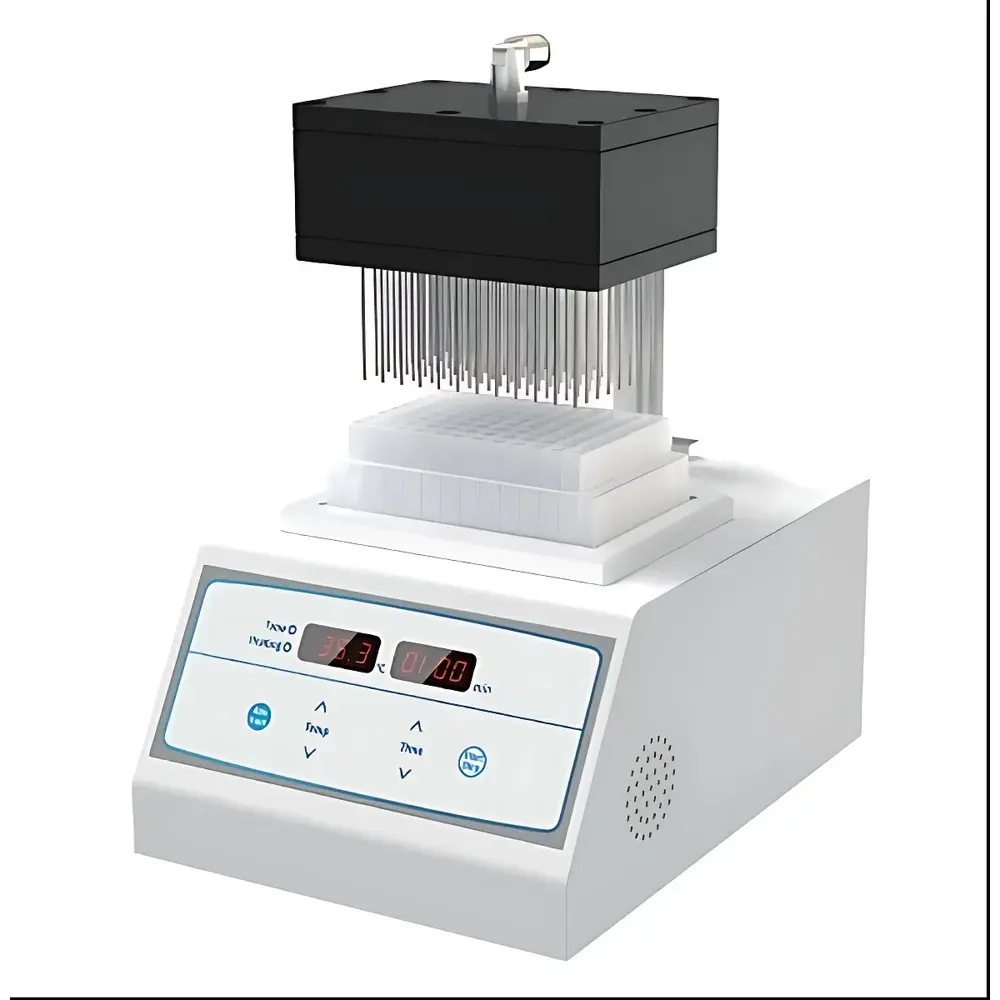
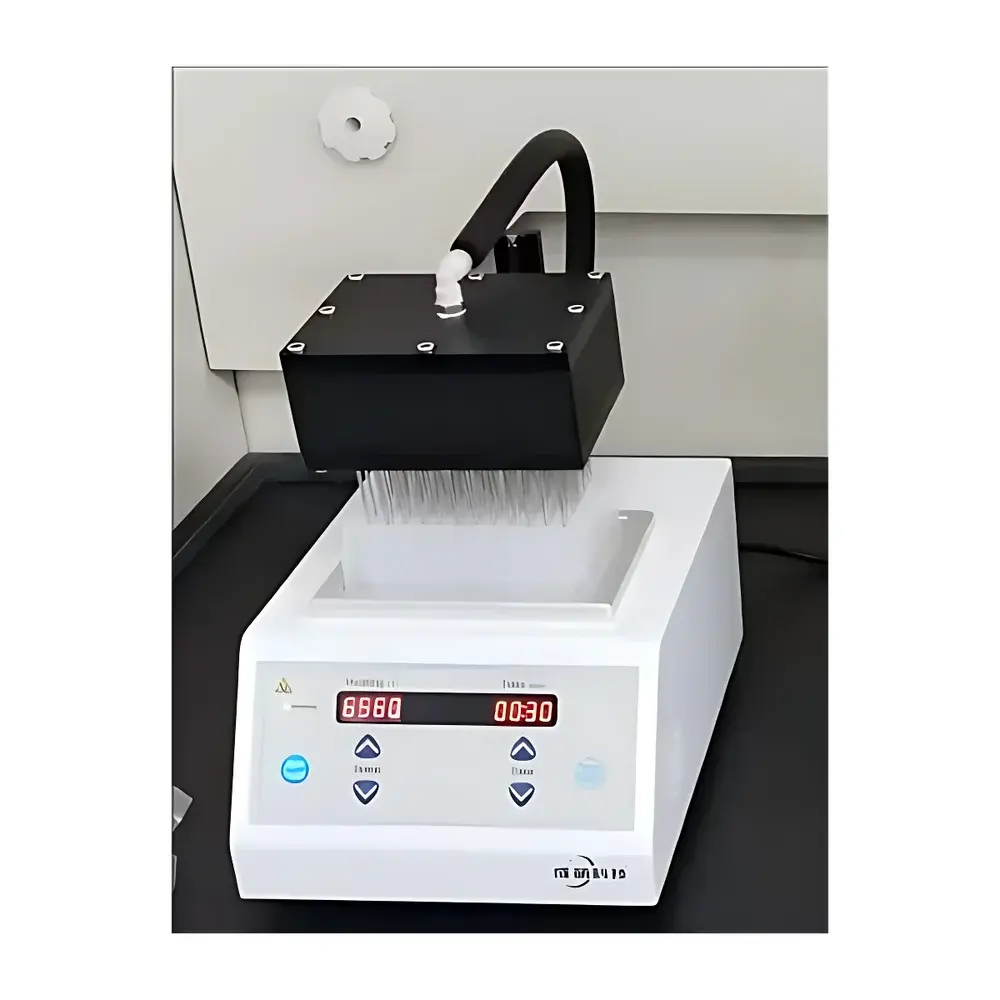
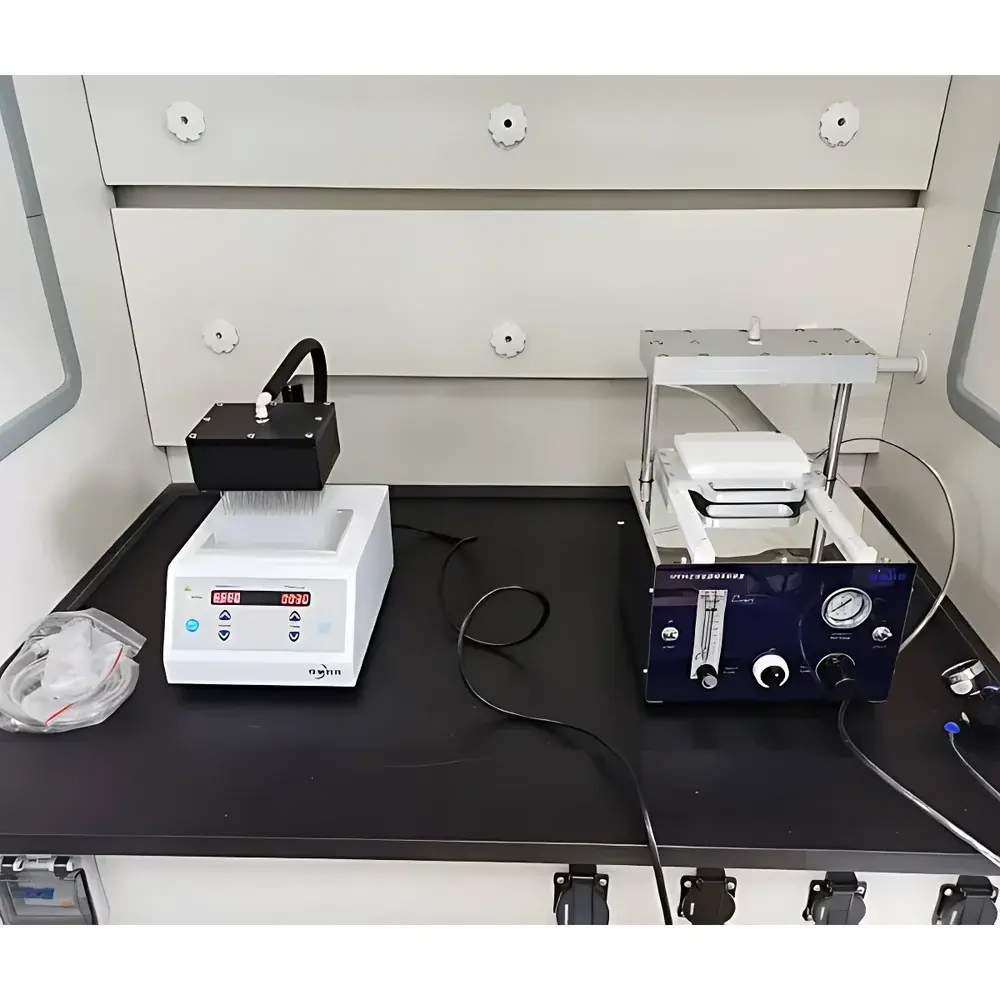
Chengmeng CM-96-1A 96-Well Plate Nitrogen Evaporator
| Brand | Chengmeng |
|---|---|
| Origin | Beijing, China |
| Model | CM-96-1A |
| Heating Method | Dry Block Heating |
| Temperature Range | Ambient +5°C to 80°C |
| Temperature Uniformity | ±1°C |
| Sample Format | 96-Well Microplate |
| Gas Flow Rate | 15 L/min |
| Heating Power | 600 W |
| Dimensions | 220 × 290 × 310 mm |
| Weight | 7.5 kg |
| Timer Range | 1–99 h 59 min or Continuous |
| Lift Travel | 100 mm |
| Gas Pressure Requirement | 0.05 MPa |
| Display Resolution | 0.1°C |
| Ramp Time | ≤20 min (25°C → 80°C) |
Overview
The Chengmeng CM-96-1A 96-Well Plate Nitrogen Evaporator is a precision-engineered dry-block thermal concentrator designed for high-throughput sample preparation in analytical laboratories. It operates on the principle of inert gas-assisted solvent evaporation—specifically, controlled nitrogen flow directed across the surface of heated samples in standard 96-well microplates. Unlike vacuum-based concentration systems, this instrument maintains sample integrity under ambient pressure while eliminating oxidative degradation through oxygen-free nitrogen purging. The unit integrates a dual-stage thermal management architecture: an aluminum heating block provides rapid, uniform conductive heating, while regulated nitrogen flow delivers convective heat transfer directly to sample surfaces. This hybrid thermal delivery ensures reproducible evaporation kinetics across all 96 positions, critical for quantitative workflows in regulated environments.
Key Features
- Microprocessor-controlled PID temperature regulation with digital display (0.1°C resolution) and user-accessible calibration function
- Dry-block heating system using high-thermal-conductivity aluminum alloy, enabling fast ramp times (≤20 min from 25°C to 80°C) and stable operation within ±1°C at both 40°C and 80°C setpoints
- Independent, vertically adjustable nitrogen delivery nozzles per well—preventing cross-contamination and allowing differential flow distribution across the plate
- Motorized vertical lift mechanism with 100 mm travel range, facilitating safe and ergonomic access during plate loading/unloading
- Programmable timer with dual modes: fixed duration (1–99 h 59 min) or continuous operation; auto-shutdown upon timer expiration
- Integrated safety features including over-temperature protection, gas pressure monitoring (0.05 MPa nominal), and thermal cut-off circuitry
Sample Compatibility & Compliance
The CM-96-1A accommodates standard ANSI/SBS-compliant 96-well plates (flat-bottom, round-bottom, and PCR-format), supporting volumes from 50 µL to 300 µL per well. Its inert nitrogen environment preserves thermolabile analytes—particularly relevant for pesticide residue analysis (per ASTM D5072, EN 15662), environmental water testing (EPA Method 525.3), and clinical hormone quantification (CLIA-aligned workflows). While not certified to ISO/IEC 17025 or FDA 21 CFR Part 11 out-of-the-box, the instrument’s deterministic temperature control, traceable calibration capability, and non-volatile timer logic support GLP/GMP-aligned documentation when integrated into validated SOPs. All electrical components comply with IEC 61010-1 safety standards for laboratory equipment.
Software & Data Management
The CM-96-1A operates via embedded firmware without external software dependency—ensuring operational continuity in air-gapped lab networks. Temperature setpoints, timer values, and real-time status are displayed on a high-contrast LED interface. For auditability, users may log parameters manually or integrate the unit into broader LIMS environments via serial output (RS-232 optional upgrade). Though the base model lacks electronic data capture, its repeatable thermal profile and mechanical consistency enable robust method transfer between instruments—essential for multi-site QC labs validating residue analysis methods per ISO 17025 clause 7.2.2.
Applications
- Agricultural residue analysis: High-throughput cleanup of QuEChERS extracts from fruits, vegetables, cereals, and plant tissues prior to GC-MS/MS or LC-MS/MS
- Environmental monitoring: Concentration of trace-level organochlorines, PAHs, and pharmaceuticals from drinking water, groundwater, and wastewater matrices
- Clinical & pharmaceutical research: Preparative concentration of steroid hormones, bile acids, and small-molecule metabolites in serum, urine, and cell culture supernatants
- Food & beverage quality control: Solvent removal from milk protein digests, beer polyphenol extracts, and wine volatile fractions
- Drug discovery support: Parallel sample prep for HTS libraries requiring consistent solvent elimination prior to bioassay or crystallization
FAQ
What types of 96-well plates are compatible with the CM-96-1A?
Standard ANSI/SBS-format microplates (128 × 85.5 mm footprint) with flat, round, or V-bottom wells—up to 15 mm well depth and 1.2 mL maximum volume.
Can the instrument be used with gases other than nitrogen?
Yes—argon or compressed air may be substituted, though nitrogen remains preferred for oxidation-sensitive applications due to its inertness and moisture-free delivery.
Is temperature calibration traceable to NIST standards?
The unit supports user-performed calibration using a certified reference thermometer; full NIST-traceable calibration requires third-party service and documented uncertainty reporting.
Does the CM-96-1A meet requirements for regulated pharmaceutical testing?
It satisfies core functional requirements for sample prep in USP , EP 2.2.46, and ICH Q2(R2) guideline contexts when operated within validated temperature/time parameters and supported by appropriate change control documentation.
How is gas flow distributed across the 96 nozzles?
Nitrogen enters a manifold that feeds each nozzle independently via calibrated orifices—ensuring balanced flow distribution without active regulation per channel. Total flow is fixed at 15 L/min at 0.05 MPa inlet pressure.



