
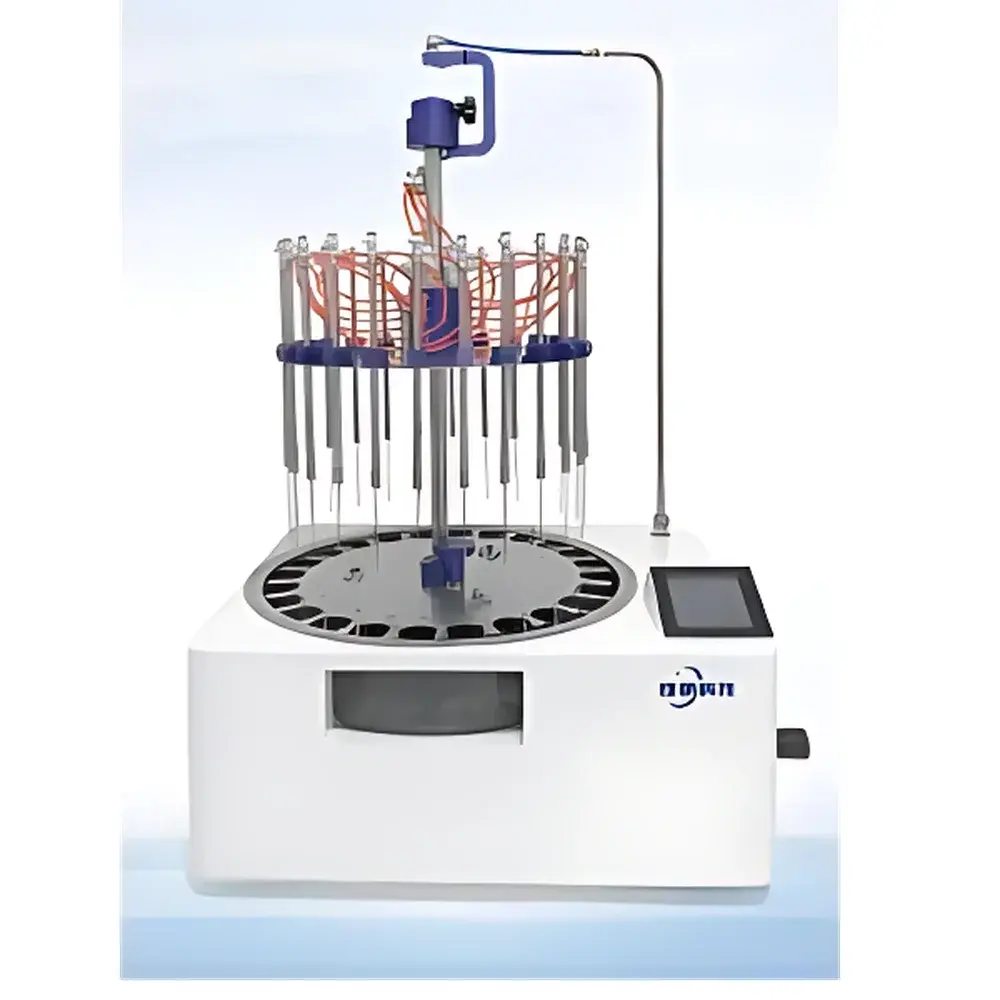
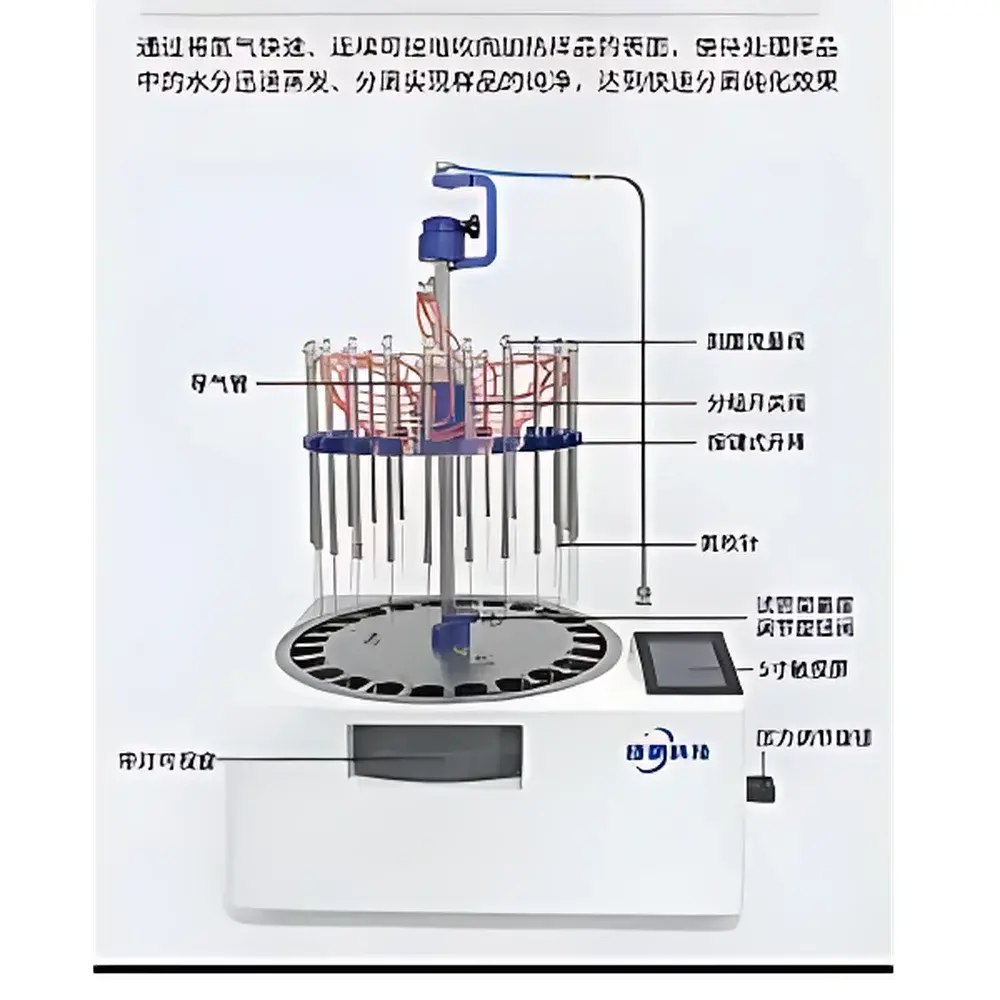
Chengmeng CMDS-12 Intelligent Water Bath Nitrogen Evaporator
| Brand | Chengmeng |
|---|---|
| Origin | Beijing, China |
| Model | CMDS-12 |
| Heating Method | Water Bath |
| Temperature Range | Ambient to 100 °C |
| Temperature Stability | ±0.5 °C |
| Sample Capacity | 12 positions (independently controllable) |
| Tube Diameter Compatibility | 10–35 mm |
| Tube Height Compatibility | 32–200 mm (customizable) |
| Gas Input Pressure | 0.2–1.0 MPa |
| Gas Output Pressure | 0.2–0.8 MPa |
| Needle Stroke | 0–200 mm |
| Control Interface | 5-inch HD color touchscreen |
| Programmable Steps | Up to 30 segments |
| Power Rating | 1500 W |
| Drainage | Quick-connect auto-drain port |
| Material | 304 stainless steel sample rack and needle assembly (optional 316 SS or PTFE-coated) |
Overview
The Chengmeng CMDS-12 Intelligent Water Bath Nitrogen Evaporator is an engineered solution for reproducible, low-temperature solvent removal in analytical laboratories. It combines precise water bath thermal control with regulated nitrogen gas flow to gently concentrate liquid samples—commonly used in residue analysis, environmental testing, clinical toxicology, food safety, and pharmaceutical QC workflows. Unlike dry-block or air-heated evaporators, the water bath design ensures uniform heat transfer across all sample vessels, minimizing thermal degradation of thermolabile analytes such as pesticides, hormones, and metabolites. The system operates on the principle of forced convection: nitrogen gas—delivered via individually adjustable stainless-steel needles—is directed tangentially across the liquid surface at controlled velocity and temperature, accelerating evaporation while suppressing oxidation and splashing. Its architecture complies with fundamental laboratory safety and operational integrity requirements, including fail-safe thermal cutoffs and gas flow interlocks.
Key Features
- 5-inch high-resolution color touchscreen interface with real-time animated status display—showing bath temperature, nitrogen pressure, elapsed time, remaining program steps, and alarm conditions.
- PID-controlled water bath with ±0.5 °C thermal accuracy across ambient to 100 °C range; integrated LED-lit transparent viewing window enables continuous visual monitoring without lifting the sample rack.
- Independent digital flow control per channel using calibrated rotary valves with engraved scale markings—ensuring inter-sample flow consistency and method reproducibility.
- One-touch pneumatic needle lift mechanism (0–200 mm travel), enabling rapid height adjustment and seamless needle exchange without tooling.
- Rotating circular sample platform (360° free rotation) with coaxial needle alignment—eliminating hose entanglement and allowing frontal access during operation.
- Quick-connect drainage port with automatic siphon activation—reducing maintenance downtime and improving workflow continuity during multi-batch processing.
- Dual-mode operation: manual override for ad-hoc tasks and fully programmable automated runs (up to 30 user-defined segments per method).
- Integrated low-level detection with audible/visual alarm and automatic shutdown of heating and gas supply—preventing dry-bath operation and excessive nitrogen consumption.
- Modular 304 stainless steel construction (optional 316 SS or electropolished PTFE-coated variants available) for corrosion resistance in acidic, basic, or halogenated solvent environments.
Sample Compatibility & Compliance
The CMDS-12 accommodates a broad range of vessel geometries—including round-bottom flasks, Kuderna-Danish (KD) concentrators, centrifuge tubes (1.5–50 mL), culture tubes, and custom glassware—with diameter support from 10 to 35 mm and height up to 200 mm. Adjustable rack height and modular insert plates allow seamless transition between tube types within a single run. From a regulatory standpoint, the instrument supports GLP-compliant documentation practices through timestamped parameter logging and event-driven alarms. While not certified to ISO/IEC 17025 or FDA 21 CFR Part 11 out-of-the-box, its deterministic control logic, non-volatile method storage, and audit-ready status reporting make it suitable for environments requiring traceable, repeatable evaporation protocols aligned with ASTM D5845 (pesticide residue analysis) and USP supporting procedures.
Software & Data Management
The embedded firmware stores up to 100 user methods with full parameter recall—including temperature ramp profiles, dwell times, gas pressure setpoints, and group-wise channel enable/disable sequences. All runtime data—including actual bath temperature, measured nitrogen pressure, elapsed time, and alarm triggers—is logged internally with UTC timestamps and exportable via USB to CSV format. No external PC dependency is required for routine operation; however, optional serial communication (RS-232) enables integration into LIMS or centralized lab automation systems for remote monitoring and batch record generation. Firmware updates are performed locally via USB drive, ensuring long-term maintainability without cloud connectivity.
Applications
- Preparative cleanup in GC-MS and LC-MS sample preparation workflows—especially for pesticide multiresidue analysis (e.g., QuEChERS extracts).
- Concentration of aqueous extracts prior to ICP-MS trace metal analysis, where minimal blank contribution and thermal stability are critical.
- Stabilization of unstable compounds (e.g., prostaglandins, nitrosamines) under oxygen-free, low-temperature nitrogen blanket.
- High-throughput evaporation of calibration standards and QC reference materials across environmental and clinical labs.
- Parallel concentration of biological matrices—including plasma, urine, and tissue homogenates—prior to derivatization or immunoassay.
FAQ
What safety mechanisms prevent overheating or dry-bath operation?
The system features dual redundant safeguards: a PID-controlled thermal sensor continuously monitors bath temperature, while a separate float-level switch detects water depletion. Upon low-level detection, audible/visual alerts activate and both heating and nitrogen flow are terminated within 2 seconds.
Can the CMDS-12 be validated for regulated environments?
Yes—the instrument supports IQ/OQ documentation packages. Its deterministic control architecture, stable thermal performance (±0.5 °C), and programmable method recall align with GMP/GLP validation expectations when paired with third-party calibration certificates for temperature and pressure sensors.
Is nitrogen pressure regulation internal or external to the unit?
Gas pressure is regulated externally using standard lab-grade nitrogen manifolds. The CMDS-12 accepts input pressures between 0.2–1.0 MPa and features internal proportional valves to deliver precise output (0.2–0.8 MPa) per channel.
How is cross-contamination minimized between samples?
Each stainless-steel needle is pneumatically isolated; no shared gas manifolds exist between channels. Additionally, the rotating platform ensures consistent distance between needle tip and liquid surface—reducing aerosol carryover risk.
Does the system support unattended overnight operation?
Yes—programmable timers, automatic endpoint shutdown, and robust thermal cutoffs permit extended autonomous runs. For optimal reliability, we recommend periodic verification of water level and gas line integrity before initiating overnight protocols.



