
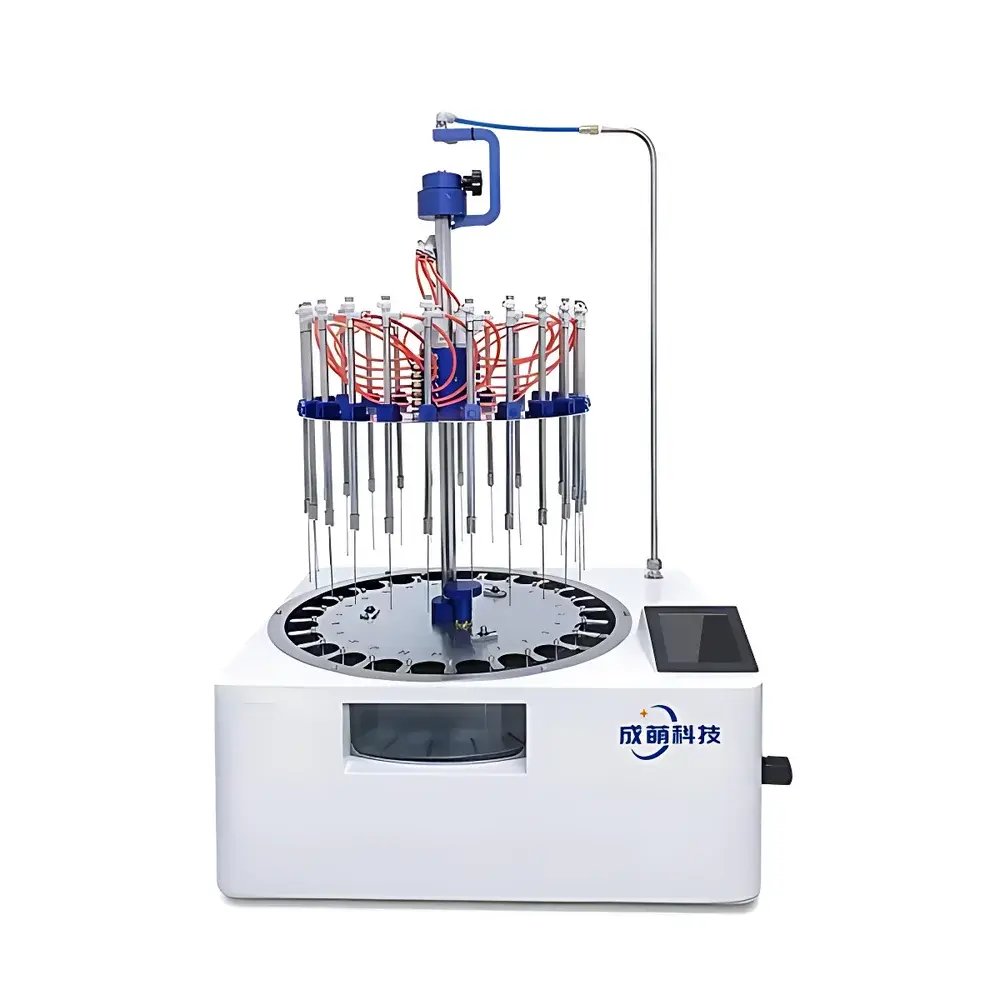
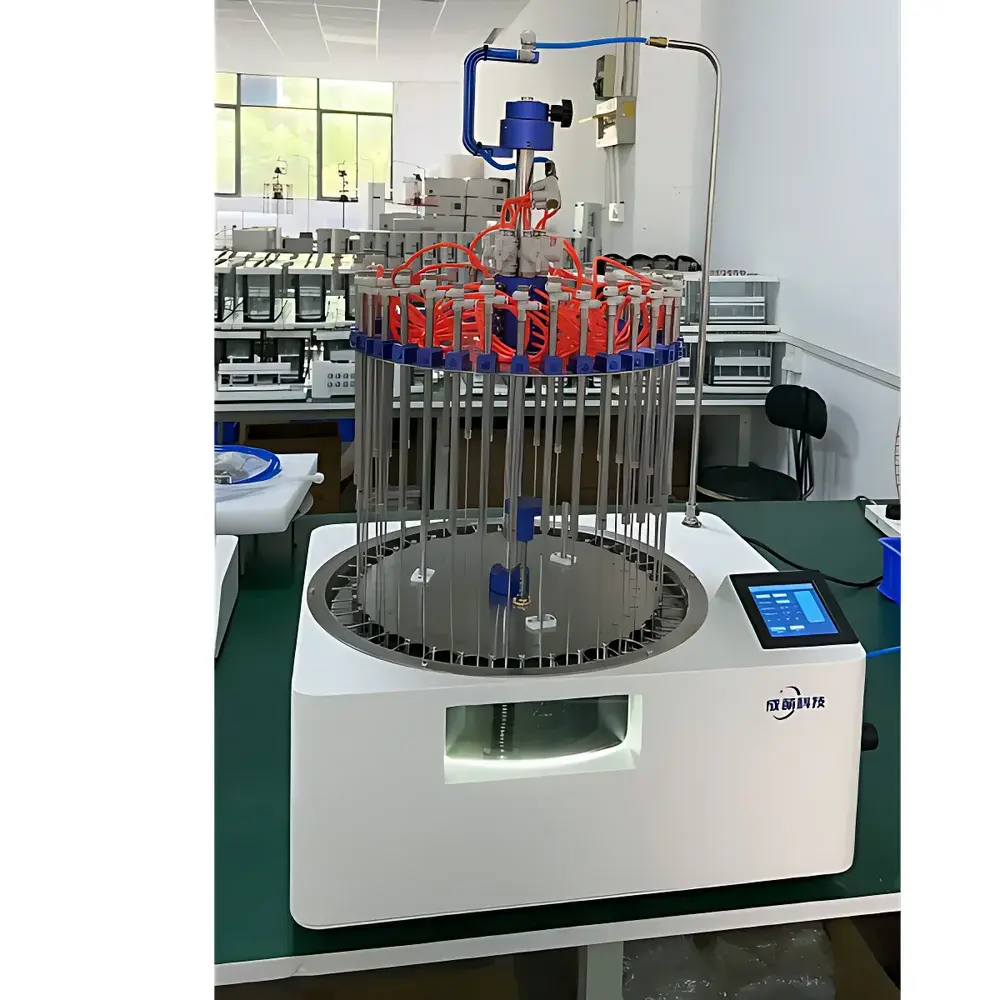
Chengmeng CMDS-24 Intelligent Water Bath Nitrogen Evaporator
| Brand | Chengmeng |
|---|---|
| Origin | Beijing, China |
| Model | CMDS-24 |
| Heating Method | Water Bath |
| Temperature Range | Ambient to 99 °C |
| Temperature Stability | ±0.5 °C |
| Sample Capacity | 24 positions |
| Tube Diameter Compatibility | 10–35 mm |
| Nitrogen Flow Rate | 0–15 L/min |
| Heating Power | 1500 W |
| Drainage | Quick-connect |
| Control Interface | 5-inch HD color touchscreen |
| Programmability | Up to 30 user-defined methods |
| Gas Pressure Input | 0.2–1.0 MPa |
| Gas Pressure Output | 0.2–0.8 MPa |
| Needle Lift Range | 0–200 mm |
| Material | 304 stainless steel (optional 316 SS or PTFE coating) |
Overview
The Chengmeng CMDS-24 Intelligent Water Bath Nitrogen Evaporator is an engineered solution for parallel sample concentration in analytical laboratories performing liquid-phase sample preparation prior to GC, HPLC, LC-MS, or ICP-MS analysis. It combines precise water bath thermal control with programmable nitrogen gas delivery to accelerate solvent evaporation while minimizing analyte loss, oxidation, and cross-contamination. Unlike dry-block or air-heated evaporators, the CMDS-24 utilizes uniform conductive heating via a thermostatically regulated water bath—ensuring consistent thermal transfer across all 24 sample positions. The system operates on the principle of inert gas sweeping: nitrogen flows coaxially over the liquid surface at controlled velocity and temperature, reducing vapor pressure above the solvent and enhancing mass transfer without introducing thermal degradation. Its architecture supports GLP-compliant workflows through real-time parameter logging, automated endpoint detection, and hardware-level safety interlocks.
Key Features
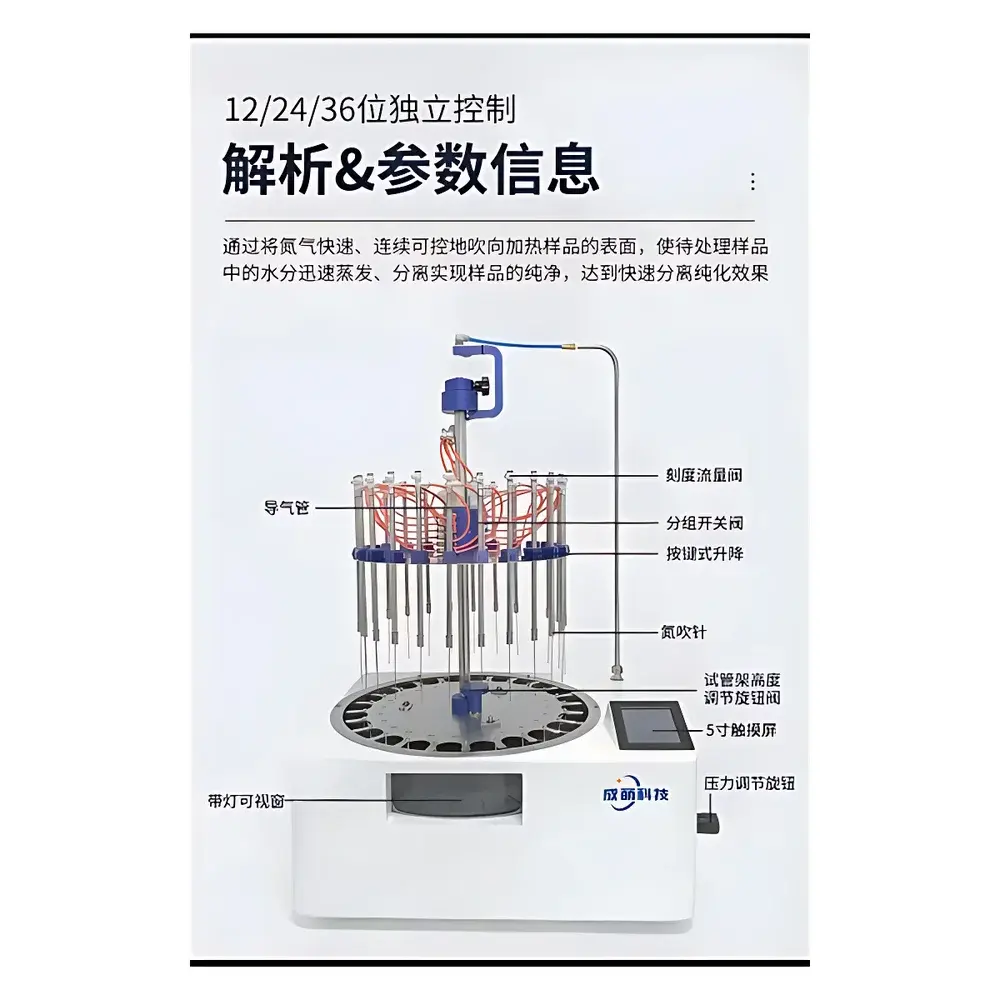
- 5-inch high-resolution color touchscreen interface with animated status visualization—including live nitrogen pressure, bath temperature, elapsed time, and remaining countdown.
- PID-controlled water bath with ±0.5 °C thermal stability across the full operating range (ambient to 99 °C), verified per ASTM E2234 calibration protocols.
- Independent flow regulation per channel via precision digital-flow valves with engraved scale markings—enabling reproducible inter-sample gas delivery and eliminating manual rebalancing.
- One-touch pneumatic needle lift mechanism (0–200 mm travel) with quick-release couplings for rapid tip exchange; no need to raise or reposition sample racks during operation.
- Integrated illuminated viewing window in the water bath chamber allows continuous visual monitoring of sample volume reduction without interrupting evaporation or disturbing thermal equilibrium.
- Quick-connect drainage port enables tool-free water exchange in under 30 seconds—critical for method transitions requiring solvent or temperature changes.
- Rotatable 360° sample carousel with concentric gas manifold routing prevents hose entanglement and ensures constant alignment between nitrogen needles and tube centers throughout rotation.
- Dual-mode operation (manual and auto) with programmable multi-step methods (up to 30 segments), including ramped temperature profiles, staged flow reduction, and timed pause intervals.
- Hardware-enforced safety logic: low-water-level detection triggers simultaneous shutdown of heater and nitrogen valve; audible/visual alarm confirms activation.
- Modular construction using electropolished 304 stainless steel (optionally upgraded to 316 SS or PTFE-coated surfaces) for corrosion resistance against organic solvents, acids, and halogenated media.
Sample Compatibility & Compliance
The CMDS-24 accommodates a broad spectrum of labware geometries—including round-bottom flasks (5–50 mL), conical centrifuge tubes (15–50 mL), Kuderna-Danish (KD) concentrators, scintillation vials, and custom-fitted glassware—with adjustable rack height (32–200 mm vertical clearance). Its open-platform design permits integration with third-party accessories such as cold traps or solvent recovery condensers. From a regulatory standpoint, the instrument supports audit-ready data integrity requirements: all user actions, setpoint modifications, and alarm events are timestamped and stored locally. While not pre-certified for FDA 21 CFR Part 11, its logging architecture aligns with ALCOA+ principles (Attributable, Legible, Contemporaneous, Original, Accurate) and facilitates validation documentation per ISO/IEC 17025 and USP guidelines.
Software & Data Management
The embedded firmware provides non-volatile storage for up to 30 user-defined evaporation protocols, each configurable with independent temperature ramps, flow schedules, dwell times, and endpoint conditions. All operational parameters—including actual bath temperature, measured nitrogen pressure, and real-time countdown—are continuously logged at 1-second intervals and exportable via USB to CSV format. No external PC or proprietary software is required for routine use; however, optional RS-485 or Ethernet interfaces support integration into LIMS environments or centralized lab automation systems. Audit trail functionality records operator ID (via optional RFID badge reader), method version, start/stop timestamps, and deviation flags—meeting minimum traceability expectations for ISO 17025-accredited testing laboratories.
Applications
This evaporator is routinely deployed in environmental labs for EPA Method 505/525 residue concentration from aqueous extracts; in pharmaceutical QC for residual solvent removal prior to dissolution testing (ICH Q3C); in food safety labs for pesticide multiresidue analysis (EN 15662); and in clinical toxicology for derivatized amphetamine metabolite cleanup. Its thermal uniformity and gas flow consistency make it especially suitable for quantitative applications where relative standard deviation (RSD) across replicates must remain below 3%—a performance benchmark confirmed during internal verification using chlorpyrifos-methyl in acetonitrile spiked at 100 ng/mL (n=6, CV = 2.1%).
FAQ
What is the maximum recommended nitrogen inlet pressure?
The system is rated for input pressures between 0.2 MPa and 1.0 MPa. Operating above 0.8 MPa may exceed the pressure rating of internal regulators and compromise long-term valve integrity.
Can the CMDS-24 be validated for GMP environments?
Yes—its deterministic control logic, event-driven logging, and mechanical safety interlocks provide foundational elements for IQ/OQ/PQ execution. A full validation package (including URS, DQ, and test scripts) is available upon request.
Is remote monitoring supported?
Standard configuration includes local touchscreen control only. Optional communication modules (RS-485 Modbus RTU or Ethernet TCP/IP) enable SCADA integration and remote parameter readout—but do not support remote actuation of critical functions such as heater or gas valve control.
How often should the water bath be cleaned and refilled?
For optimal thermal response and corrosion prevention, distilled or deionized water should be replaced after every 10 operational hours—or immediately following use with volatile organic solvents that may leave residues on the bath surface.
Does the system comply with CE or UL safety standards?
The CMDS-24 conforms to IEC 61010-1:2010 for laboratory electrical equipment. CE marking is applied for EU market distribution; UL listing is not currently held but can be pursued under customer-sponsored certification pathways.



