
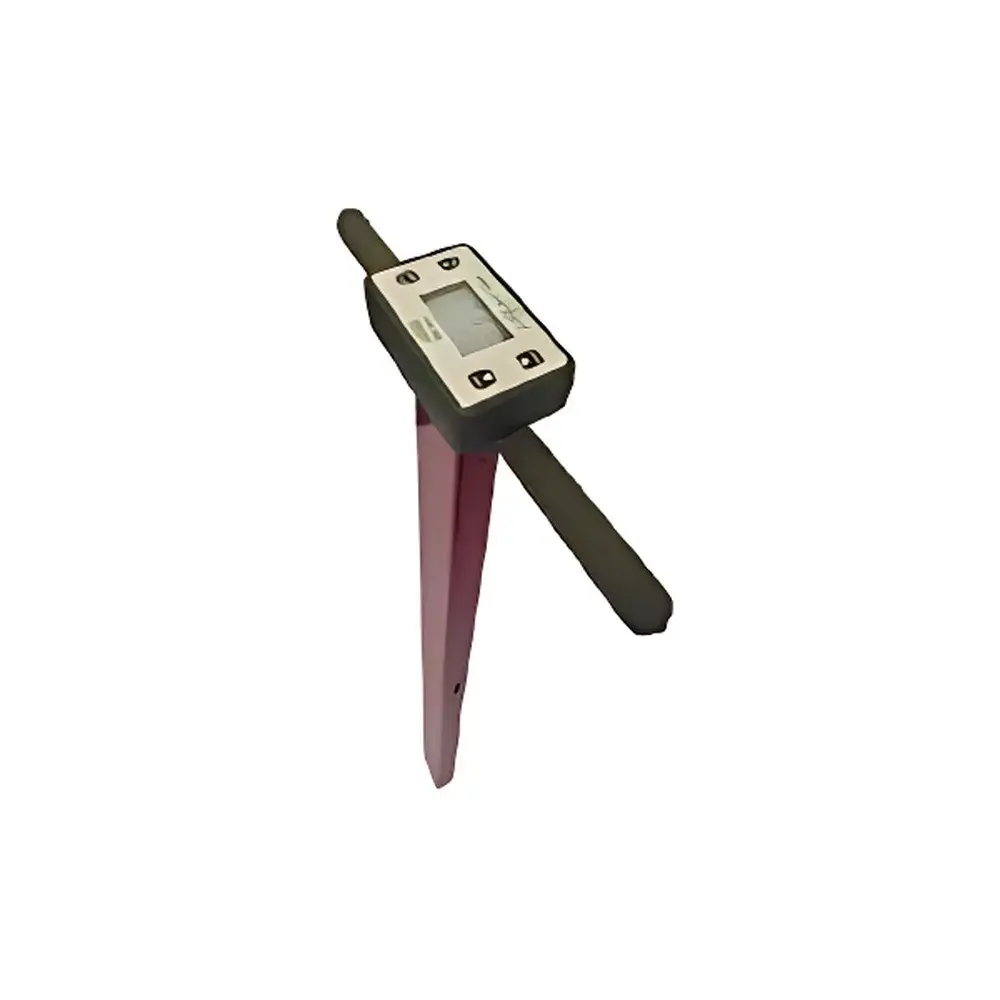
Spectrum TDR350 Portable Soil Moisture, Temperature & Electrical Conductivity Analyzer
| Origin | USA |
|---|---|
| Manufacturer Type | Authorized Distributor |
| Import Status | Imported |
| Model | TDR350 |
| Instrument Category | Soil Moisture / Water Potential Analyzer |
| Measurement Principle | Time-Domain Reflectometry (TDR) |
| Moisture Range | 0–saturation (volumetric water content, VWC) |
| Moisture Resolution | 0.1% VWC |
| Moisture Accuracy | ±3.0% VWC (at EC < 2 mS/cm) |
| EC Range | 0–5 mS/cm |
| EC Resolution | 0.01 mS/cm |
| EC Accuracy | ±0.1 mS/cm |
| Temperature Range | −30°C to +60°C |
| Temperature Resolution | 0.1°C |
| Temperature Accuracy | ±1.0°C |
| Probe Length Options | 3.8 cm, 7.5 cm, 12 cm, 20 cm |
| Probe Diameter | 5 mm |
| Probe Electrode Spacing | 33 mm |
| Data Storage Capacity | 50,000 GPS-tagged measurements |
| Power Supply | 4 × AA alkaline batteries |
| Integrated Modules | Bluetooth 4.2, GPS receiver, optional IR temperature sensor (non-contact surface/canopy temperature) |
Overview
The Spectrum TDR350 Portable Soil Moisture, Temperature & Electrical Conductivity Analyzer is a field-deployable, multi-parameter geophysical instrument engineered for high-reproducibility in-situ assessment of soil physical and electrochemical properties. It operates on the established principle of Time-Domain Reflectometry (TDR), wherein a fast-rise electromagnetic pulse is transmitted along parallel stainless-steel rods embedded in soil; the travel time and attenuation of the reflected signal are quantitatively related to the dielectric permittivity—primarily governed by volumetric water content (VWC)—and bulk electrical conductivity (EC). Unlike capacitance-based sensors, TDR is minimally affected by soil texture, salinity, or temperature drift, delivering robust VWC measurements across the full range from air-dry to saturated conditions. The integrated EC module enables real-time correction of moisture readings in saline soils, while the dual-temperature capability—via both probe-contact and optional infrared (IR) sensing—supports comprehensive stress diagnostics, including canopy temperature differentials used in crop water status modeling (e.g., Crop Water Stress Index, CWSI).
Key Features
- True TDR-based volumetric water content measurement with ±3.0% accuracy (EC < 2 mS/cm), traceable to NIST-calibrated reference soils
- Simultaneous high-resolution EC measurement (0–5 mS/cm, 0.01 mS/cm resolution) for salinity correction and soil solution characterization
- Integrated contact temperature sensor (−30°C to +60°C, ±1.0°C) embedded within the probe rod assembly
- Optional detachable IR temperature sensor (8–14 µm spectral band) for non-contact surface or canopy temperature acquisition, enabling thermal stress analysis without physical contact
- Ergonomic, telescoping probe handle with quick-release mechanism—enabling single-operator deployment at multiple depths (3.8 cm, 7.5 cm, 12 cm, 20 cm) without bending or kneeling
- Onboard GPS receiver (WAAS-enabled, <3 m horizontal accuracy) and Bluetooth 4.2 module for georeferenced data logging and wireless transfer to iOS/Android field apps
- Large backlit monochrome LCD (128 × 64 pixels) with intuitive icon-driven interface optimized for outdoor readability under direct sunlight
- Internal memory stores up to 50,000 timestamped, GPS-tagged records—including VWC, EC, probe temperature, IR temperature (if equipped), and spatial metadata
Sample Compatibility & Compliance
The TDR350 is validated for use in mineral soils (sand to clay loam), organic substrates (peat, compost), and managed turf systems (golf greens, sports fields). Its stainless-steel probe geometry (5 mm diameter, 33 mm electrode spacing) ensures minimal soil disturbance and consistent waveguide impedance across heterogeneous profiles. All firmware and data handling routines comply with GLP-aligned data integrity requirements: each measurement includes immutable timestamps, GPS coordinates, instrument serial number, and sensor calibration checksums. While not certified for regulated pharmaceutical or clinical use, the device meets ASTM D5778 (Standard Test Method for Electronic Friction Cone and Piezocone Penetration Testing) for field sensor interoperability and supports export formats compatible with ISO 2859-1 sampling plans for environmental monitoring programs.
Software & Data Management
Data retrieval is supported via Spectrum’s free FieldScout Mobile app (iOS/Android) and desktop-compatible CSV/Excel export protocols. The app enforces audit-trail functionality: every download event logs user ID, device MAC address, timestamp, and record count—meeting foundational elements of FDA 21 CFR Part 11 for electronic records in research-grade applications. Raw TDR waveform files (binary .tdr format) can be exported for advanced post-processing using third-party tools such as MATLAB or Python-based TDR analysis libraries (e.g., tdrpy). No cloud storage is mandatory; all data remain under user control on local devices unless explicitly synced. Firmware updates are delivered via signed OTA packages to prevent unauthorized modification.
Applications
- Irrigation scheduling in precision agriculture, vineyards, and orchards—using real-time VWC thresholds coupled with canopy temperature differentials
- Soil hydrological monitoring for watershed-scale drought early-warning systems and USDA NRCS Soil Moisture Monitoring Networks
- Turfgrass management on golf courses and athletic fields—assessing root-zone moisture deficits and salinity accumulation beneath drainage layers
- Ecological research on plant-soil-atmosphere continuum (PSAC), including evapotranspiration partitioning and stomatal conductance modeling
- Environmental remediation site assessment—tracking moisture redistribution and leachate migration in capped landfills or phytoremediation plots
- Green infrastructure performance evaluation—measuring infiltration rates and retention capacity in bioswales and rain gardens
FAQ
Does the TDR350 require soil-specific calibration?
No—factory calibration covers standard mineral soils per ASTM F2709. Optional user-defined calibrations may be loaded for organic media or highly saline soils via the FieldScout app.
Can the IR sensor measure soil surface temperature through vegetation cover?
Yes—the 8–14 µm spectral band penetrates thin leaf litter and sparse canopy, providing representative surface emissivity-weighted temperature; dense foliage requires manual clearing or downward-pointing measurement protocol.
Is GPS data logged with every measurement, even when Bluetooth is off?
Yes—GPS acquisition occurs autonomously during startup and is embedded in each stored record regardless of wireless state.
What is the expected battery life under typical field use?
Approximately 20 hours of continuous operation with 4 × AA alkaline cells; low-power sleep mode extends idle life to >6 months.
How does the TDR350 handle frozen soil conditions?
The probe operates down to −30°C, but TDR signal interpretation becomes unreliable below 0°C due to phase transition effects on dielectric response; users should annotate freeze-thaw state manually in metadata.
Related Products







