
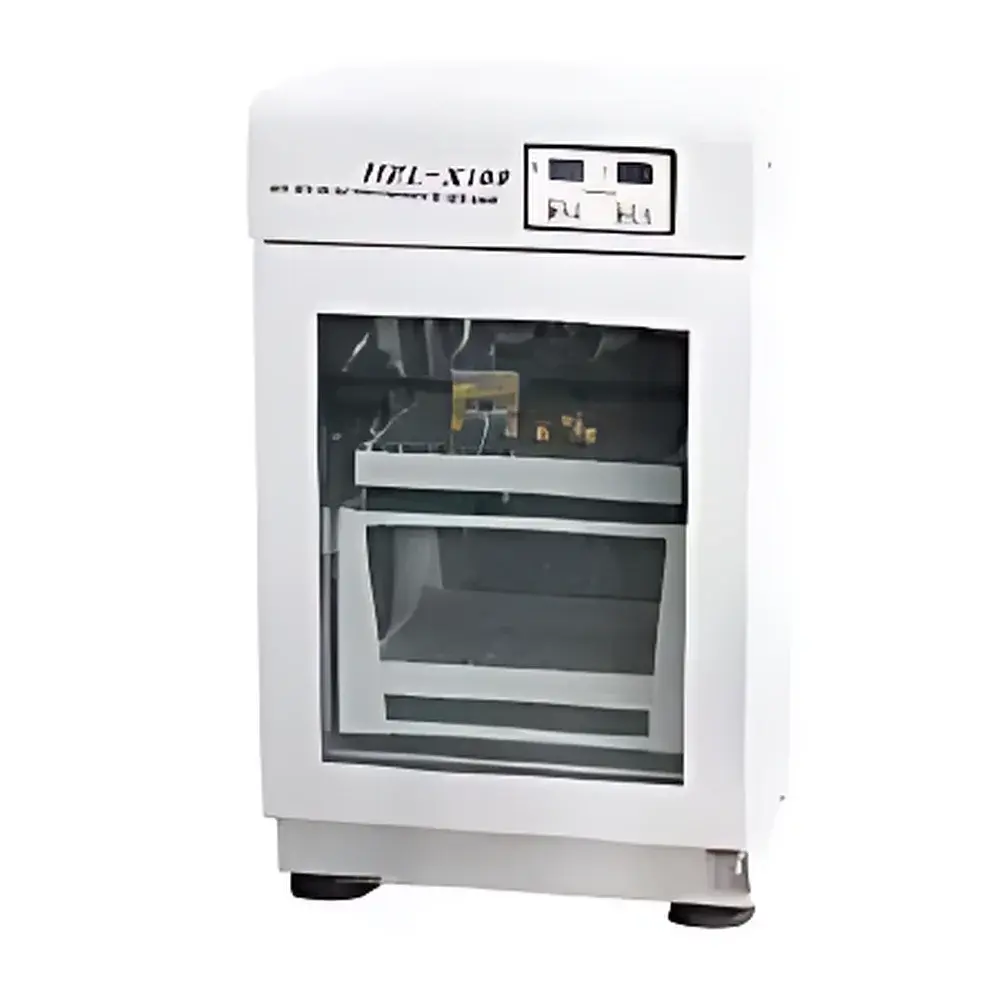
HZL-X160 Dual-Shelf Full-Temperature Orbital Shaking Incubator
| Origin | Jiangsu, China |
|---|---|
| Manufacturer Type | Authorized Distributor |
| Product Category | Domestic |
| Model | HZL-X160 |
| Quotation | USD 2,200 (FOB) |
| Instrument Type | Benchtop Orbital Shaker-Incubator |
| Timer Range | 0–999 min |
| Oscillation Frequency | 40–280 rpm (continuously adjustable) |
| Orbit Diameter | 26 mm |
| Temperature Range | Ambient +5°C to 60°C (at 25°C ambient) |
| Shelf Configuration | Dual independent shelves |
| Chamber Capacity | 160 L (40 × 250 mL flasks per shelf, double-layer arrangement) |
| Temperature Uniformity | ±0.3°C across chamber |
| Temperature Accuracy | ±0.1°C (at setpoint, calibrated at 37°C) |
| Power Supply | 220 V AC, 50 Hz |
| Drive System | Microprocessor-controlled brushless DC motor |
| Dimensions (W×D×H) | 670 × 620 × 1320 mm |
| Net Weight | 128 kg |
Overview
The HZL-X160 Dual-Shelf Full-Temperature Orbital Shaking Incubator is an integrated benchtop bioreactor platform engineered for precise simultaneous control of temperature and orbital agitation—critical for microbial growth, cell culture expansion, enzyme kinetics, and suspension-based bioprocess development. It operates on the principle of orbital shaking (horizontal circular motion with fixed 26 mm diameter), generating uniform shear profiles ideal for aerobic cultivation of bacteria, yeast, insect, and mammalian cells in Erlenmeyer flasks, baffled bottles, and culture tubes. Unlike simple shakers or standalone incubators, the HZL-X160 integrates microprocessor-regulated PID temperature control with digitally stabilized motor drive, enabling reproducible environmental conditions across two independently accessible shelves—each supporting up to 40 × 250 mL vessels under identical thermal and mechanical parameters. Its 160 L internal volume accommodates high-density parallel experiments while maintaining ISO Class 5-compatible air circulation via tangential fan-assisted convection and insulated double-wall construction.
Key Features
- Dual-shelf architecture with independent access doors—minimizes thermal disturbance during sample loading/unloading and supports staggered experimental timelines
- Brushless DC motor drive with closed-loop speed feedback ensures long-term frequency stability (±1 rpm) and zero maintenance over >20,000 hr operational life
- PID-controlled heating system with three-point calibrated NTC sensors and adaptive algorithm delivers ±0.1°C setpoint accuracy and ±0.3°C intra-chamber uniformity (per ISO 15189 Annex B)
- Full-range oscillation control from 40 to 280 rpm in 1-rpm increments, programmable per experiment with ramp-up/down profiles
- Integrated timer with non-volatile memory retains settings after power interruption; supports multi-step timed sequences (e.g., 120 min @ 180 rpm → hold @ 37°C for 48 hr)
- Intuitive LCD interface with English-language menu navigation, real-time display of actual vs. set values (temperature, rpm, elapsed time), and password-protected parameter lockout
- Structural design includes reinforced stainless-steel shelves, anti-slip silicone matting, and vibration-dampened mounting feet compliant with IEC 61000-6-2 EMC standards
Sample Compatibility & Compliance
The HZL-X160 accommodates standard laboratory glassware and plastic vessels—including 50 mL to 2 L Erlenmeyer flasks, baffle flasks, roller bottles, and multi-well plates—via configurable clamping systems and universal shelf inserts. Its temperature range (ambient +5°C to 60°C) covers common applications from psychrophilic screening (10–15°C) to thermophilic fermentation (55–60°C), while the 26 mm orbit ensures optimal oxygen transfer in cultures up to OD600 ≈ 8.0 without foaming or splashing. The unit meets CE marking requirements (2014/30/EU EMC Directive, 2014/35/EU LVD), conforms to ISO 13485-aligned manufacturing controls, and supports GLP-compliant operation through audit-trail-capable data logging (optional RS-485/Modbus RTU interface). It is routinely validated per ASTM E2500-13 for equipment qualification in QC microbiology labs.
Software & Data Management
While the base configuration features embedded firmware with local parameter storage, optional PC connectivity enables advanced data governance. Via USB or RS-485, users may export timestamped CSV logs of temperature, rpm, and timer status at user-defined intervals (1 sec–10 min). Third-party SCADA integration (e.g., Ignition, LabVIEW) is supported through open Modbus register mapping. All configurations comply with FDA 21 CFR Part 11 requirements when paired with validated electronic signature modules and role-based access control—enabling full traceability for regulated environments including pharmaceutical QC, contract research organizations (CROs), and academic core facilities subject to NIH or NSF audit protocols.
Applications
- Aerobic bacterial culture (E. coli, Bacillus spp.) and yeast propagation (S. cerevisiae, P. pastoris) under controlled O2 transfer rates
- Mammalian cell line expansion in serum-free or chemically defined media, particularly for transient transfection workflows
- Enzyme activity assays requiring thermal stabilization during kinetic mixing (e.g., lipase hydrolysis, protease digestion)
- Environmental microbiology: enrichment cultures for wastewater isolates, soil slurry respiration studies, and biodegradation monitoring
- Biopharmaceutical upstream process development—small-scale mimicry of stirred-tank bioreactor hydrodynamics using scalable orbital parameters
- Teaching laboratories: standardized demonstration of growth curves, diauxic shifts, and temperature-sensitive mutant phenotypes
FAQ
Is the HZL-X160 suitable for CO₂-sensitive cultures?
No—this model lacks CO₂ supplementation or pH monitoring; it is designed for ambient-air aerobic applications only.
Can both shelves operate at different temperatures or speeds?
No—the dual shelves share a single thermal zone and synchronized drive; they maintain identical setpoints for temperature and rpm.
What validation documentation is provided?
Factory calibration certificates (temperature sensor and tachometer), IQ/OQ protocol templates, and material compliance declarations (RoHS, REACH) are included.
Does it support external humidity control?
Not natively; relative humidity is unregulated and typically ranges between 40–65% RH at 37°C (non-condensing).
What is the recommended preventive maintenance schedule?
Visual inspection every 6 months; fan filter cleaning quarterly; annual verification of temperature uniformity and speed accuracy using NIST-traceable references.
Related Products



