
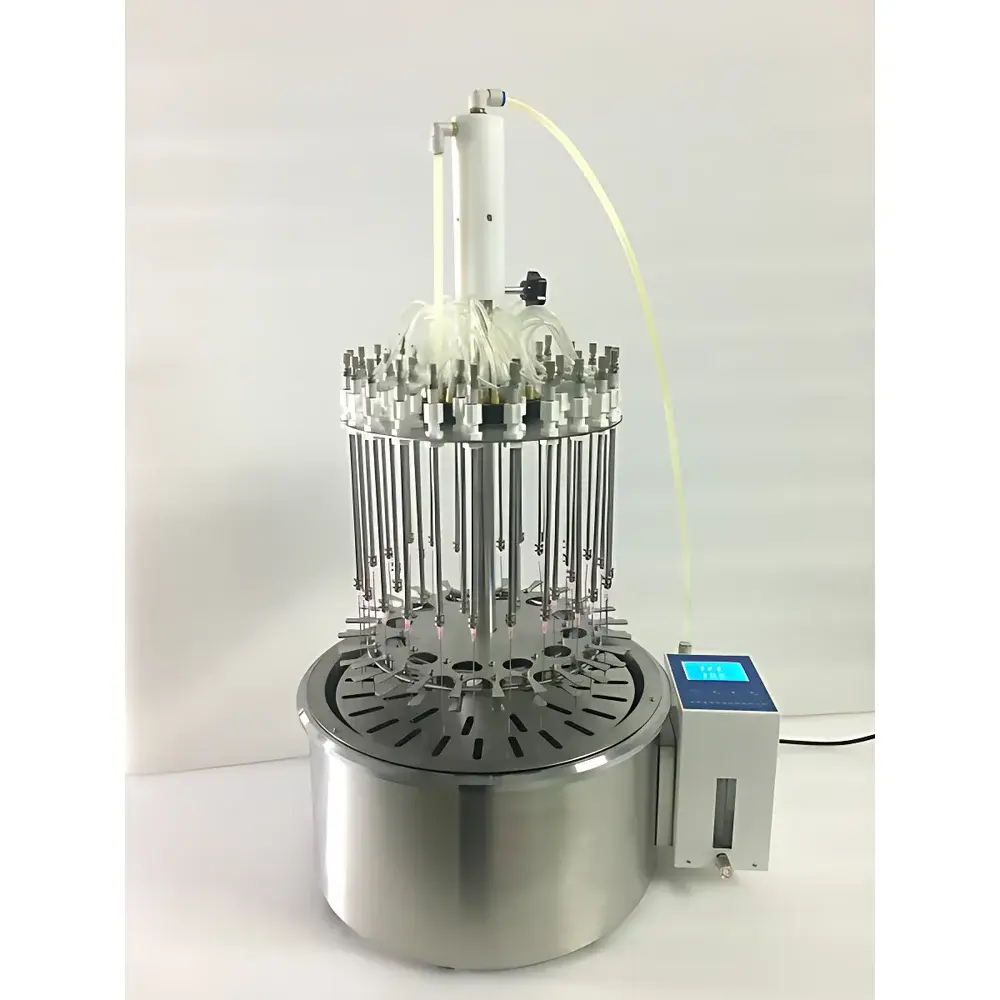
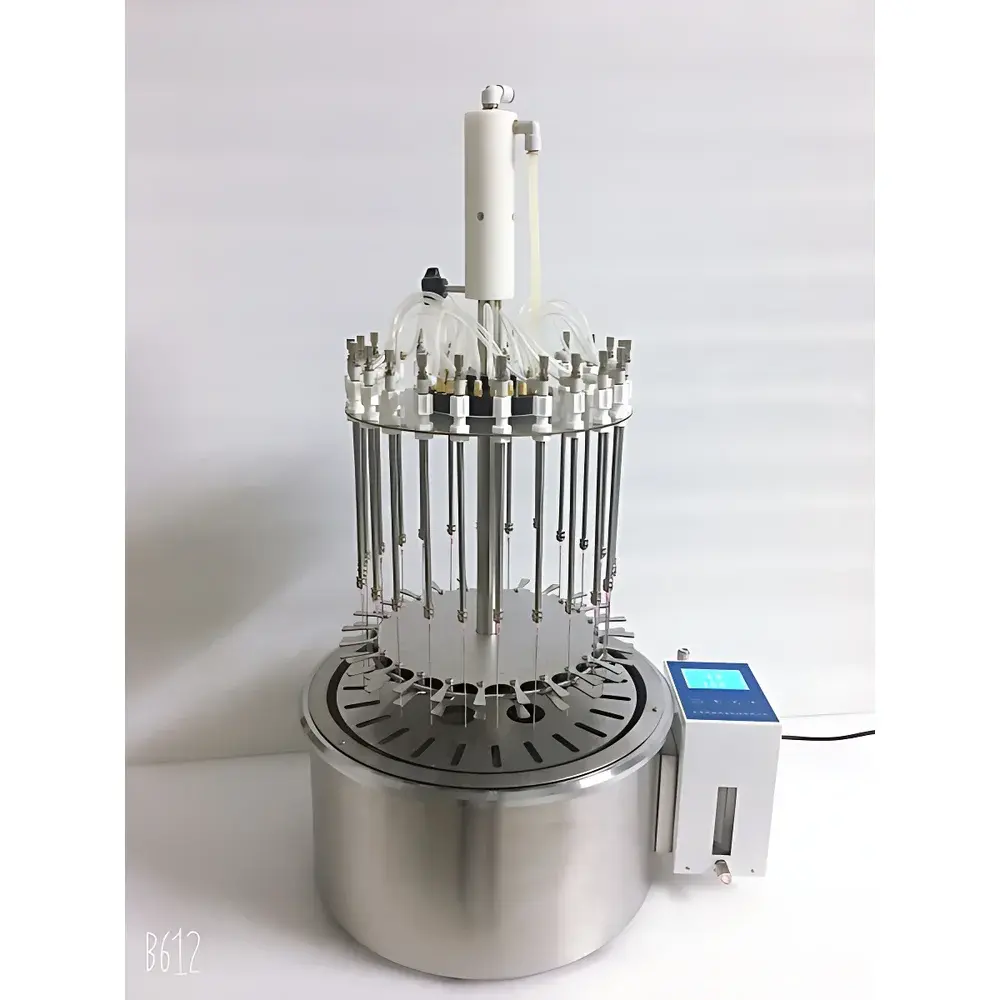
Chengmeng CM-36 Circular Water Bath Nitrogen Evaporator
| Brand | Chengmeng |
|---|---|
| Origin | Beijing, China |
| Model | CM-36 |
| Heating Method | Water Bath |
| Temperature Range | Ambient to 99 °C |
| Temperature Stability | ±0.5 °C |
| Tube Diameter Compatibility | 10–30 mm |
| Gas Flow Rate | 0–15 L/min |
| Sample Positions | 36 |
| Heating Power | 1000 W |
Overview
The Chengmeng CM-36 Circular Water Bath Nitrogen Evaporator is an engineered solution for parallel solvent evaporation and sample concentration in analytical laboratories. It operates on the principle of gentle, inert gas displacement—introducing controlled streams of nitrogen (or compressed air) directly above heated liquid surfaces to accelerate solvent volatilization while minimizing thermal degradation and analyte loss. Unlike dry-block or infrared-based concentrators, the CM-36 employs a precisely regulated water bath as its thermal medium, ensuring uniform heat distribution across all 36 sample positions and eliminating localized hot spots that compromise reproducibility. Designed for routine high-throughput workflows in regulated environments, it supports method standardization aligned with AOAC, EPA, and ISO 17025-compliant procedures where temperature accuracy, gas flow consistency, and positional repeatability are critical.
Key Features
- Circular 36-position stainless steel sample holder with engraved numeric identification for unambiguous traceability and error-resistant setup.
- Independent vertical adjustment (200 mm travel) of each gas delivery needle—enabling precise positioning relative to meniscus height across variable tube diameters (10–30 mm) and sample volumes (1–50 mL).
- Dual-gas capability: Dedicated inlet pathways for nitrogen (for oxygen-sensitive or thermally labile analytes) and compressed air (for robust matrices), both regulated via SMC TUS-grade transparent polyurethane tubing (non-leaching, solvent-resistant).
- PID-controlled digital thermostat with 66 × 45 mm backlit LCD display; maintains setpoint within ±0.5 °C over full range (ambient +5 °C to 99 °C); includes over-temperature cutoff and dry-run protection.
- Rotating sample disc and blow-down manifold—mechanically synchronized to prevent cross-contamination during sequential processing and simplify loading/unloading under fume hood constraints.
- Full 304 stainless steel construction: bath chamber (Φ400 × 200 mm internal), support frame, and gas manifolds—all compatible with common organic solvents including acetonitrile, methanol, dichloromethane, and ethyl acetate.
- Modular gas distribution system featuring individual needle valves per position, calibrated mass-flow control (0–15 L/min total), and standardized 150 mm stainless steel injection needles with replaceable tips.
Sample Compatibility & Compliance
The CM-36 accommodates a broad range of vessel formats—including round-bottom test tubes (10–30 mm OD), conical centrifuge tubes, and small-volume vials—without adapter requirements. Its rotational symmetry and low-profile footprint (420 × 420 × 850 mm) allow seamless integration into Class II biosafety cabinets and standard laboratory fume hoods. All wetted components meet USP Class VI biocompatibility criteria, and the system is fully operable under GLP and GMP conditions when paired with documented calibration protocols. While not pre-certified to FDA 21 CFR Part 11, its digital temperature logging (with optional external data capture) supports audit-ready recordkeeping when integrated into validated LIMS environments.
Software & Data Management
The CM-36 operates as a standalone instrument with embedded firmware—no proprietary software required. Time-based operation is programmable from 0 to 9999 minutes, enabling unattended overnight runs. Temperature setpoints, elapsed time, and real-time bath readings are retained in non-volatile memory during power interruption. For laboratories requiring electronic records, analog voltage outputs (0–5 V) are available for connection to third-party data loggers or SCADA systems. Optional RS-485 interface modules enable remote monitoring and parameter synchronization across multi-unit installations in centralized QC labs.
Applications
- Residue Analysis: Pesticide and veterinary drug residue concentration in fruits, vegetables, grains, and plant tissues per EPA Method 525.3 and EN 15662.
- Pharmaceutical Testing: Residual solvent removal in herbal extracts, active pharmaceutical ingredient (API) purification, and stability-indicating assay preparation under ICH Q2(R2) guidelines.
- Environmental Monitoring: Pre-concentration of trace-level PAHs, PCBs, and dioxins in drinking water, wastewater, and sediment extracts (EPA Methods 8270, 8082).
- Clinical & Forensic Toxicology: Plasma, serum, and urine sample cleanup prior to LC-MS/MS analysis for drugs of abuse, metabolites, and endogenous biomarkers.
- Food Safety: Mycotoxin (aflatoxin, ochratoxin A) and contaminant (melamine, melamine cyanurate) isolation from dairy, alcoholic beverages, and infant formula matrices.
FAQ
Can the CM-36 be used with flammable solvents such as hexane or diethyl ether?
Yes—when operated inside a certified fume hood with proper ventilation and grounding. The unit itself contains no ignition sources; however, nitrogen purging must be confirmed before introducing volatile solvents.
Is calibration documentation provided with the instrument?
A factory-verified temperature calibration certificate (traceable to NIST standards) is included. Users are advised to perform quarterly verification using a calibrated PT100 probe immersed at three radial positions within the bath.
What maintenance is required for long-term reliability?
Monthly inspection of gas tubing integrity, quarterly cleaning of stainless steel bath interior with mild detergent, and annual replacement of silicone O-rings in the gas manifold assembly.
Does the CM-36 support method transfer from older nitrogen evaporators?
Yes—the modular needle height adjustment, consistent gas flow per channel (330 mL/min nominal), and stable thermal profile facilitate direct method porting from comparable 36-position platforms without re-validation of evaporation kinetics.
Can the rotation function be disabled for static applications?
Yes—rotation is mechanically disengaged via a dedicated clutch lever located beneath the base plate, allowing fixed-position operation for sensitive immunoassay plates or microcentrifuge tube arrays.



