
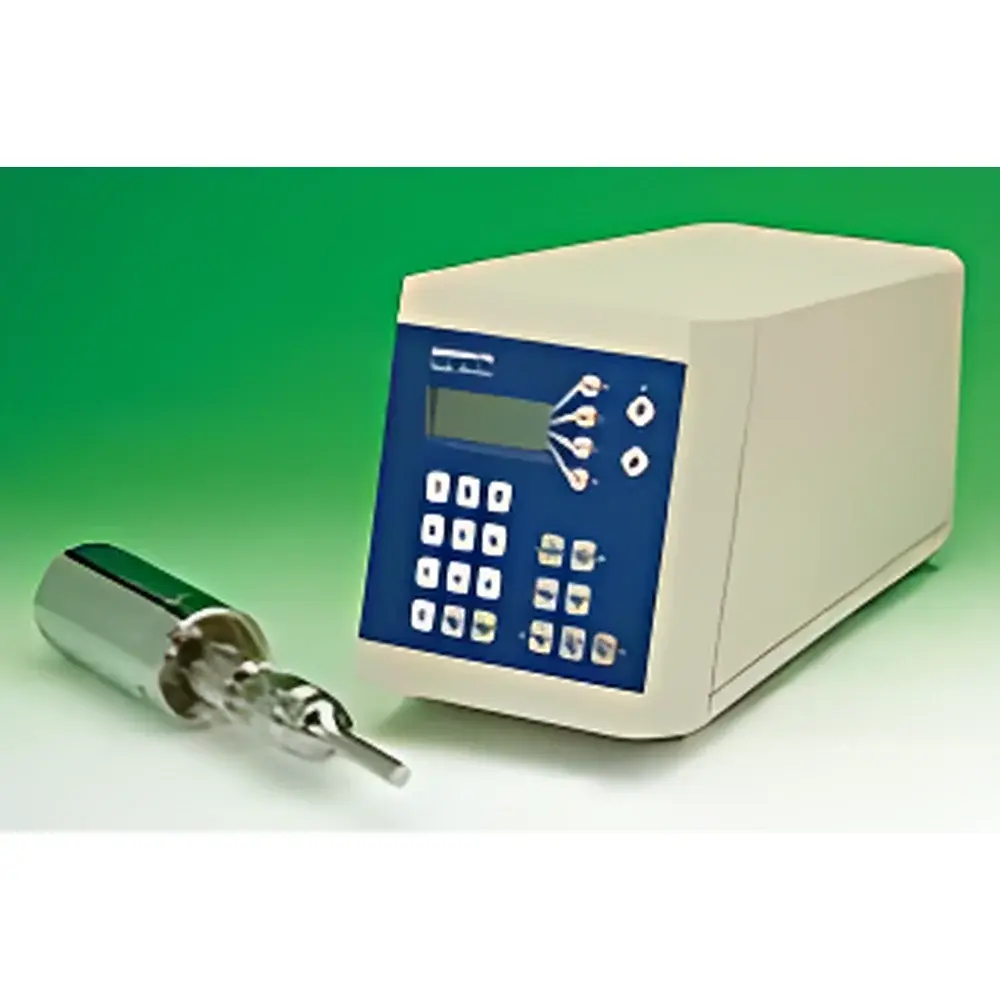
Branson Sonifier S-250A Ultrasonic Homogenizer
| Brand | Branson |
|---|---|
| Power Output | 200 W |
| Frequency | 20 kHz |
| Probe Diameter | 1/2" (12.7 mm) Titanium Alloy Horn |
| Sample Volume Range | 1 mL to >500 mL |
| Operating Modes | Continuous, Timed, Pulsed |
| Auto-Tuning | Yes |
| Control Type | Analog |
| Dimensions (W×D×H) | 24.1 × 30.5 × 21.6 cm |
| Weight | 6.8 kg |
| Origin | USA |
| Compliance | CE, UL 61010-1, RoHS |
Overview
The Branson Sonifier S-250A is a benchtop ultrasonic homogenizer engineered for precise cell disruption, emulsification, dispersion, and lysis in life science, pharmaceutical, and academic laboratories. It operates on the principle of high-intensity ultrasonic cavitation—generating controlled acoustic energy at a fixed frequency of 20 kHz through a titanium alloy probe (horn), which induces rapid pressure fluctuations in the liquid medium. These fluctuations produce microbubbles that grow and collapse violently (inertial cavitation), delivering localized shear forces sufficient to fracture cellular membranes, disaggregate aggregates, or reduce particle size without significant thermal buildup when used in pulsed mode. Designed for reproducible, scalable processing of volumes from 1 mL to over 500 mL, the S-250A serves as a foundational tool for nucleic acid extraction, protein solubilization, nanoparticle synthesis, and tissue homogenization—applications requiring consistent mechanical energy delivery under non-denaturing conditions.
Key Features
- 200 W nominal output power with analog amplitude control (0–100%) for fine-tuned energy delivery across diverse sample viscosities and compositions.
- Integrated auto-tuning circuitry continuously monitors and adjusts generator output to maintain optimal resonance at 20 kHz, compensating for load changes, temperature drift, or probe wear.
- Three operational modes: continuous (for rapid processing), timed (0.1–99.9 min), and pulsed (0.1–99.9 s ON/OFF cycles) to minimize sample heating and enhance process control.
- Ergonomic tilt-angle front panel with LED display enables intuitive parameter monitoring and real-time adjustment without repositioning the unit.
- Compact footprint (24.1 × 30.5 × 21.6 cm) and low mass (6.8 kg) support integration into biosafety cabinets, cold rooms, or shared instrumentation benches.
- Standard 1/2″ (12.7 mm) solid titanium alloy probe—corrosion-resistant, fatigue-tested, and optimized for high-amplitude transmission with minimal harmonic distortion.
- Modular accessory compatibility includes microtips (2 mm, 3 mm), cup horns, flow-through cells, and temperature-controlled sample chambers for expanded application flexibility.
Sample Compatibility & Compliance
The S-250A accommodates aqueous buffers, organic solvents (e.g., ethanol, chloroform), viscous suspensions (e.g., bacterial lysates, tissue homogenates), and temperature-sensitive formulations (when operated in pulsed mode with external cooling). It complies with international safety standards including UL 61010-1 (Laboratory Equipment Safety), CE marking per EU Directive 2014/30/EU (EMC) and 2014/35/EU (LVD), and RoHS 2011/65/EU for hazardous substance restriction. While not certified for GMP manufacturing environments, its stable performance and repeatable amplitude control support GLP-compliant workflows in R&D and QC labs—particularly where method validation requires documented operating parameters (time, amplitude, pulse ratio) traceable via manual log entry.
Software & Data Management
The S-250A is an analog-controlled instrument with no embedded data logging or computer interface. All operational parameters—including amplitude setting, mode selection, timer value, and pulse configuration—are set manually via front-panel dials and switches. Users are responsible for maintaining procedural records in laboratory notebooks or LIMS-compatible electronic logs. For applications demanding audit-ready documentation (e.g., FDA-regulated studies), integration with external timers, temperature probes, or video recording systems is recommended to capture time-stamped process metadata. The absence of digital connectivity aligns with environments prioritizing electromagnetic isolation or cybersecurity constraints.
Applications
- Cell lysis of E. coli, yeast, mammalian cells, and plant tissues for downstream protein or DNA recovery.
- Preparation of subcellular fractions (e.g., mitochondria, nuclei) via selective disruption protocols.
- Nanomaterial dispersion in polymer matrices or solvent-based inks to prevent agglomeration.
- Emulsification of oil-in-water or water-in-oil systems for cosmetic or pharmaceutical formulation development.
- Accelerated solvent extraction (ASE) of analytes from solid matrices prior to HPLC or GC analysis.
- Deagglomeration of ceramic or metal oxide nanoparticles during colloidal synthesis.
FAQ
What is the maximum recommended sample volume for the S-250A using the standard 1/2″ probe?
For optimal cavitation efficiency and uniform energy distribution, the 1/2″ probe is validated for volumes between 10 mL and 250 mL in standard cylindrical vessels; volumes exceeding 300 mL require extended treatment time or auxiliary mixing.
Can the S-250A be used with corrosive solvents such as concentrated acids or halogenated hydrocarbons?
Titanium alloy probes resist most aqueous acids and bases, but prolonged exposure to hydrofluoric acid, hot concentrated sulfuric acid, or chlorine-containing solvents may cause surface pitting; chemical compatibility must be verified case-by-case.
Is calibration required before first use or after probe replacement?
No factory calibration is needed; however, users should verify amplitude linearity using a calibrated laser vibrometer or manufacturer-provided reference standards during installation or after mechanical impact to the probe assembly.
Does the S-250A meet FDA 21 CFR Part 11 requirements for electronic records?
No—the device lacks electronic data capture, user authentication, or audit trail functionality; it is intended for non-GxP research use unless supplemented with externally validated documentation systems.
How often should the titanium probe be inspected for erosion or cracking?
Visual inspection is recommended before each use; replace the probe if surface erosion exceeds 0.1 mm depth, tip diameter reduction exceeds 5%, or visible microcracks are observed under 10× magnification.



