
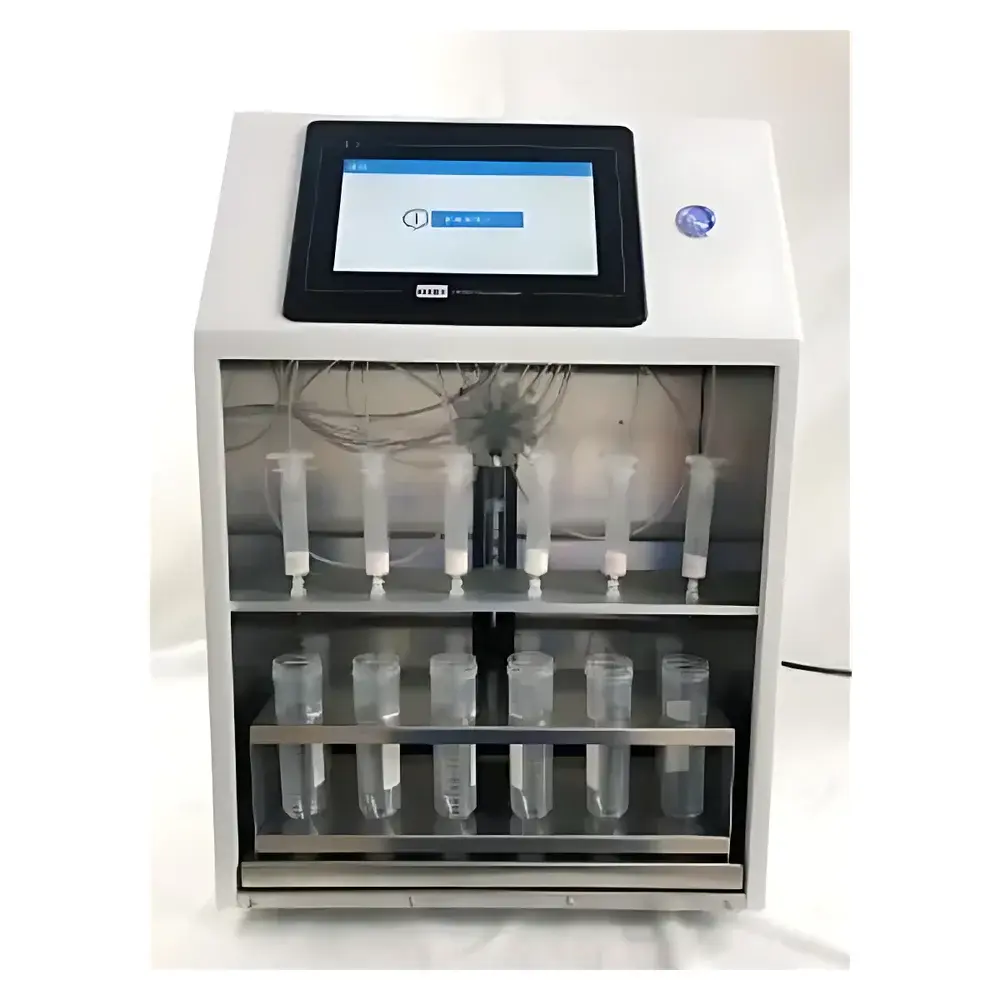
Chengmeng CM-SPE60 Fully Automated Solid Phase Extraction System
| Brand | Chengmeng |
|---|---|
| Origin | Beijing, China |
| Manufacturer Type | Authorized Distributor |
| Country of Origin | China |
| Model | CM-SPE60 |
| Automation Level | Fully Automated |
| Number of Channels | 6 |
| Extraction Format | Cartridge-Based SPE |
| Flow Rate Control | Precision Numerical-Controlled Pump (0–60 mL/min) |
| Solvent Selection | 8 Independent Solvent Reservoirs |
| Sample Capacity | 6 Positions |
| Sample Loading Volume | 1–60 mL (pressure-assisted up to 50 mL |
| Wetted Materials | PTFE, Chemically Resistant Tubing & Fittings |
| Flow Accuracy | ≤1% |
| Linearity (Speed vs. Flow) | R² ≥0.999 |
| Power Supply | 220 V / 50 Hz |
Overview
The Chengmeng CM-SPE60 Fully Automated Solid Phase Extraction System is an engineered solution for high-throughput, reproducible sample preparation in analytical laboratories. Built upon core principles of positive-pressure-driven solid-phase extraction, the system delivers precise, programmable control over all critical SPE steps—cartridge conditioning, sample loading, washing, elution, and post-run cleaning—without manual intervention. Unlike robotic-arm-based platforms, the CM-SPE60 employs a valve-switching fluidic architecture that minimizes dead volume, eliminates positional variability, and ensures consistent hydraulic performance across all six independent channels. This design directly supports method robustness required in regulated environments such as food safety testing, environmental monitoring, clinical toxicology, and pharmaceutical QC. The system is optimized for trace-level organic analyte isolation from complex matrices including water, soil extracts, biological fluids (serum, urine), beverages, and food homogenates—where matrix interference, low analyte concentration, and batch-to-batch reproducibility are primary analytical challenges.
Key Features
- Six parallel, pneumatically isolated SPE channels with independent flow control—enabling true concurrent processing without cross-channel interference.
- Positive-pressure sample introduction using a high-precision numerical-controlled syringe pump (0–60 mL/min range), ensuring stable flow profiles and superior recovery consistency (≤1% flow accuracy).
- Eight dedicated solvent reservoirs with chemically inert PTFE-compatible fluid paths, supporting multi-step gradient elution and rigorous column reconditioning protocols.
- Universal cartridge compatibility: accommodates 1 mL, 3 mL, 6 mL, and 12 mL SPE cartridges from major global suppliers (e.g., Waters, Agilent, Thermo Fisher), eliminating vendor lock-in.
- Integrated fast-concentration module (optional configuration) enables inline evaporation post-elution, reducing downstream LC-MS/MS analysis time.
- Full method programming via intuitive graphical software interface—including timed step sequencing, pause points, and conditional logic for adaptive protocol execution.
- Comprehensive hardware safeguards: real-time pressure monitoring with automatic shutdown above preset thresholds; temperature supervision of pump housing; leak detection via flow deviation alerts.
- Low-noise, energy-efficient DC motor drive and long-life chemically resistant tubing (resistant to acids, bases, chlorinated solvents, and oxidizers).
Sample Compatibility & Compliance
The CM-SPE60 supports a broad range of sample types—from clean aqueous standards to highly particulate or protein-rich biological matrices—through adjustable pressure limits and programmable flow ramping. Its modular cartridge holder accepts both standard polypropylene and stainless-steel SPE manifolds. All wetted surfaces comply with USP Class VI biocompatibility requirements and meet ISO 9001 manufacturing controls. While not pre-certified for FDA 21 CFR Part 11, the system’s audit-trail-capable software (with user authentication, electronic signatures, and immutable method logs) provides foundational infrastructure for GLP/GMP-aligned validation. It aligns with common method standards including EPA Method 508.1 (halogenated hydrocarbons in water), ASTM D7245 (pesticide residues in food), and ISO 17025-compliant laboratory SOP development.
Software & Data Management
The embedded Windows-based control software features drag-and-drop method builder, real-time flow/pressure visualization, and automated report generation (PDF/CSV). Preloaded application libraries include validated workflows for PAHs in wastewater, mycotoxins in grain, opioids in urine, and veterinary drug residues in milk. All method parameters—including solvent selection sequence, dwell times, flow rates, and cleaning cycles—are stored with version timestamps and user attribution. Raw system logs (including pump actuation events, valve position changes, and sensor readings) are exportable for internal QA review or external regulatory submission. Optional integration with LIMS via HL7 or REST API enables seamless sample tracking and result handoff.
Applications
- Environmental labs: extraction of PCBs, organochlorine pesticides, and perfluoroalkyl substances (PFAS) from surface water, groundwater, and sediment porewater.
- Clinical toxicology: cleanup of whole blood, plasma, and urine prior to GC-MS or LC-MS/MS quantification of benzodiazepines, amphetamines, and synthetic cannabinoids.
- Food safety: isolation of aflatoxins, ochratoxin A, and nitrofuran metabolites from cereals, meat, and dairy products.
- Pharmaceutical QC: removal of excipients and degradation products from tablet dissolution samples prior to HPLC assay.
- Research settings: fractionation of natural product extracts for bioactivity-guided isolation or metabolomic profiling.
FAQ
Does the CM-SPE60 support method validation under ISO/IEC 17025?
Yes—the system’s deterministic fluidic control, traceable calibration routines, and full audit logging support documentation required for method validation and uncertainty estimation.
Can I integrate third-party SPE cartridges with non-standard fittings?
Standard Luer-lock and 1/4-28 threaded interfaces are supported; custom adapters are available upon request for proprietary cartridge formats.
Is remote monitoring or unattended overnight operation possible?
Fully supported—system status, active method progress, and alarm conditions can be viewed via Ethernet-connected PC; built-in thermal and pressure safety interlocks permit extended无人值守 operation.
What maintenance intervals are recommended for pump tubing and valves?
PTFE-lined pump tubing is rated for ≥5,000 cycles at 30 mL/min; rotary valves require lubrication every 6 months under continuous use; full preventive maintenance checklist is provided in the service manual.
How does the system handle viscous or particulate-laden samples?
Pre-filtration is recommended for samples >5 µm particulate load; optional in-line filter holders (0.45 µm PTFE) can be installed upstream of each channel inlet.



