
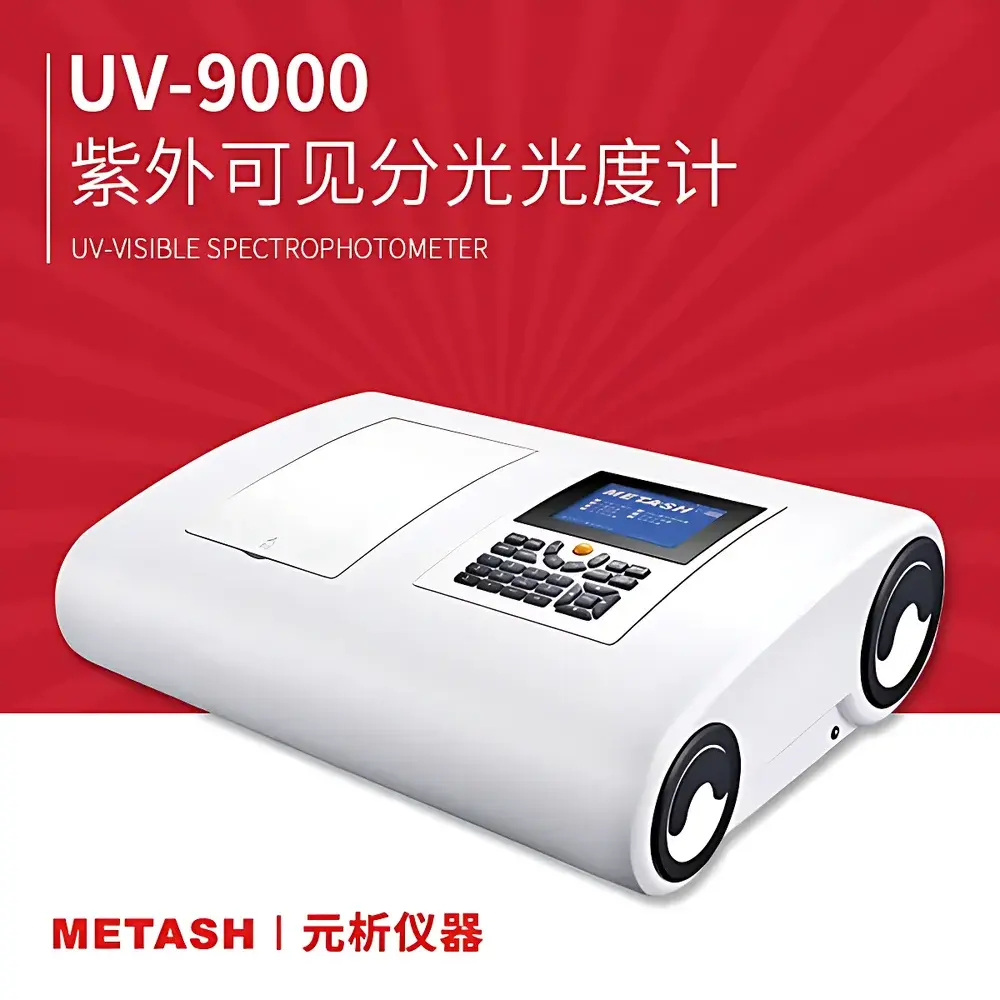
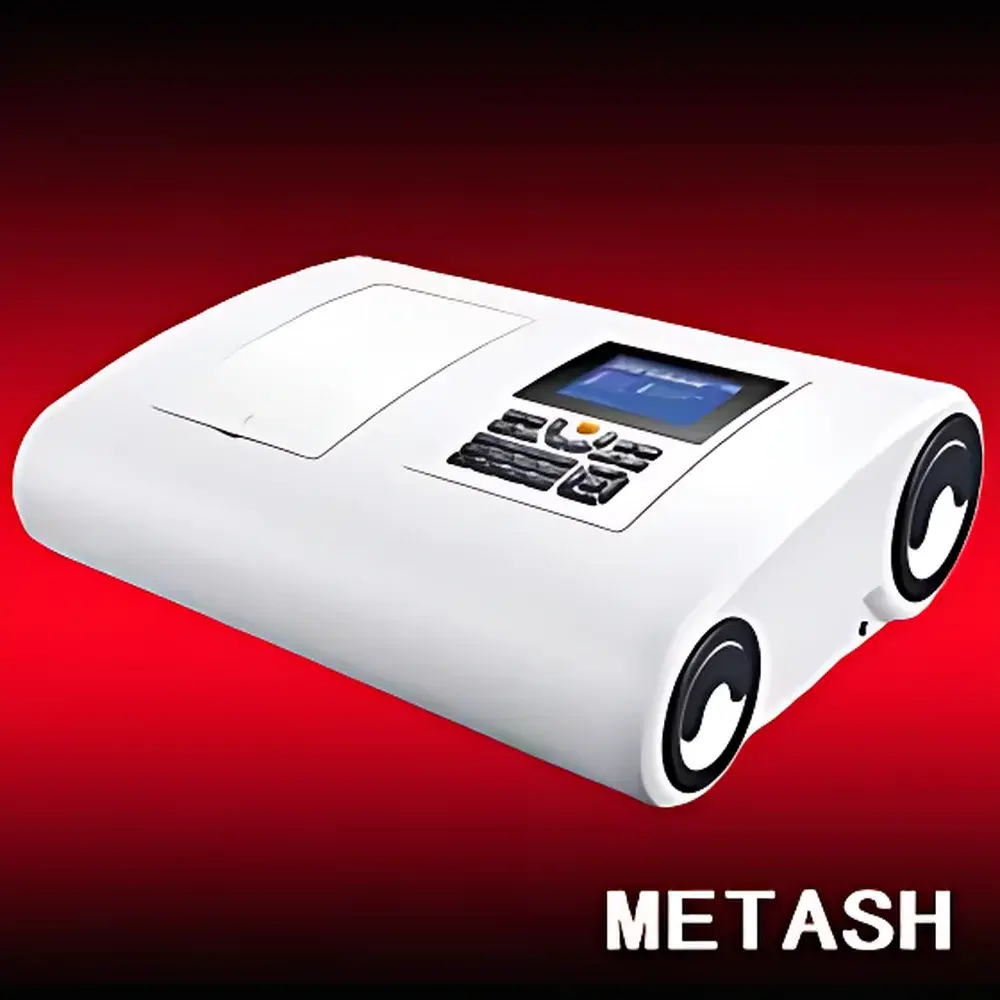
Metash UV-9000 Dual-Beam Ultraviolet-Visible Spectrophotometer
| Brand | Metash Instruments |
|---|---|
| Origin | Shanghai, China |
| Manufacturer Type | Original Equipment Manufacturer (OEM) |
| Product Category | Domestic |
| Model | UV-9000 |
| Price Range | USD 9,800–13,900 (FOB Shanghai) |
| Optical Configuration | Dual-beam |
| Detector Type | Silicon Photocell |
| Wavelength Range | 190–900 nm (extendable to 1100 nm with optional tungsten-halogen source) |
| Wavelength Accuracy | ±0.1 nm at D₂ line (656.1 nm), ±0.3 nm across full range |
| Spectral Bandwidth | 2 nm |
| Stray Light | ≤0.01% T (at 220 nm and 340 nm) |
| Wavelength Scanning Mode | Motorized automatic wavelength drive |
| Display | 6-inch full-color LED TFT LCD |
| Data Interface | USB 2.0 |
| Software Compliance | GLP/GMP-ready with user authentication, audit trail, electronic signature support (21 CFR Part 11 compatible configuration available) |
Overview
The Metash UV-9000 is a high-performance dual-beam ultraviolet-visible (UV-Vis) spectrophotometer engineered for precision absorbance, transmittance, and reflectance measurements in research laboratories, quality control environments, and regulatory-compliant analytical workflows. Its optical architecture employs a true split-beam design with independent reference and sample paths, enabling real-time compensation for source intensity drift, lamp aging, and environmental fluctuations—critical for long-duration kinetic studies and high-reproducibility quantitative assays. The instrument operates on the principle of Beer-Lambert law-based photometric analysis, utilizing a high-stability deuterium arc lamp for the UV region (190–350 nm) and a tungsten-halogen lamp for the visible-to-NIR region (350–900 nm, extendable to 1100 nm). All optical components—including the Czerny-Turner monochromator with imported holographic grating—are rigidly mounted on a 16 mm thick aerospace-grade aluminum optical baseplate, decoupling the optical train from mechanical vibration and thermal expansion effects inherent in conventional chassis designs.
Key Features
- Dual-beam optical system with real-time reference beam correction, ensuring baseline stability over extended measurement cycles (e.g., >4-hour kinetics or temperature-controlled scans)
- High-fidelity 6-inch color TFT LCD display with intuitive icon-driven interface—enabling standalone operation without PC connectivity for routine photometric and multi-point quantitative analyses
- Suspension-mounted optical assembly isolated from instrument housing, minimizing sensitivity to table vibration, air currents, and ambient thermal gradients
- Imported silicon photocell detector with low dark current and high linearity (R² > 0.9999 over 0–3.0 A), optimized for both high-transmittance and low-absorbance applications
- Holographic grating with enhanced UV throughput and reduced higher-order diffraction, directly contributing to the specified stray light performance of ≤0.01% T
- Motorized, micro-stepper-driven wavelength drive with encoder feedback for repeatable positioning accuracy within ±0.1 nm at calibration wavelengths
Sample Compatibility & Compliance
The UV-9000 accommodates standard 10 mm pathlength cuvettes (quartz, glass, or plastic), as well as specialized accessories including an automated 8-cell rotating sample changer, micro-volume cuvette holders (down to 50 µL), Peltier-controlled thermostatted cell holders (±0.1 °C stability), integrating spheres for diffuse reflectance (e.g., powder, film, or coated surface analysis), and specular reflectance attachments. All hardware and firmware comply with ISO/IEC 17025:2017 general requirements for testing laboratories. The system supports method validation per ICH Q2(R2) guidelines and is routinely deployed in pharmaceutical QC labs operating under USP , EP 2.2.25, and JP 17 standards. When configured with optional secure software modules, it meets FDA 21 CFR Part 11 requirements for electronic records and signatures, including role-based access control, immutable audit trails, and encrypted data storage.
Software & Data Management
The included Metash SpectraPro™ software is a Windows-based analytical platform supporting spectral acquisition, quantitative calibration (single/multi-point, standard addition), kinetic time-course modeling, DNA/RNA/protein concentration and purity assessment (A₂₆₀/A₂₈₀, A₂₆₀/A₂₃₀), multi-wavelength ratio analysis, and derivative spectroscopy. Raw absorbance data are stored in vendor-neutral CSV and JCAMP-DX formats; processed reports export to PDF with embedded metadata (operator ID, timestamp, instrument serial number, calibration status). The software enforces GLP/GMP operational discipline through mandatory user login, session logging, version-controlled method templates, and automatic archiving of all raw spectra with checksum verification. Optional network deployment allows centralized instrument monitoring and data aggregation across multi-site laboratory networks.
Applications
- Pharmaceutical: Assay of active pharmaceutical ingredients (APIs), excipient compatibility screening, dissolution profile monitoring, and stability-indicating method development
- Environmental: Quantification of nitrate, phosphate, heavy metals (via complexometric assays), and organic pollutants (e.g., phenols, PAHs) in water and soil extracts
- Life Sciences: Nucleic acid quantification and integrity assessment, enzyme kinetics (e.g., NADH/NADPH oxidation), protein-ligand binding studies, and cell culture density monitoring
- Materials Science: Thin-film thickness estimation via interference fringe analysis, bandgap determination of semiconductors, and optical density profiling of coatings
- Food & Beverage: Colorimetric analysis of pigments (anthocyanins, carotenoids), preservative concentration (sulfites, benzoates), and authenticity verification (e.g., honey adulteration)
FAQ
What is the maximum scan speed supported by the UV-9000?
The instrument achieves up to 3,000 nm/min scanning speed in rapid mode, with spectral resolution preserved at 2 nm bandwidth; slower speeds (e.g., 120 nm/min) are recommended for high-S/N applications requiring integration averaging.
Can the UV-9000 be integrated into a LIMS environment?
Yes—via its native TCP/IP and USB HID protocols, the UV-9000 supports bidirectional communication with major LIMS platforms using ASTM E1384 or HL7-compliant middleware; custom API integration is available upon request.
Is ozone generation a concern during UV operation below 200 nm?
No—while the deuterium lamp emits below 190 nm, the optical path is fully purged only when the optional purge gas module is installed; standard operation between 190–900 nm requires no external purge and generates negligible ozone in ambient lab conditions.
How often does the instrument require wavelength calibration verification?
Per ISO 17025 recommendations, wavelength accuracy should be verified daily using holmium oxide or didymium filters prior to critical measurements; full recalibration is advised every six months or after lamp replacement.
Does the software support compliance with 21 CFR Part 11 out-of-the-box?
The base software includes core features (audit trail, user roles, electronic signatures); full Part 11 compliance requires activation of the validated security module and completion of site-specific risk assessment documentation, provided in the IQ/OQ/PQ validation package.





