
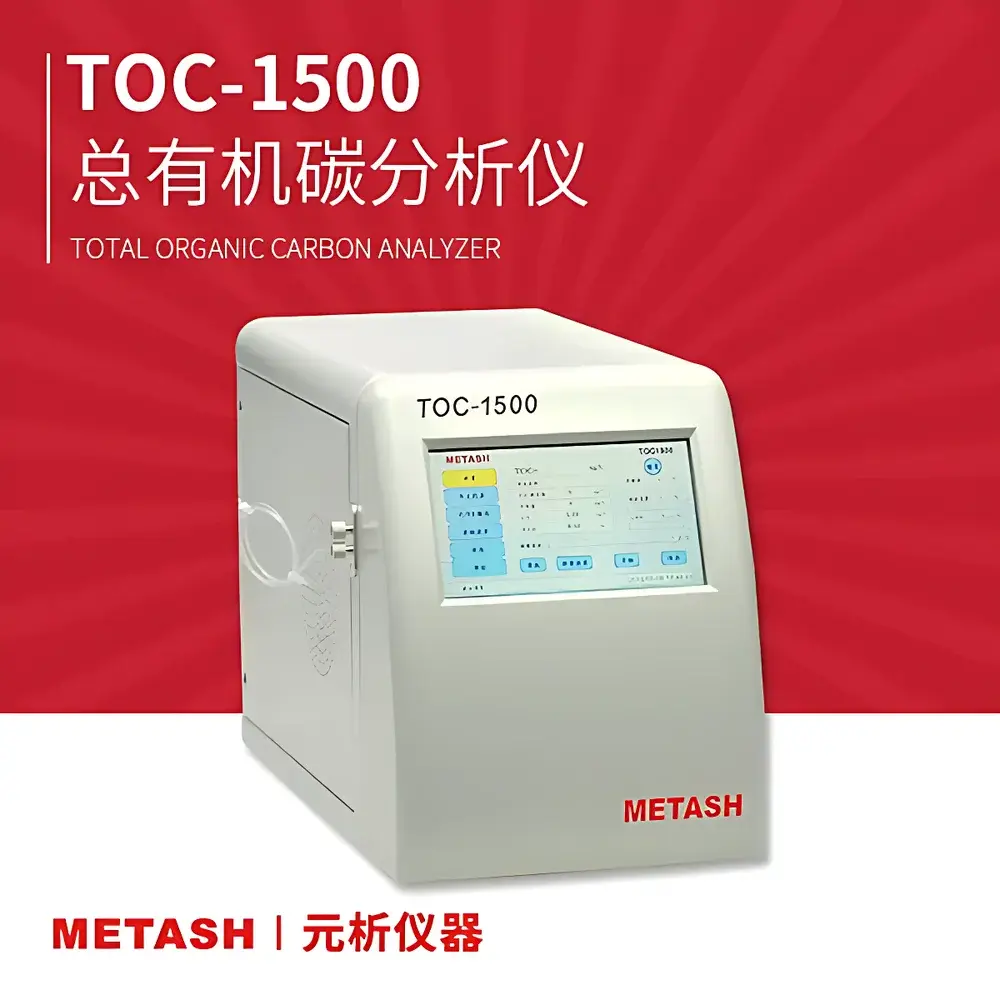
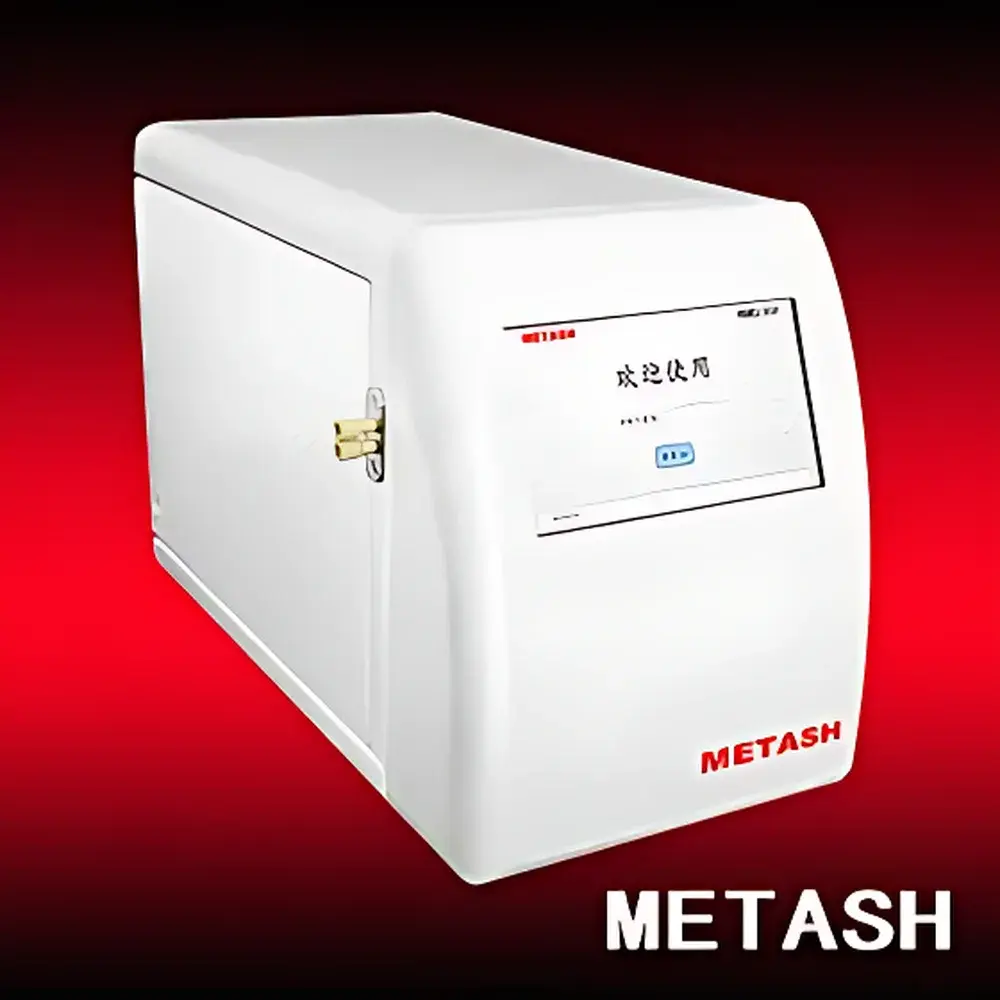
Metash TOC-1500 Total Organic Carbon Analyzer
| Brand | Metash Instruments |
|---|---|
| Origin | Shanghai, China |
| Manufacturer Type | Direct Manufacturer |
| Instrument Type | Laboratory TOC Analyzer |
| Model | TOC-1500 |
| Detection Principle | Direct Conductivity Detection |
| Oxidation Method | UV Photocatalytic Oxidation |
| Measurement Range | 0.001–1.5 ppm (as C) |
| Accuracy | ±3% of reading |
| Resolution | 0.001 ppb |
| Detection Limit | 1 ppb (as C) |
| Repeatability | ≤3% RSD |
| Display | 7-inch color touchscreen |
| Data Storage | 8 GB internal flash memory |
| Analysis Time | ≤3 minutes per sample |
| Compliance | USP <643>, CP 2025 Appendix IX Q, FDA 21 CFR Part 11 (audit trail & user authentication enabled) |
Overview
The Metash TOC-1500 is a laboratory-grade total organic carbon (TOC) analyzer engineered for high-precision quantification of trace-level organic contamination in ultrapure water systems, pharmaceutical process water, and clean utility streams. It employs direct conductivity detection following low-pressure ultraviolet (UV) photocatalytic oxidation—a reagent-free, non-invasive oxidation pathway that converts dissolved organic carbon (DOC) into CO₂, which is then measured as a change in solution conductivity. Unlike combustion-based or persulfate-oxidation TOC analyzers, the TOC-1500 eliminates requirements for acid reagents, metal catalysts, carrier gases, or high-temperature furnaces—reducing operational complexity, consumable costs, and long-term maintenance burden. Its design targets applications where regulatory compliance, measurement stability, and minimal system interference are critical—particularly in GMP-regulated environments such as biopharmaceutical manufacturing, sterile water-for-injection (WFI) validation, and semiconductor ultrapure water (UPW) monitoring.
Key Features
- UV photocatalytic oxidation at 185/254 nm wavelengths ensures complete mineralization of non-purgeable organic compounds without chemical additives or gas supply.
- Direct conductivity detection architecture provides inherent linearity across the 0.001–1.5 ppm TOC range, with sub-part-per-trillion resolution (0.001 ppb) and a validated method detection limit of 1 ppb (as carbon).
- 7-inch capacitive touchscreen interface supports intuitive workflow navigation, real-time status monitoring, and context-sensitive help—all accessible without external PC dependency.
- FDA 21 CFR Part 11-compliant software architecture includes role-based user authentication, electronic signatures, full audit trail logging (including parameter changes, calibration events, and data exports), and immutable record retention.
- Integrated acoustic alarm triggers upon exceeding user-defined TOC thresholds—preventing instrument overload and supporting proactive quality intervention.
- Modular mechanical design enables rapid field replacement of UV lamp, conductivity cell, and fluidic manifolds—minimizing downtime during routine service or component recalibration.
- Optional autosampler integration (up to 60 positions) supports unattended batch analysis with programmable sequence logic and sample dilution capability.
Sample Compatibility & Compliance
The TOC-1500 is validated for aqueous matrices with conductivity ≤5 µS/cm and total dissolved solids (TDS) < 10 ppm—making it suitable for purified water (PW), water-for-injection (WFI), and ultrapure water (UPW) per ASTM D5127, ISO 8573-7, and ICH Q5C guidelines. It meets system suitability criteria defined in United States Pharmacopeia (USP) and Chinese Pharmacopoeia (CP) 2025 Appendix IX Q for TOC determination in pharmaceutical water systems. All firmware and data handling routines comply with ALCOA+ principles (Attributable, Legible, Contemporaneous, Original, Accurate, Complete, Consistent, Enduring, Available) and support GLP/GMP audit readiness. No sample pretreatment—such as acidification or sparging—is required for standard operation.
Software & Data Management
Embedded firmware supports time-stamped data capture with automatic metadata tagging (operator ID, method name, calibration status, ambient temperature). Raw conductivity signals, calculated TOC values, and diagnostic logs are stored in encrypted binary format on the onboard 8 GB NAND flash—capable of retaining >10 years of continuous daily testing (assuming 50 samples/day). Data export is supported via USB 2.0 port using FAT32-formatted drives; users may filter and extract records by date range, sample ID, or event type. Optional Bluetooth 4.2 wireless printing enables direct thermal output of QC reports, calibration certificates, and system verification summaries—without network dependency or driver installation.
Applications
- Pharmaceutical water system validation and routine release testing (PW, WFI, pure steam condensate)
- Biotechnology upstream/downstream process water monitoring (buffer prep, CIP rinse water, column eluates)
- Semiconductor fab UPW loop surveillance and point-of-use verification
- Medical device cleaning validation and rinse water analysis
- Environmental lab certification of low-carbon reference standards and blank verification
- Academic research on carbon speciation kinetics in deionized water aging studies
FAQ
Does the TOC-1500 require periodic recalibration with certified reference standards?
Yes—daily system suitability testing with potassium hydrogen phthalate (KHP) or sucrose solutions is recommended per USP . Full calibration (span and zero) should be performed at least weekly or after maintenance.
Can the instrument detect TOC in saline or high-conductivity samples?
No—the TOC-1500 is optimized for low-conductivity matrices (<5 µS/cm). Saline, seawater, or wastewater samples require dilution or alternate oxidation/detection methods not supported by this platform.
Is the UV lamp life monitored automatically?
Yes—the firmware tracks cumulative UV exposure hours and alerts users when lamp output degradation exceeds 15%, prompting scheduled replacement to maintain oxidation efficiency.
What cybersecurity protocols are implemented for remote access?
The TOC-1500 does not support network connectivity or remote login. All data exchange occurs via physical USB media or Bluetooth peripherals—eliminating network attack vectors and aligning with ISA/IEC 62443-3-3 Level 1 requirements for standalone analytical instruments.







