
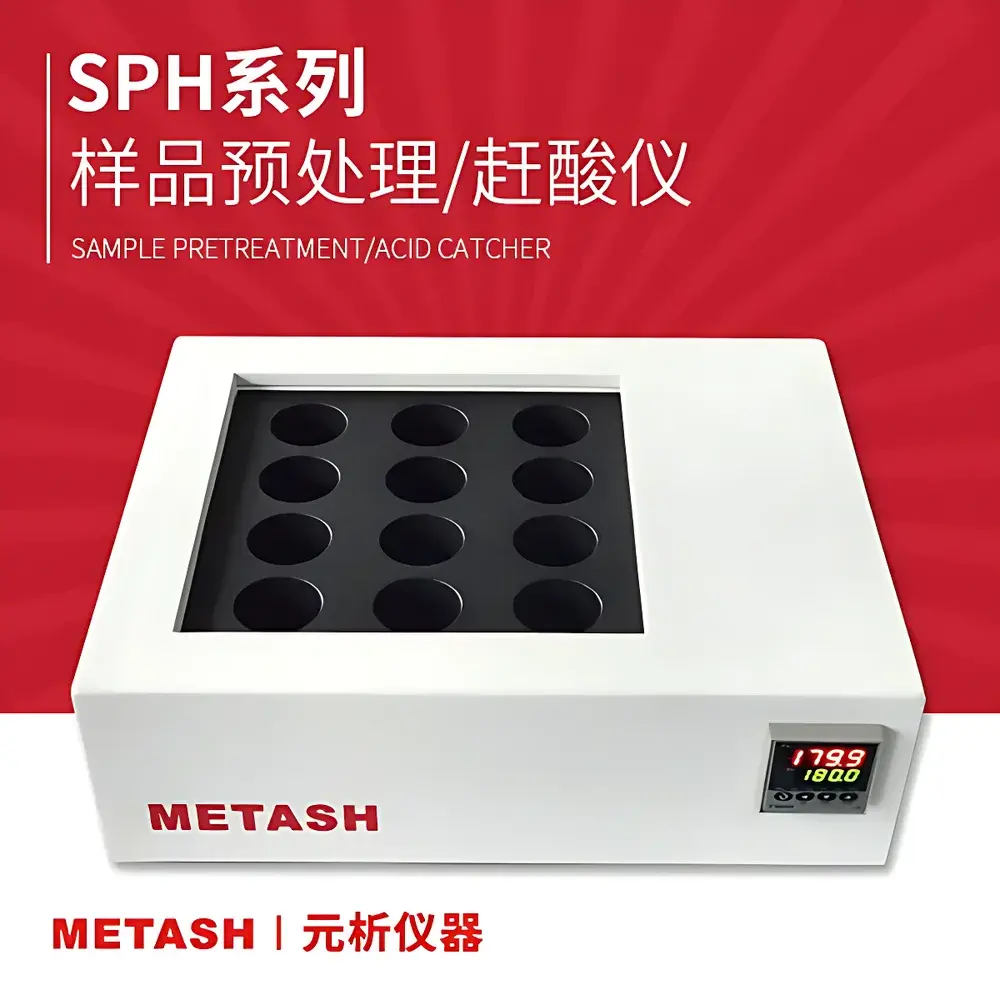
Metash SPH Series Microwave Digestion Auxiliary Hot Block System
| Brand | Metash Instruments |
|---|---|
| Origin | Shanghai, China |
| Manufacturer Type | Direct Manufacturer |
| Country of Origin | China |
| Model | SPH Series |
| Price Range | USD 7,000–14,000 (FOB Shanghai) |
| Cavity Rating | Industrial-Grade |
| Batch Capacity | 6 samples per run |
| Microwave Source | Single Magnetron (for paired MWD systems) |
| Max Operating Temperature | 250 °C / 300 °C (SPH-1/SPH-2 vs. SPH-3) |
| Max Pressure Tolerance (of compatible vessels) | 6 MPa |
| Heating Surface Coating | PFA (Perfluoroalkoxy) |
| Temperature Control | AI-enhanced PID with ramp/soak programming |
| Temp Resolution | 0.1 °C |
| Temp Accuracy | ±0.5 °C |
| Power Input | 1.6–2.0 kW |
| Weight | 13–39 kg |
| Power Supply | AC 220 V ±10% |
| Compatible Main Systems | MWD-500/520, MWD-630/Trump, MWD-700/750, MWD-800/850 |
Overview
The Metash SPH Series is an industrial-grade hot block system engineered specifically as a complementary unit for the Metash MWD series of closed-vessel microwave digestion instruments. It operates on the principle of precise, uniform conductive heating—distinct from microwave energy absorption—and serves two critical sequential roles in sample preparation workflows: pre-digestion open-vessel thermal conditioning and post-digestion acid removal (‘acid evaporation’ or ‘赶酸’). Unlike standalone microwave digesters, the SPH does not generate microwaves; instead, it delivers tightly regulated conductive heat to digestion vessels placed directly on its PFA-coated aluminum heating surface. This enables controlled thermal management of volatile, exothermic, or solvent-rich matrices—such as foodstuffs, cosmetics, biological tissues, and environmental sludges—prior to sealed high-pressure microwave irradiation. Its design ensures safe dissipation of reactive gases and low-boiling organic solvents before vessel sealing, thereby mitigating risks of over-pressurization, vessel rupture, and analyte loss during subsequent microwave steps.
Key Features
- Industrial-grade aluminum heating block with electrostatically applied PFA coating—resistant to HNO₃, HF, HCl, and aqua regia up to 300 °C, ensuring long-term corrosion resistance and minimal metal leaching.
- AI-optimized PID temperature control algorithm that dynamically adjusts proportional, integral, and derivative parameters in real time—reducing overshoot, improving thermal stability (<±0.5 °C), and enabling reproducible ramp/soak profiles across batches.
- Programmable heating slope control: users define linear or segmented temperature ramps (e.g., 5 °C/min to 120 °C, hold 15 min, then ramp to 250 °C), with digital display of setpoint, actual temperature, elapsed time, and remaining ramp duration.
- Dual operational mode support: open-vessel pre-treatment (e.g., gentle oxidation of organics, solvent evaporation) and post-digestion open-vessel acid fuming (HNO₃/HF removal prior to dilution and ICP-MS/AAS analysis).
- Integrated safety interlocks including over-temperature cutoff (>310 °C), audible/visual alarm activation, and automatic power disengagement upon lid removal or thermal anomaly detection.
Sample Compatibility & Compliance
The SPH Series accommodates standard digestion vessels used across the Metash MWD platform—including quartz, TF-PTFE, and reinforced PTFE-TFM tubes—with bore diameters ranging from Φ32 mm to Φ45 mm and depths up to 150 mm. It supports batch processing of 1–56 samples depending on model (SPH-1 to SPH-3), with optimized thermal uniformity across all positions (±1.2 °C at 250 °C). The system complies with ISO/IEC 17025:2017 requirements for equipment qualification in accredited testing laboratories. Its temperature calibration traceability aligns with NIST-traceable RTD standards, and its programmable protocols support audit-ready documentation for GLP and GMP environments. While not a standalone digestion device, its use is referenced in ASTM D5511 (solid waste digestion), USP (heavy metals), and EPA Method 3050B (acid digestion of sediments and soils) as a validated auxiliary step.
Software & Data Management
The SPH Series features a built-in microprocessor-based controller with non-volatile memory capable of storing up to 20 user-defined methods—including multi-step ramp/soak sequences, dwell times, and target temperatures. All parameters are entered via a tactile membrane keypad with LED backlighting and confirmed by real-time graphical feedback on a 128×64 pixel monochrome LCD. No external PC interface or proprietary software is required; however, optional RS-485 serial output (with Modbus RTU protocol) enables integration into centralized laboratory information management systems (LIMS) for automated log export and electronic record retention compliant with FDA 21 CFR Part 11 (when paired with validated LIMS infrastructure). Audit trails—including method execution timestamps, operator ID entry, and deviation alerts—are retained locally for ≥3 months.
Applications
- Pre-digestion thermal stabilization of high-fat or high-sugar food matrices (e.g., chocolate, dairy, confectionery) to prevent violent foaming during microwave pressurization.
- Volatile organic solvent removal (e.g., ethanol, acetone, chloroform) from pharmaceutical excipients or herbal extracts prior to closed-vessel digestion.
- Controlled decomposition of polymeric or composite materials (e.g., plastics, textiles, electronic waste) where rapid microwave energy coupling poses safety or reproducibility challenges.
- Post-digestion HNO₃/HF fuming for residual acid elimination—critical for low-background trace metal analysis by ICP-MS, especially for Si, B, Ti, and Zr quantification.
- Method development support for labs transitioning from open-vessel hot plate digestion to automated microwave platforms, providing a bridge for process validation and operator training.
FAQ
Is the SPH Series a microwave digestion instrument?
No. It is a conductive hot block system designed exclusively for open-vessel thermal conditioning and acid evaporation—it does not emit microwaves and must be used in conjunction with a compatible Metash MWD-series microwave digester.
Can the SPH be used independently of Metash microwave systems?
Yes, provided users supply compatible digestion vessels and validate thermal profiles against their analytical requirements; however, full method compatibility, safety interlocks, and vessel-specific temperature/pressure coordination are guaranteed only when paired with designated MWD models.
What calibration documentation is supplied?
Each unit ships with a factory calibration certificate referencing NIST-traceable Pt100 RTD standards, including as-tested accuracy data at 100 °C, 200 °C, and 250 °C, plus uncertainty budgets per ISO/IEC 17025 Annex A.
Does the PFA coating require periodic reapplication?
No. The electrostatically bonded PFA layer is rated for continuous operation up to 300 °C and exhibits no measurable degradation after 5,000+ thermal cycles under routine use with mineral acids.
How is temperature uniformity verified across the block?
Metash performs 9-point thermal mapping (per ASTM E220) during final QA, with results documented in the unit’s Certificate of Conformance—available upon request.



