
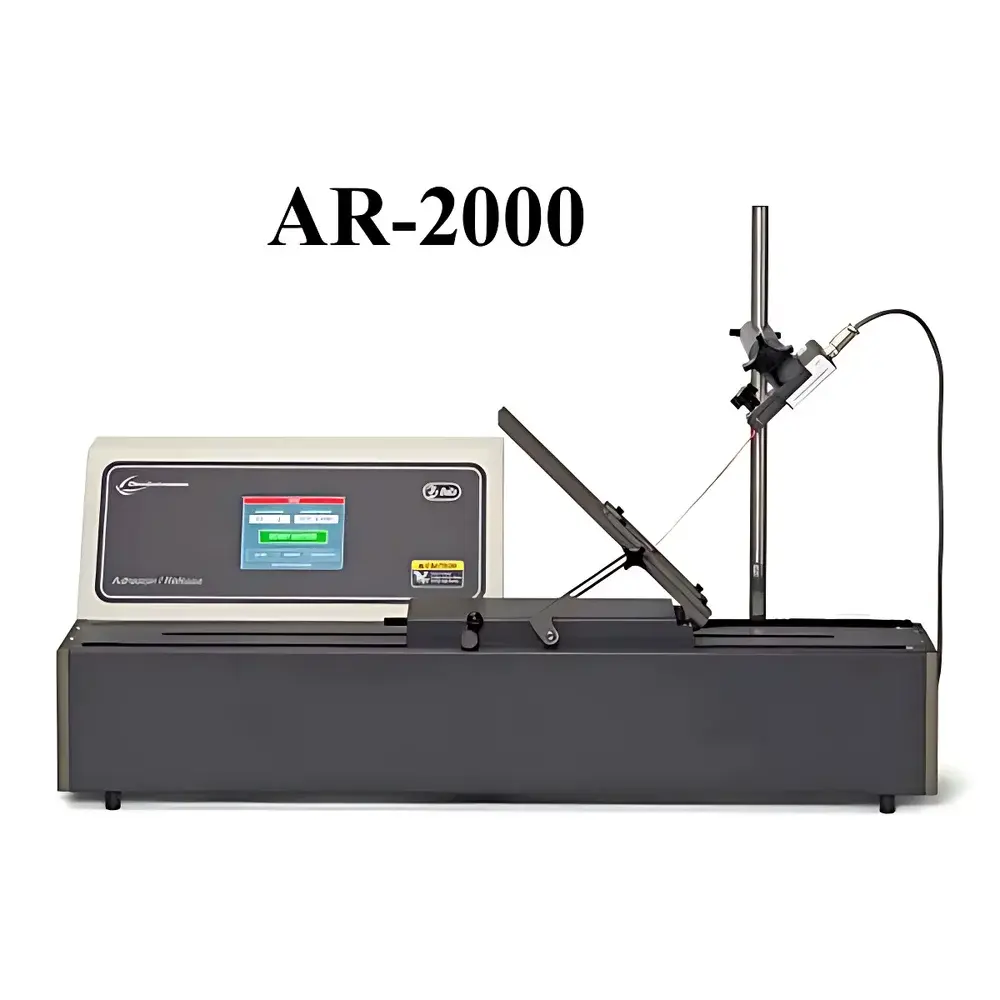
Yuelian AR-2000 Universal Adhesion and Peel Tester
| Brand | Yuelian |
|---|---|
| Origin | USA |
| Manufacturer Type | Authorized Distributor |
| Origin Category | Imported Instrument |
| Model | AR-2000 |
| Pricing | Available Upon Request |
| Display | 5.7-inch full-color touchscreen interface |
| Speed Range | 1–1200 ipm (3–3048 cpm) with encoder-based digital speed control |
| Peel Angle Selection | 90°, 180° (standard), with optional custom-angle fixtures |
| Load Cell Options | 2 lb, 5 lb, 10 lb, or 25 lb (±0.1% full-scale accuracy) |
| Specimen Length Range | 0.5" to 12" (12.7 mm to 305 mm) |
| Operating Temperature | 0°C to 70°C (32°F to 150°F) |
| Power Input | 220 VAC, 50/60 Hz |
| Dimensions (H×W×D) | 61 cm × 91 cm × 33 cm |
| Weight | 42 kg |
| Compliance Standards | PSTC-101 (A–F), PSTC-4, PSTC-15, PSTC-55, ASTM D3330, TLMI L-IA1/L-IA2/L-IA3, AFERA 4001 R11, FINAT FTM 1–6, FTM 10, FTM 11 |
| Data Interface | USB 2.0 for EZ-Date software integration |
| Standalone Operation | Yes — fully functional via onboard touchscreen without PC |
Overview
The Yuelian AR-2000 Universal Adhesion and Peel Tester is an engineered precision instrument designed for quantitative measurement of peel adhesion, tack, and shear resistance in pressure-sensitive tapes, labels, laminates, medical adhesives, and flexible packaging materials. Built upon the proven mechanical architecture of the AR-1000 platform and enhanced with modern human-machine interface (HMI) and closed-loop motion control, the AR-2000 operates on the fundamental principle of controlled-force tensile separation—where a defined specimen is peeled from a standardized substrate at a specified angle and constant linear velocity. Its metrological design adheres to the physical constraints and procedural rigor outlined in internationally recognized test standards, enabling traceable, repeatable, and auditable results in both laboratory and production-floor environments.
Key Features
- 5.7-inch high-resolution color touchscreen with intuitive icon-driven navigation—enabling full instrument configuration, test execution, real-time force/velocity profiling, and pass/fail evaluation without external computing hardware
- Robust cast-aluminum frame and industrial-grade linear motion system engineered for long-term stability under continuous operation in ambient manufacturing conditions (including elevated humidity and particulate exposure)
- Digital speed control with optical encoder feedback ensures velocity deviation ≤ ±0.2% across the full 1–1200 ipm range, critical for compliance with PSTC-101 Method B (constant-speed peel) and ASTM D3330 Section 7.2
- Selectable peel angles (90° and 180°) implemented via precision-machined fixture mounts; optional angular adapters available for specialized configurations per FINAT FTM 2 or TLMI L-IA3 requirements
- Interchangeable load cells (2, 5, 10, or 25 lb capacity) calibrated to NIST-traceable standards, delivering resolution down to 0.005% FS and accuracy within ±0.1% of full scale per ISO/IEC 17025-accredited calibration protocols
- Onboard data logging with timestamped force vs. displacement curves; internal memory stores ≥500 test records with metadata (operator ID, date/time, method ID, specimen ID)
Sample Compatibility & Compliance
The AR-2000 accommodates specimens ranging from 12.7 mm to 305 mm in length and up to 50 mm in width—sufficient for standard PSTC-101 strips, ASTM D3330 Type I specimens, and FINAT FTM 1–6 test coupons. Substrate compatibility includes stainless steel, glass, polyethylene terephthalate (PET), and aluminum foil—each prepared per respective standard surface energy and cleaning protocols. The system supports all major international peel test methodologies: PSTC-101 (A–F), PSTC-4 (loop tack), PSTC-15 (rolling ball tack), PSTC-55 (low-speed peel), ASTM D3330 (180° peel), TLMI L-IA1–L-IA3 (label adhesion on cylindrical surfaces), AFERA 4001 R11 (adhesive classification), and FINAT FTM 1–6, 10, and 11 (tack, peel, and shear performance). All test sequences are programmable to enforce strict adherence to dwell time, pre-peel tension, and separation rate parameters mandated by each standard.
Software & Data Management
Data acquisition and reporting are managed through EZ-Date—a Windows-based software suite compliant with FDA 21 CFR Part 11 requirements for electronic records and signatures. EZ-Date provides audit trail functionality (user action logging, timestamped edits, immutable record archiving), customizable report templates aligned with GLP/GMP documentation workflows, and statistical process control (SPC) charting for trend analysis across batches or shifts. Raw force-displacement datasets export in CSV and XML formats for integration into LIMS or enterprise QA systems. USB 2.0 connectivity enables secure, one-way data transfer—no remote access or network exposure—ensuring data integrity and cybersecurity compliance per ISO/IEC 27001 guidelines.
Applications
- Quality assurance of pressure-sensitive adhesives in tape, label, and graphic film manufacturing
- R&D validation of new adhesive formulations against target peel strength and cohesive failure thresholds
- Regulatory submission support for medical device transdermal patches (ISO 25537, ASTM F2255)
- Process capability studies in converting operations—correlating peel values with coating weight, cure energy, and liner release characteristics
- Supplier qualification testing per contractual specifications referencing PSTC, ASTM, or FINAT methods
- Root cause analysis of delamination failures in multilayer flexible packaging structures
FAQ
Is the AR-2000 validated for use in regulated pharmaceutical or medical device environments?
Yes—the instrument’s mechanical design, calibration traceability, and EZ-Date software architecture support IQ/OQ/PQ validation protocols aligned with ISO 13485 and FDA 21 CFR Part 11. Documentation packages include URS, FRS, and test scripts for GxP audits.
Can the AR-2000 perform loop tack or rolling ball tack tests?
Yes—when equipped with the optional loop tack fixture (PSTC-4) or rolling ball apparatus (PSTC-15), the AR-2000 executes both methods using its programmable speed control and integrated load cell.
What maintenance intervals are recommended for long-term accuracy?
Annual NIST-traceable load cell recalibration and biannual verification of encoder linearity and peel angle alignment are recommended. Preventive maintenance logs are auto-generated in EZ-Date.
Does the system support multi-language user interfaces?
The touchscreen UI is English-only by default; however, EZ-Date software supports localized language packs (German, French, Japanese, Chinese) for report generation and metadata entry.
Is third-party calibration certification included with purchase?
Each unit ships with a factory-issued calibration certificate compliant with ISO/IEC 17025, including as-found/as-left data, uncertainty budgets, and reference standard traceability statements.



