
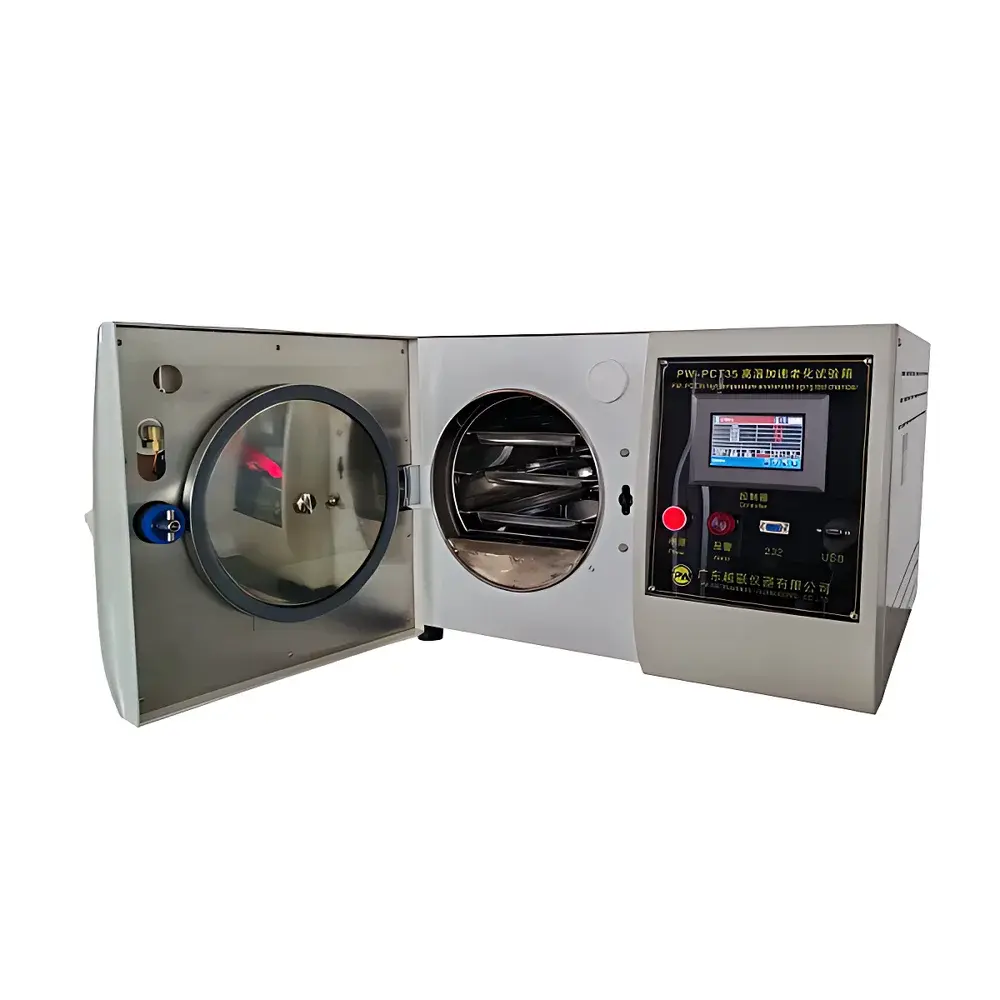
Yuelian PW-PCT35 High-Temperature Pressure Cooker-Type Accelerated Aging Test Chamber
| Brand | Yuelian / PW |
|---|---|
| Origin | Guangdong, China |
| Manufacturer Type | Authorized Distributor |
| Product Category | Domestic |
| Model | PW-PCT35 |
| Max Operating Temperature | ≤150 °C |
| Internal Chamber Dimensions (Ø×D) | 260 mm × 400 mm |
| External Dimensions (W×D×H) | 660 mm × 620 mm × 420 mm |
| Weight | ~120 kg |
| Pressure Range | 0.0–3.0 kg/cm² (Safety Limit: 3.5 kg/cm²) |
| Temperature Range | 100–132 °C (Saturated Steam) |
| Humidity | 100 % RH |
| Power Supply | AC 220 V, 50/60 Hz, 25 A |
| Temperature Uniformity | ±2.0 °C |
| Ramp Time (RT → 132 °C) | ≤35 min (at control point) |
| Pressurization Time (0 → 2.0 kg/cm²) | ≤45 min |
| Timer Range | 0–999 h |
Overview
The Yuelian PW-PCT35 High-Temperature Pressure Cooker-Type Accelerated Aging Test Chamber is a precision-engineered environmental stress test system designed to simulate accelerated thermal-humidity-pressure aging conditions in accordance with industry-standard reliability protocols for electronic components, polymer packaging, PCB laminates, and moisture-sensitive devices. It operates on the principle of saturated steam pressurization—leveraging elevated temperature and pressure to drive rapid moisture ingress into materials, thereby accelerating hydrolytic degradation mechanisms such as delamination, wire bond corrosion, and popcorning failure modes. Unlike ambient-pressure ovens, the PW-PCT35 maintains full saturation at temperatures up to 132 °C under controlled overpressure (up to 3.0 kg/cm²), enabling reproducible exposure profiles aligned with JEDEC JESD22-A102, MIL-STD-883 Method 1030, and IPC/JEDEC-95 standards. Its robust stainless-steel chamber, integrated water-level monitoring, and dual-stage safety interlocks ensure operational integrity during extended high-stress testing cycles.
Key Features
- Stainless-steel cylindrical chamber (Ø260 mm × 400 mm depth) optimized for uniform steam distribution and minimal thermal gradient.
- Microprocessor-based PID temperature & pressure controller with real-time digital display of setpoint, actual value, elapsed time, and residual pressure.
- Dual safety architecture: mechanical pressure relief valve (calibrated at 3.5 kg/cm²) + electronic over-temperature cutoff (activated upon deviation >±5 °C from setpoint).
- Interlocked manual door mechanism—physically prevents opening during pressurized operation; requires pressure decay to 0 kg/cm² before release.
- Low-water-level detection with audible alarm and automatic heating element shutdown to prevent dry-run damage.
- Programmable timer (0–999 hours) supporting two operational modes: full depressurization cycle (Mode 1) and pressure-retained termination (Mode 2) for sequential test staging.
- Preheating sequence logic ensures stable steam generation prior to test initiation—typical warm-up to 132 °C and 2.0 kg/cm² takes ≤35 min and ≤45 min respectively.
Sample Compatibility & Compliance
The PW-PCT35 accommodates standard JEDEC trays, component reels, bare die wafers (in carrier frames), and encapsulated modules within its cylindrical chamber. Samples must be non-volatile, non-flammable, and compatible with saturated steam environments. The chamber meets essential requirements for GLP-compliant aging validation when used with documented SOPs and calibration traceability. While not inherently 21 CFR Part 11 compliant, its data logging capability (via optional RS485 interface or external recorder) supports audit-ready documentation when paired with validated software systems. It conforms to mechanical safety provisions of IEC 61010-1 and thermal stability criteria per ISO 17025 clause 5.4.2 for environmental test equipment. Users are advised to validate chamber performance annually using NIST-traceable PT100 probes and calibrated pressure transducers.
Software & Data Management
The PW-PCT35 operates via embedded firmware without proprietary PC software. All operational parameters—including temperature setpoint, pressure target, soak duration, and cycle count—are configured directly on the front-panel keypad. Real-time status indicators (power, heating, pressure build-up, alarm, completion) provide immediate visual feedback. For regulatory traceability, users may integrate optional analog output signals (0–5 V or 4–20 mA) into third-party SCADA or LIMS platforms. When deployed in QA/QC laboratories, it supports manual logbook entries aligned with ASTM E29 or ISO/IEC 17025 record retention policies. Calibration certificates, maintenance logs, and operator training records should be retained for minimum five years to satisfy internal audit and supplier qualification requirements.
Applications
- Reliability screening of plastic-encapsulated microcircuits (PEMs) per JEDEC J-STD-020 and JESD22-A102 (Pressure Cooker Test).
- Moisture sensitivity level (MSL) classification and floor-life validation for surface-mount devices.
- Accelerated aging of conformal coatings, potting compounds, and adhesive bonds in automotive electronics.
- Qualification testing of medical device housings and sterilizable polymer assemblies.
- Failure analysis root-cause correlation between moisture-induced defects and package architecture (e.g., mold compound hygroscopicity, leadframe plating integrity).
FAQ
What type of water is recommended for operation?
Distilled or reverse-osmosis (R.O.) water is strongly recommended to minimize mineral scale buildup in the steam generator and extend heater service life.
Can the chamber be operated without reaching full pressure?
Yes—users may configure lower pressure targets (e.g., 1.0–2.0 kg/cm²) to match specific test standards or material tolerances, provided temperature remains within the saturated steam curve.
How is safety ensured during manual venting?
The manual exhaust valve is positioned outside the door seal zone and features tactile feedback and flow restriction to prevent uncontrolled pressure release; operators must wear heat-resistant gloves and eye protection during post-cycle venting.
Is periodic calibration required?
Yes—temperature and pressure sensors should be verified annually against certified references; chamber uniformity mapping is recommended every six months for critical qualification runs.
What happens if power fails mid-cycle?
The unit retains last-set parameters upon power restoration but does not auto-restart; all active cycles must be manually reinitiated after confirming safe chamber conditions.



