
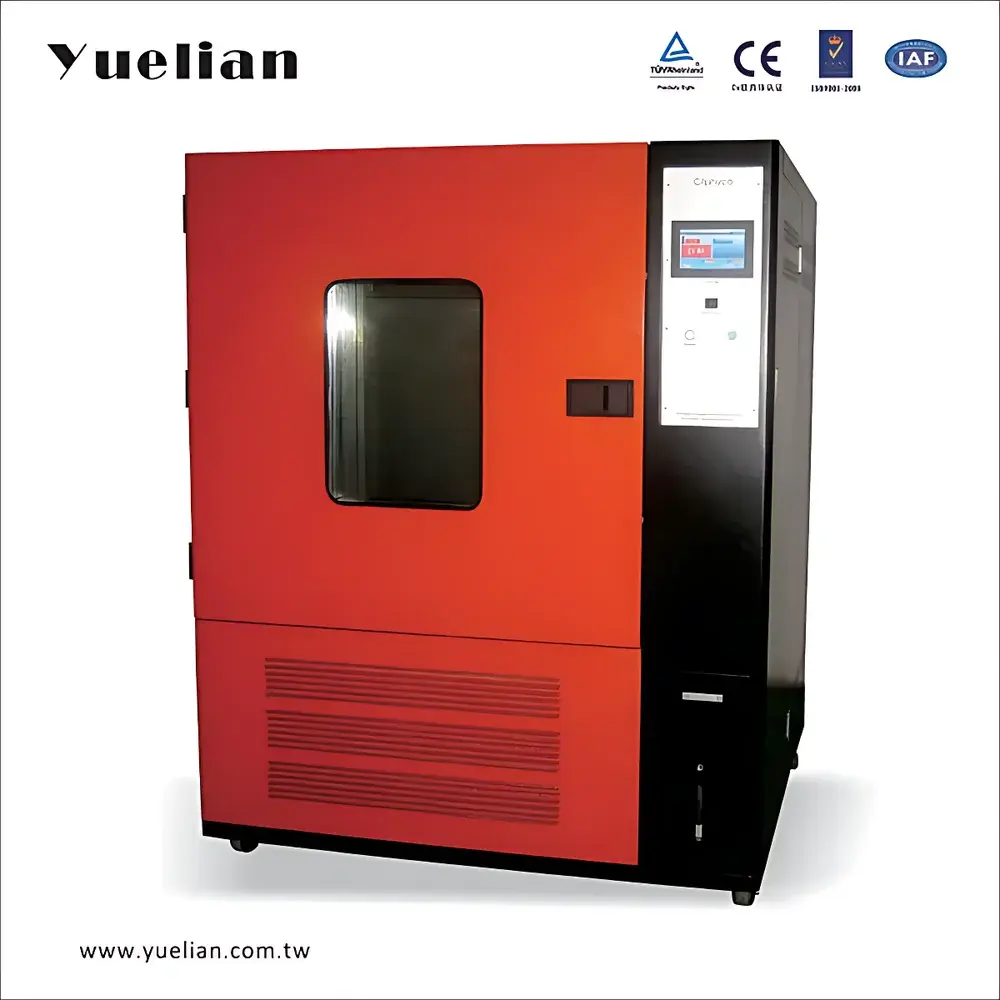
Yuelian TS-150 Temperature and Humidity Controlled Environmental Test Chamber
| Brand | Yuelian |
|---|---|
| Origin | Guangdong, China |
| Model | TS-150 |
| Internal Dimensions (W×H×D) | 50×60×50 cm |
| External Dimensions (W×H×D) | 103×141×91 cm |
| Capacity | 150 L |
| Temperature Range | −70 °C to +150 °C |
| Humidity Range | 20–98 % RH (optional low-humidity configuration down to 5 % RH) |
| Temperature Uniformity | ±0.5 °C |
| Humidity Uniformity | ±3 % RH |
| Temperature Stability | ±0.3 °C |
| Humidity Stability | ±2.5 % RH |
| Heating Rate | −70 °C → 100 °C in ≈60 min |
| Cooling Rate | 20 °C → −70 °C in ≈90 min |
| Control System | PID + SSR/SCR bidirectional output with slope logic |
| Programmable Memory | 150 programs × 1500 segments |
| Cycle Capability | 9999 cycles × 999 repeats, subdivisible into 5 independent partial cycles |
| Safety Monitoring | 15-point real-time system diagnostics with fault logging |
| Refrigeration | Twin-stage air-cooled system (R404A/R507) with oil separation |
| Humidification | Surface evaporation type with auto-recirculating pure-water generation |
| Construction | SUS#304 stainless steel interior and exterior |
| Compliance | Designed for ASTM D4332, ISO 22068, IEC 60068-2-1/2/14/30, GB/T 10586, and GLP-aligned validation readiness |
Overview
The Yuelian TS-150 Temperature and Humidity Controlled Environmental Test Chamber is an engineered platform for precise, repeatable simulation of climatic stress conditions during material qualification, product reliability testing, and accelerated aging studies. Built upon dual-stage refrigeration architecture and microprocessor-based climate control, it delivers stable, traceable thermal and hygrothermal environments across a wide operational envelope—from deep-freeze (−70 °C) to high-temperature bake (+150 °C), and from low-humidity desiccation (down to 5 % RH, optional) to near-saturation (98 % RH). Its design adheres to the fundamental principles of thermodynamic equilibrium and psychrometric control, enabling reproducible exposure profiles essential for compliance-driven testing in electronics, aerospace components, pharmaceutical packaging, automotive interiors, and food-grade materials.
Key Features
- Robust dual-stage air-cooled refrigeration system utilizing environmentally compliant R404A/R507 refrigerants and Tecumseh (France) compressors—engineered for long-term reliability and efficient oil management.
- PID + SSR/SCR bidirectional temperature/humidity control with advanced slope logic, supporting both rapid ramping and finely graded transitions between setpoints.
- 150-program × 1500-segment programmable controller with 9999 × 999 cycle capability; supports nested, conditional, and partial-cycle sequencing for complex test protocols.
- High-integrity chamber construction: full SUS#304 stainless steel interior and exterior walls; multi-layer insulation comprising mineral wool and rigid polyurethane foam for minimized thermal bridging and energy loss.
- Integrated pure-water generation system eliminates manual refilling—accepts municipal tap water input and automatically produces deionized water for humidification, with real-time low-water and overheat protection.
- Triple-layer anti-fog observation window with embedded heating element and high-lumen fluorescent lighting ensures unobstructed visual monitoring under all operating conditions.
- Comprehensive safety architecture: 15-point real-time diagnostics covering compressor overload, refrigerant pressure anomalies, temperature excursions, power failure, door interlock, and heater overtemperature—with timestamped fault logging and actionable remediation guidance.
Sample Compatibility & Compliance
The TS-150 accommodates diverse sample geometries via its 150 L internal volume (50 × 60 × 50 cm) and configurable stainless-steel shelving (two adjustable trays standard). It supports non-intrusive through-chamber access via a 50 mm diameter test port and maintains integrity during extended-duration tests (up to 9999 cycles). The chamber meets structural and performance criteria referenced in ASTM D4332 (conditioning of plastics), ISO 22068 (environmental testing of automotive components), IEC 60068-2-1 (cold), -2 (dry heat), -14 (change of temperature), and -30 (damp heat, cyclic), as well as Chinese national standard GB/T 10586. Its control firmware and data handling architecture are structured to support GLP-compliant validation—including audit trails, user access levels, and electronic signature readiness per FDA 21 CFR Part 11 when integrated with validated software platforms.
Software & Data Management
The embedded controller provides local real-time display of chamber status, active program phase, deviation alarms, and historical trend graphs (temperature/humidity vs. time). RS-232 serial interface enables bidirectional communication with external PCs running third-party data acquisition or LIMS-compatible applications. Optional Ethernet expansion supports Modbus TCP or custom API integration for centralized lab-wide environmental monitoring. All logged data—including setpoint history, actual readings, alarm events, and diagnostic codes—is time-stamped with millisecond resolution and exportable in CSV format. No proprietary runtime licenses or cloud dependencies are required; raw data remains fully owned and controllable by the end user.
Applications
- Accelerated life testing of polymer seals, gaskets, and encapsulants under combined thermal cycling and humidity ingress.
- Stability assessment of medical device packaging per ISO 11607, including peel strength degradation and moisture vapor transmission rate (MVTR) correlation.
- Qualification of printed circuit board assemblies (PCBAs) per IPC-9701, particularly for solder joint fatigue under thermal-hygric stress.
- Validation of food contact materials’ dimensional stability and barrier performance under tropical or arid simulated storage conditions.
- Pre-conditioning of lithium-ion battery cells prior to electrochemical characterization, following UN 38.3 Section 4.1 thermal abuse protocols.
- Material compatibility screening for aerospace composites exposed to ground-hold and flight-deck environmental profiles.
FAQ
What is the standard temperature and humidity recovery time after door opening?
Recovery to ±0.5 °C and ±3 % RH from a 30-second door opening at 25 °C / 60 % RH typically requires ≤8 minutes, verified per IEC 60068-3-5.
Can the TS-150 be validated for IQ/OQ/PQ protocols?
Yes—the chamber’s mechanical design, sensor placement (calibration-ready Pt100 RTDs), and controller architecture comply with GAMP5 Category 3 requirements; documentation packages and calibration certificates are available upon request.
Is remote monitoring supported without additional hardware?
RS-232 connectivity is standard; Ethernet or Wi-Fi modules are optional add-ons requiring separate configuration and network integration.
Does the unit meet CE or UKCA marking requirements?
The TS-150 conforms to the EMC Directive 2014/30/EU and Low Voltage Directive 2014/35/EU; CE marking is applied post-factory conformity assessment—UKCA equivalency may be issued under mutual recognition agreements.
What maintenance intervals are recommended for long-term operation?
Compressor oil inspection every 24 months; refrigerant leak check annually; humidifier tank cleaning quarterly; filter replacement biannually—full schedule provided in the operator manual.



