
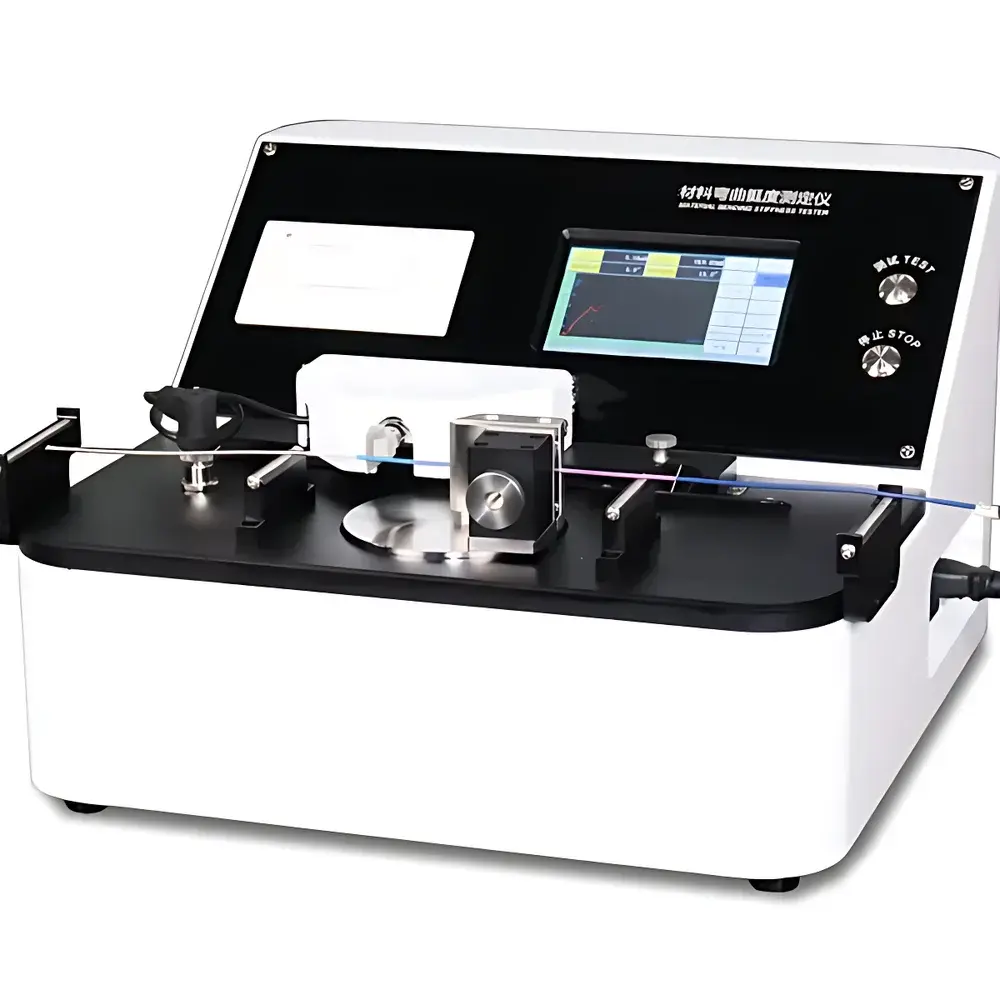
YueLian PW-6605 Static Bending Stiffness Tester for Paper and Paperboard
| Brand | YueLian / PW |
|---|---|
| Origin | Guangdong, China |
| Manufacturer Type | Authorized Distributor |
| Origin Category | Domestic (China) |
| Model | PW-6605 |
| Quotation | Available Upon Request |
| Measurement Range | Torque (0–500) mN·m, Force (0–10,000) mN |
| Accuracy | ±0.1% |
| Span Adjustment | 8 discrete spans (5, 10, 15, 20, 25, 30, 40, 50 mm) |
| Specimen Dimensions | Compatible with both legacy (38 × 70 mm) and updated standard (38 × 80 mm) |
| effective measurement length | 38 × 50 mm |
| Resolution | Force 0.01 mN, Angular 0.1° |
| Self-Calibration | Supported with included calibration weights and tools |
| Angular Velocity Control | 0.5–1000 °/min (adjustable) |
| Bending Duration | Programmable from 5–35 s |
| Bending Angle | Continuously adjustable from 1° to 92° |
| Interface | 5-inch or 7-inch capacitive touchscreen with hierarchical menu navigation |
| Sensor Interchangeability | Tool-free quick-swap sensor module |
| Thermal Printer | Integrated modular thermal printer |
| Overall Dimensions | 350 × 330 × 350 mm (W × D × H) |
| Optional PW-601 Precision Sampling Cutter | Specimen size 80 × 38 mm |
| blade material | Mo-V alloyed chromium steel, wire-EDM cut + CNC precision grinding + triple high-temp quenching |
Overview
The YueLian PW-6605 Static Bending Stiffness Tester is an electromechanical instrument engineered for the precise quantification of bending resistance—commonly referred to as “stiffness”—in planar sheet materials under controlled angular displacement. It operates on the principle of static beam deflection, applying a defined moment about a fixed support span while measuring the resulting reaction torque and angular displacement in accordance with standardized cantilever or two-point bending configurations. This method aligns with fundamental mechanics of materials theory, where stiffness (expressed in mN·m or mN·mm) is derived from the relationship between applied bending moment and angular deformation. The instrument is explicitly designed for compliance with international paper and packaging testing standards, including ISO 5628 (determination of bending resistance of paper and board), ISO 2493 (bending stiffness of paper and board using the Taber method), GB/T 22364 (Chinese national standard for paper bending stiffness), and GB/T 23144 (test method for bending stiffness of corrugated fiberboard). Its architecture integrates closed-loop angular positioning, high-resolution force transduction, and programmable dwell timing to ensure repeatability across heterogeneous substrates—from lightweight printing papers to rigid composite laminates.
Key Features
- Eight-step mechanical span adjustment (5–50 mm) enables precise adaptation to specimen geometry and standard-specific requirements without recalibration.
- Programmable angular velocity (0.5–1000 °/min) and bending duration (5–35 s) allow optimization for viscoelastic response characterization of diverse materials—including thermoplastic films and graphite foils.
- True continuous angular control (1°–92°) with ±0.3° accuracy at common test angles (±7.5°, ±15°) ensures strict adherence to ISO-defined angular excursions.
- Integrated self-calibration routine supported by traceable stainless-steel calibration weights and lever-arm tools—reducing dependency on external metrology services.
- Modular sensor design permits rapid field replacement of load cells without mechanical realignment or firmware reconfiguration.
- Capacitive touchscreen interface (5″ or 7″ option) provides intuitive navigation through test setup, real-time curve visualization, and post-test parameter review—fully compliant with GLP documentation workflows.
- Onboard thermal printer outputs timestamped reports containing test ID, span setting, angle, torque, force, and calculated stiffness—all formatted for audit-ready record retention.
Sample Compatibility & Compliance
The PW-6605 accommodates a broad spectrum of planar specimens beyond conventional paper and paperboard. Validated applications include polymeric films (e.g., PET, BOPP), mica sheets, graphite foils, aluminum-laminated composites, and coated cardboard substrates. Specimen handling supports both legacy (38 × 70 mm) and updated Chinese national standard dimensions (38 × 80 mm), with effective gauge length fixed at 38 × 50 mm to maintain consistency in moment arm calculation. When paired with the optional PW-601 precision sampling cutter—engineered with Mo-V alloyed chromium steel blades, wire-EDM machining, and triple-stage quenching—the system guarantees dimensional fidelity (<0.015 mm edge parallelism) and minimizes shear-induced edge defects that could compromise bending modulus interpretation. All hardware and software components are designed to support ISO/IEC 17025-compliant laboratory environments and satisfy data integrity expectations under FDA 21 CFR Part 11 when used with validated electronic signatures and audit-trail-enabled firmware versions.
Software & Data Management
The embedded firmware implements deterministic real-time control of motor position, torque acquisition, and angular feedback loops with sub-millisecond sampling synchronization. Test parameters—including span, angle, dwell time, and velocity—are stored in non-volatile memory with user-assigned identifiers and timestamp metadata. Export options include CSV-formatted datasets compatible with statistical process control (SPC) platforms and LIMS integration via USB host port. For regulated environments, optional PC-based software (sold separately) provides full 21 CFR Part 11 functionality: role-based access control, electronic signatures, change history logging, and automated report generation aligned with ASTM D6415 or TAPPI T 543 protocols. Raw torque-angle curves are preserved with native resolution (0.01 mN, 0.1°), enabling secondary analysis such as tangent modulus derivation or hysteresis loop evaluation.
Applications
- Quality assurance of folding cartons and corrugated board in packaging R&D and production lines.
- Comparative stiffness profiling of coated vs. uncoated paper grades during pulp refining optimization.
- Evaluation of thermal aging effects on polymer film rigidity in flexible packaging stability studies.
- Validation of calendering or surface treatment efficacy on paperboard stiffness uniformity.
- Supporting ISO 12625-5 (tissue paper stiffness) and ISO 536 (grammage–stiffness correlation) investigations.
- Material screening for battery separator films requiring controlled flexural rigidity to prevent electrode delamination.
FAQ
Does the PW-6605 comply with ISO 5628 and ISO 2493?
Yes—the instrument’s mechanical configuration, angular resolution, torque range, and timing control meet all mandatory requirements specified in both ISO 5628:2016 and ISO 2493:2010 for static bending stiffness determination.
Can the same instrument test both paper and thin metallic foils?
Yes—provided specimen thickness falls within the 0.1–1.2 mm operational envelope and stiffness values remain within the 0–500 mN·m torque range; appropriate span selection and angular rate tuning are required to avoid plastic yielding in ductile metals.
Is third-party calibration certification available?
Calibration certificates traceable to NIM (National Institute of Metrology, China) or equivalent national metrology institutes can be arranged upon request, with uncertainty budgets provided per ISO/IEC 17025 Annex A.
What maintenance intervals are recommended for the PW-6605?
Biannual verification of angular encoder linearity and force transducer zero drift is advised; annual full-system calibration is recommended for GMP-regulated operations.
Is the PW-601 sampling cutter necessary for compliance?
While not mandated by ISO or GB standards, the PW-601 eliminates manual cutting variability and ensures geometric conformity—particularly critical for low-basis-weight papers where edge imperfections disproportionately affect bending moment distribution.




