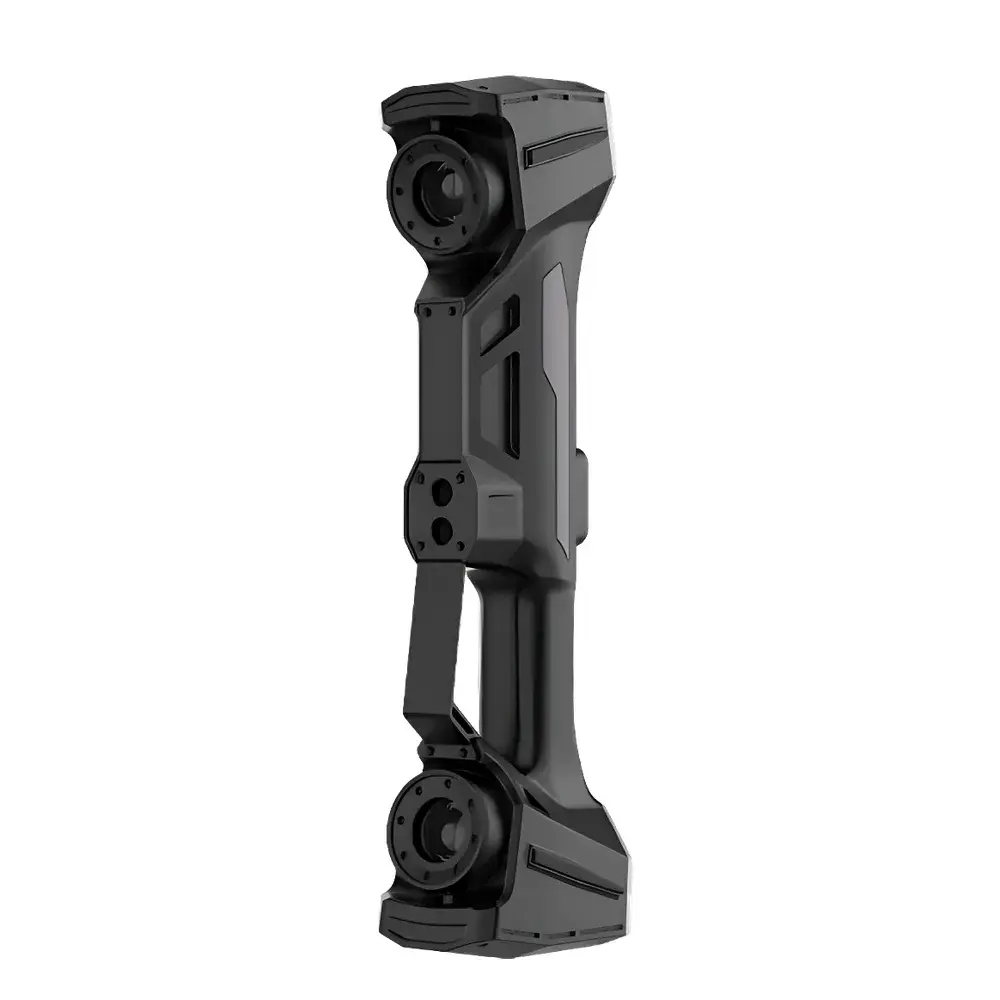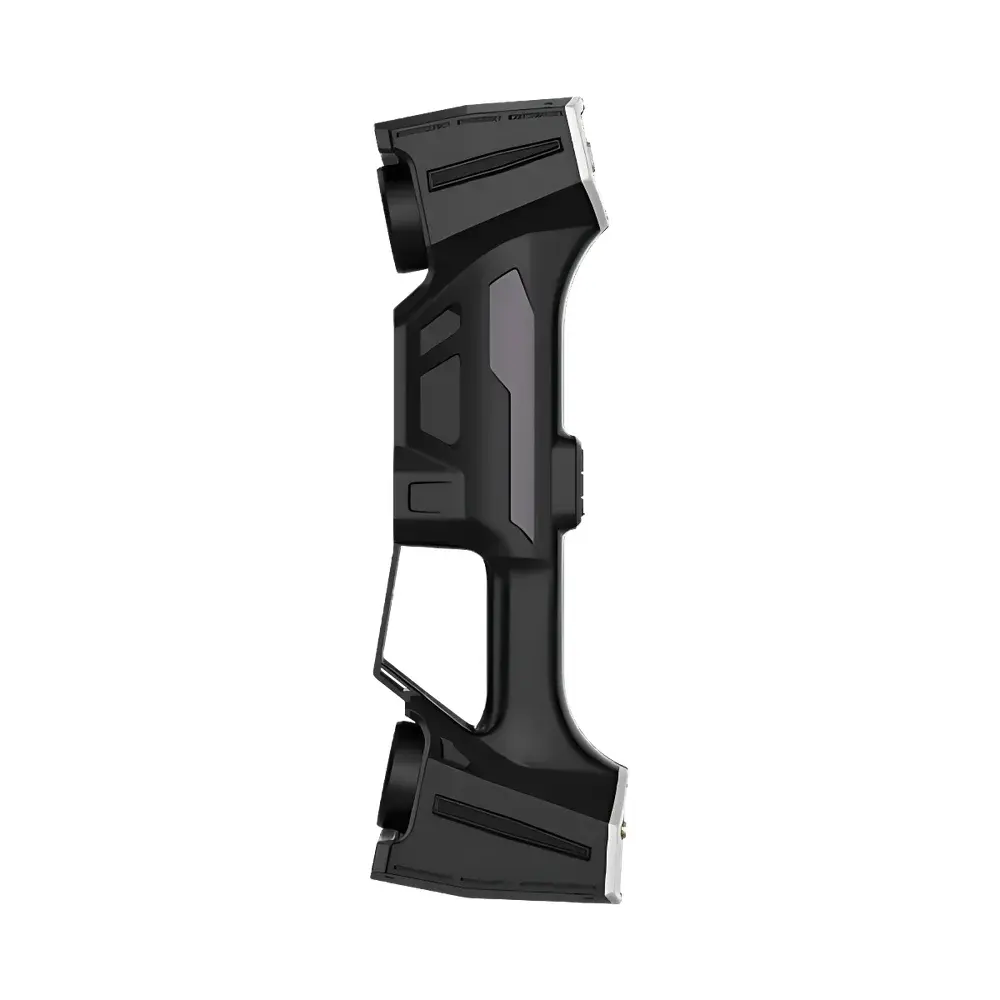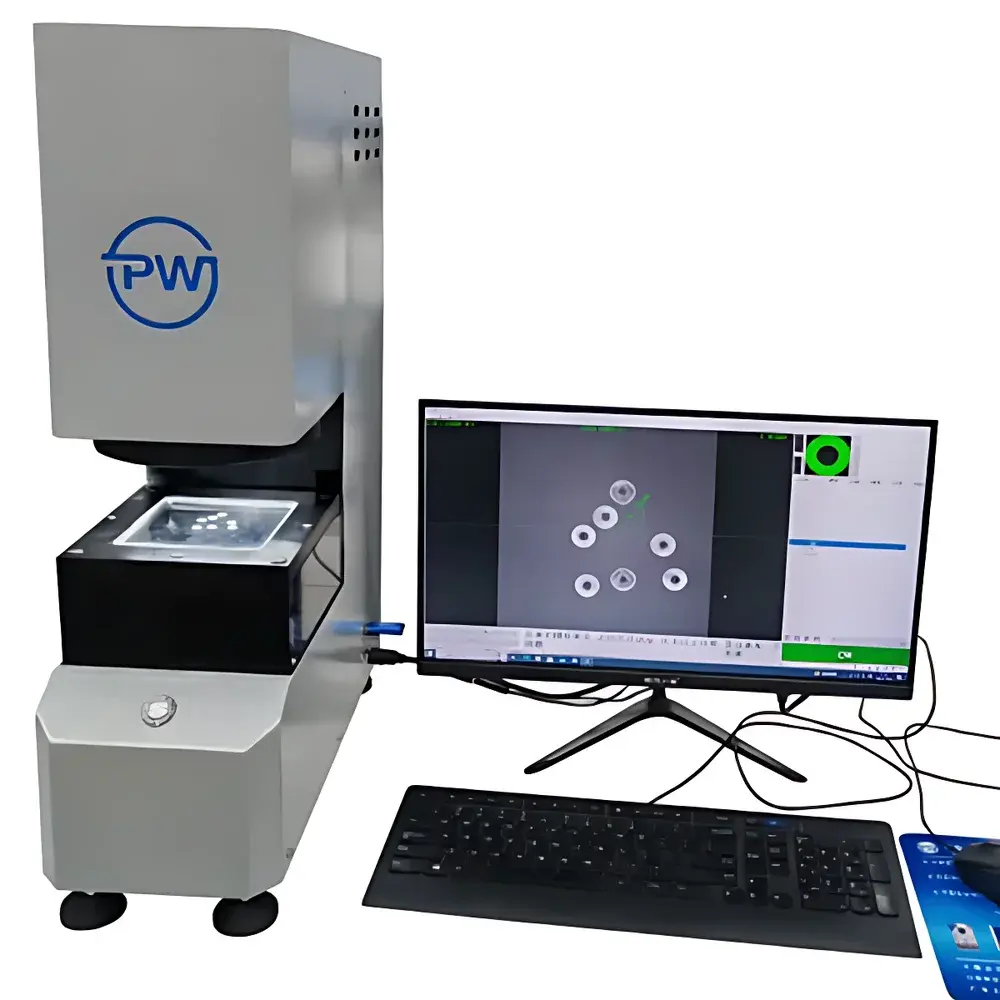
PW ORM888 One-Touch Optical Rapid Measuring Instrument
| Brand | PW |
|---|---|
| Origin | Guangdong, China |
| Manufacturer Type | Authorized Distributor |
| Country of Origin | China |
| Model | PW-ORM888 |
| Price Range | USD 2,800 – 9,800 (FOB) |
| Operation Mode | Fully Automatic |
| Encoded Linear Scale Resolution | 0.1 µm |
| Display | 21.5″ Full HD (1920×1080) Industrial Monitor |
| Camera | 20 MP Global Shutter CMOS Sensor |
| Lens | 0.109× Dual Telecentric Objective |
| Illumination | Green Collimated Telecentric Backlight + White 180° Ring Light |
| Stage Glass | 120 mm × 120 mm |
| Field of View (FOV) | 100 mm × 80 mm |
| Measurement Area | 75 mm × 75 mm |
| Z-Axis Clearance | 80 mm |
| Measurement Accuracy | ±3 µm (ISO 10360-2 compliant at 20 °C ±1 °C, 40–60% RH) |
| Units | mm, inch, µm selectable in real time |
| Software | PW Proprietary Rapid Metrology Suite v4.2 (Windows 10 IoT Enterprise) |
| Power Supply | 220 V AC, 3 A, 50/60 Hz |
| Dimensions (W×H×D) | 210 × 680 × 505 mm |
| Weight | 32 kg |
Overview
The PW ORM888 One-Touch Optical Rapid Measuring Instrument is a fully automated, non-contact vision-based metrology system engineered for high-throughput geometric inspection of precision mechanical components. It operates on the principle of telecentric optical projection combined with sub-pixel edge detection and calibrated image-space mapping—enabling traceable, repeatable measurements without physical probe contact or part repositioning. Designed for integration into production-line quality control stations, the ORM888 delivers ISO/IEC 17025-aligned dimensional verification across critical GD&T parameters—including linear dimensions, positional tolerances, form errors (straightness, circularity), and profile deviations—within a single 1-second measurement cycle per batch. Its dual-telecentric optical architecture eliminates perspective distortion, ensuring measurement invariance across object height variations up to 80 mm—a key requirement for stacked or stepped components common in automotive stampings, medical connectors, and semiconductor packaging substrates.
Key Features
- Fully automated “one-touch” workflow: Load parts arbitrarily on the glass stage; system auto-detects part presence, selects optimal measurement program via CAD template matching or feature-based pattern recognition, and executes full GD&T evaluation without manual alignment.
- Dual-telecentric optical path: 0.109× magnification lens paired with green collimated backlight ensures micron-level edge fidelity and depth-of-field consistency across the entire 100 mm × 80 mm FOV.
- 20 MP global-shutter industrial camera with hardware-triggered synchronization guarantees motion-free imaging during rapid staging—critical for inline deployment.
- Integrated multi-source illumination: Adjustable intensity green telecentric backlight for silhouette contour extraction and white 180° ring light for surface texture and edge contrast enhancement.
- Real-time coordinate transformation engine: Supports Cartesian (X,Y), polar (R,θ), and user-defined workpiece coordinate systems with automatic origin offset, rotation, and scaling.
- Comprehensive GD&T evaluation suite: Measures points, lines, circles (center, radius, diameter, roundness, area, perimeter), arcs, rectangles, ellipses, keyways, and custom profiles—plus derived calculations (max/min/mean/sum) and statistical process capability indices (Cp, Cpk, CpkL, CpkU).
Sample Compatibility & Compliance
The ORM888 accommodates flat or low-relief parts fabricated from metals (stainless steel, aluminum alloys), engineering plastics (PEEK, PTFE), ceramics, and silicon wafers—provided surface reflectivity permits stable edge detection under telecentric illumination. Typical applications include stamped terminals, CNC-machined shafts, powder metallurgy gears, SMT connectors, orthopedic implant components, and aerospace fasteners. All measurement algorithms comply with ISO 1101 (Geometrical Product Specifications), ISO 5459 (Datums and datum systems), and ASTM E1316 (Standard Terminology for Nondestructive Examinations). The system supports GLP/GMP audit trails via timestamped, operator-logged measurement records with digital signature options aligned with FDA 21 CFR Part 11 requirements.
Software & Data Management
The PW Rapid Metrology Suite v4.2 provides a deterministic, scriptable measurement environment with native support for CAD model import (DXF, STEP, IGES) for reference geometry overlay and deviation mapping. Users define measurement routines using intuitive graphical programming—not code—and store them as reusable templates with version control. Data export supports customizable Excel templates (user-defined cell mapping), CSV, PDF reports with annotated images, and direct SQL database logging. Built-in SPC dashboard visualizes trends, control charts, and real-time Cpk status per feature. Audit logs capture all parameter changes, calibration events, and user actions with immutable timestamps—ensuring full traceability for ISO 9001 and IATF 16949 audits.
Applications
- Automotive Tier-1 suppliers: In-process verification of brake caliper pins, fuel injector nozzles, and transmission synchronizer rings.
- Electronics manufacturing: Dimensional validation of PCB fiducials, connector pitch, solder paste stencil apertures, and MEMS package outlines.
- Medical device OEMs: Critical feature inspection of dental burr shanks, endoscope tube diameters, and catheter hub concentricity.
- Aerospace MRO: Rapid screening of turbine blade root contours, rivet hole spacing, and composite layup alignment markers.
- Contract manufacturers: Cross-model batch verification for mixed-SKU production lines—reducing changeover time by >90% versus manual coordinate measuring machines.
FAQ
What standards does the ORM888’s measurement accuracy conform to?
The ±3 µm stated uncertainty is validated per ISO 10360-2 Annex B using certified step gauges and sphere artifacts under controlled environmental conditions (20 °C ±1 °C, 40–60% RH, vibration-isolated bench).
Can the system measure features with surface texture or reflective finishes?
Yes—via adaptive lighting control: the white 180° ring light mitigates specular reflection on polished metals, while adjustable backlight intensity resolves matte plastic edges. Optional polarization filters are available for highly reflective surfaces.
Is CAD-based automated alignment supported?
Yes. DXF/STEP models can be imported, scaled, and registered to live images using iterative closest point (ICP) or feature-matching algorithms—enabling zero-setup “teach-and-repeat” operation across part families.
Does the software support statistical process control (SPC) reporting?
Yes. Native Cp/Cpk, Pp/Ppk, X-bar-R, and individual moving range (I-MR) charts are generated automatically; data exports directly to Minitab, JMP, or enterprise MES platforms via ODBC.
What maintenance is required for long-term accuracy stability?
Annual recalibration against NIST-traceable artifacts is recommended. The encoded linear scale and telecentric optics require no routine adjustment; only periodic cleaning of optical surfaces and verification of stage flatness per ISO 10360-7.