
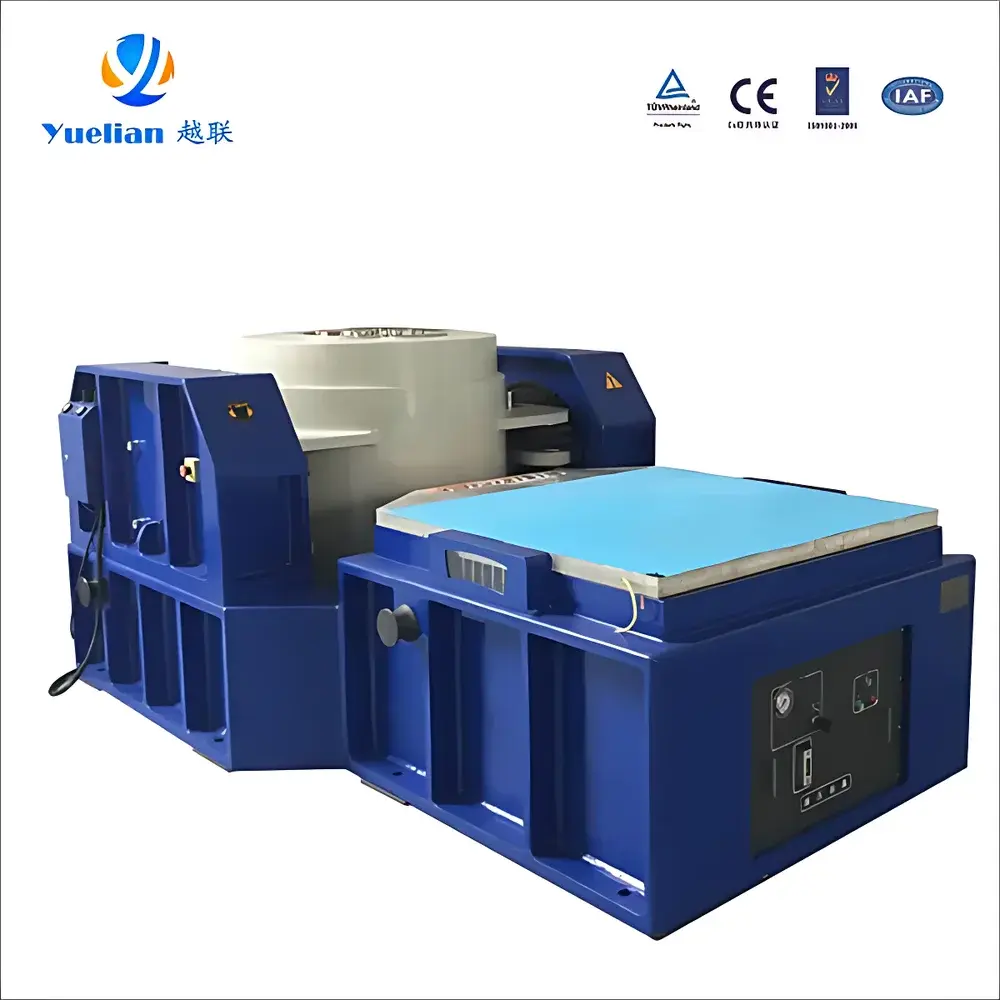
Yuelian YL-3-150 Battery Vibration Test System
| Brand | Yuelian |
|---|---|
| Origin | Guangdong, China |
| Manufacturer Type | Authorized Distributor |
| Country of Origin | China |
| Model | YL-3-150 |
| Price | Upon Request |
| Rated Sinusoidal Force (peak) | 300 kgf |
| Rated Random Force (rms) | 300 kgf |
| Max Shock Force (peak) | 600 kgf |
| Frequency Range | 5–4000 Hz |
| Max Displacement (p-p) | 25 mm |
| Max Velocity | 2.0 m/s |
| Max Acceleration | 1000 m/s² |
| First-Order Resonant Frequency | 3400 Hz ±5% |
| Max Payload | 120 kg |
| Isolation Frequency | 2.0 Hz |
| Table Diameter | Ø150 mm |
| Moving Mass | 3 kg |
| Table Mounting Thread | 13×M8 |
| Magnetic Leakage | <1.0 mT |
| Table Dimensions (L×W×H) | 1756×818×1161 mm |
| System Weight | ~995 kg |
| Operating Ambient | 0–45 °C |
Overview
The Yuelian YL-3-150 Battery Vibration Test System is an electrodynamic shaker-based qualification platform engineered for rigorous mechanical stress evaluation of lithium-ion and other rechargeable battery cells under controlled sinusoidal vibration profiles. Designed in accordance with IEC 62133, UN 38.3 Section 38.3.4, and GB/T 31467.3—key international and national standards governing transport safety and reliability of energy storage devices—the system delivers traceable, repeatable excitation across three orthogonal axes to simulate real-world dynamic loading conditions encountered during transportation, installation, and operational deployment. Its core architecture integrates a high-force, low-distortion moving-coil actuator with a rigid aluminum alloy table and precision-machined mounting interface, enabling stable transmission of defined acceleration or displacement spectra without resonance coupling or payload-induced modal interference. The system operates on closed-loop servo control, ensuring fidelity to prescribed sweep profiles—including logarithmic sine sweeps from 7 Hz to 200 Hz and back—with programmable dwell, amplitude ramping, and cycle counting for full compliance with regulatory test sequences.
Key Features
- Electrodynamic shaker with 300 kgf rated sinusoidal force (peak) and 1000 m/s² maximum acceleration capability, suitable for high-fidelity simulation of road, rail, and air transport vibrations.
- Wide frequency coverage from 5 Hz to 4000 Hz, supporting both low-frequency displacement-controlled and high-frequency acceleration-controlled test regimes per UN 38.3 requirements.
- 25 mm peak-to-peak displacement capacity and 2.0 m/s velocity limit ensure compatibility with extended low-frequency sweeps (e.g., 7–200 Hz at 0.8 mm p-p) while maintaining waveform integrity.
- Ø150 mm stainless steel test table with 13×M8 threaded inserts enables secure, repeatable mounting of cylindrical (axial/radial), prismatic, pouch, and coin-cell configurations using standardized fixtures.
- Low magnetic leakage (<1.0 mT) minimizes electromagnetic interference with adjacent instrumentation or battery management systems during concurrent monitoring.
- Integrated thermal management and over-travel protection prevent coil overheating or mechanical damage during extended 3-hour per-axis testing cycles.
- Robust structural design with 995 kg total mass and 2.0 Hz isolation frequency ensures minimal base motion transmission and stable operation on standard laboratory floors without dedicated foundations.
Sample Compatibility & Compliance
The YL-3-150 accommodates all common commercial and industrial battery formats: cylindrical (e.g., 18650, 21700), prismatic, pouch, and button cells. Fixturing supports axis-specific orientation—two orthogonal directions for cylindrical and coin cells; three mutually perpendicular axes for rectangular and flexible packages—as mandated by UN 38.3 Clause 38.3.4. Test execution follows strict sequence logic: preconditioning per IEC 62133 charge protocols, rigid clamping to eliminate slippage, and execution of 12 logarithmic cycles per axis (7 Hz → 200 Hz → 7 Hz), each lasting 15 minutes (total 3 hours/axis). Pass/fail criteria are objectively defined: no fire, explosion, venting, electrolyte leakage, or voltage drop exceeding 10% from nominal post-test. All test parameters—including real-time acceleration, displacement, and phase—are logged with timestamped metadata for audit readiness under ISO/IEC 17025 and GLP frameworks.
Software & Data Management
The system interfaces with industry-standard vibration control software (e.g., Vibration Research VR9500 or similar OEM-compatible platforms) supporting IEEE 1451-compliant data acquisition. Software enables creation and validation of custom test profiles, real-time FFT analysis, closed-loop amplitude correction, and automatic pass/fail flagging based on user-defined thresholds. Raw time-history waveforms, spectral density plots, and cycle completion logs are exported in CSV, UFF58, or MATLAB .mat formats. Audit trails include operator ID, calibration date, environmental sensor readings (temperature/humidity), and digital signatures—fully compliant with FDA 21 CFR Part 11 requirements for electronic records and signatures when configured with validated software modules.
Applications
- UN 38.3 Section 38.3.4 vibration qualification for air, sea, and ground shipment approval.
- Design verification of battery module housings, busbar mounts, and thermal interface materials under dynamic load.
- Failure mode analysis (FMEA) of cell-to-cell interconnects, weld integrity, and electrode delamination mechanisms.
- Pre-compliance screening prior to third-party certification at accredited laboratories (e.g., TÜV, SGS, UL).
- Research into mechanical-electrochemical coupling effects during cyclic stress, including impedance shift correlation with vibration exposure.
FAQ
What standards does the YL-3-150 support for battery vibration testing?
It fully implements UN 38.3 Section 38.3.4, IEC 62133-2:2017 Clause 8.4.2, GB/T 31467.3–2015, and JIS C 8714:2017 test profiles.
Can the system perform random vibration testing?
Yes—it delivers 300 kgf rms random force with PSD shaping capability up to 4000 Hz, suitable for road-simulation spectra per ISO 10326-1.
Is external cooling required for continuous 3-hour tests?
No—the integrated forced-air cooling and thermal cutoff circuitry maintain coil temperature within safe limits under nominal duty cycles.
How is test repeatability ensured across multiple operators?
Via password-protected profile libraries, calibrated transducer traceability (NIST-traceable accelerometers), and automated setup validation routines.
Does the system include fixture hardware for specific battery formats?
Standard delivery includes universal M8-threaded clamping plates; application-specific fixtures (e.g., 18650 radial holders, pouch-cell vacuum chucks) are available as optional accessories.



