
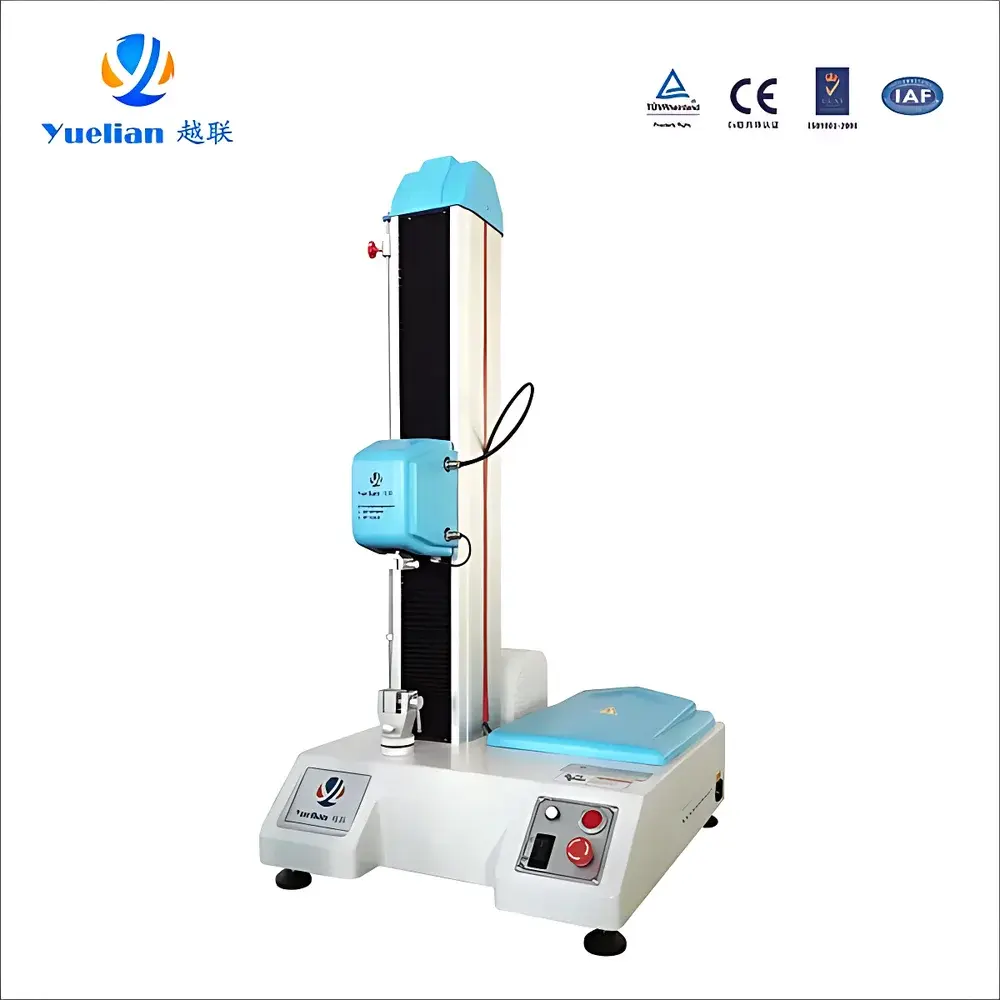
YL-S70 Computer-Controlled Universal Testing Machine for Foam Compression Testing
| Origin | Guangdong, China |
|---|---|
| Manufacturer Type | Authorized Distributor |
| Origin Category | Domestic (China) |
| Model | YL-S70 |
| Price Range | USD 1,400 – 7,200 |
| Instrument Type | Electromechanical Universal Testing Machine |
| Load Capacity Options | 10 N to 5 kN (dual-range configuration available) |
| Control Mode | Full PC-based closed-loop control |
| Force Resolution | 1/500,000 FS |
| Force Accuracy | Better than ±0.5% of full scale |
| Displacement Resolution | 1/500,000 mm |
| Sampling Rate | 50 Hz |
| Effective Stroke | 450 mm |
| Speed Range | 0.01–500 mm/min (customizable) |
| Test Space Width | 140 mm |
| Drive System | AC Servo Motor + Precision Ball Screw |
| Protection Features | Over-travel limit switch, overload cutoff, emergency stop, automatic fracture detection |
| Data Output Units | Force (N, kN, lbf, kgf), Displacement (mm, inch), Stress (MPa, Pa), Strain (%), and derived metrics (CPK, σ, median, trimmed mean, etc.) |
| Software Functions | Real-time multi-curve overlay (F–δ, F–t, δ–t, σ–ε), user-defined multi-step cyclic protocols, auto-return, auto-zero, bidirectional load cell polarity switching, 7 programmable test zones, 40 manual data points, 120 auto-sampled points |
| Included | USB/RS-232 interface cable, proprietary testing software, standard compression platens |
| Optional Accessories | Extensometers, custom fixtures (e.g., ASTM D3574 foam compression plates), dedicated PC workstation |
Overview
The YL-S70 Computer-Controlled Universal Testing Machine is an electromechanical materials testing system engineered for high-reproducibility mechanical characterization of polymeric foams, elastomers, packaging materials, and compliant composites under uniaxial compressive loading. Designed in accordance with core principles of quasi-static mechanical testing per ISO 6892-1, ASTM D3574 (Standard Test Methods for Flexible Cellular Materials—Slab, Bonded, and Molded Urethane Foams), and GB/T 7742.1, the YL-S70 implements closed-loop servo-controlled displacement actuation to deliver precise, repeatable force–displacement profiles essential for evaluating compression set, resilience, stress relaxation, and hysteresis behavior in open- and closed-cell foams. Its rigid aluminum extrusion frame, hardened ball screw transmission, and high-resolution encoder feedback ensure minimal compliance and thermal drift—critical for low-force (<100 N) and long-duration (≥24 h) compression recovery tests mandated by automotive seating and medical cushioning specifications.
Key Features
- AC servo motor drive with zero-backlash precision ball screw transmission, enabling smooth, noise-free motion across the full speed range (0.01–500 mm/min)
- Modular quick-release fixture interface compatible with standardized compression platens (e.g., 100 mm diameter per ASTM D3574), tensile grips, peel fixtures, and puncture probes
- Integrated dual-limit safety architecture: hardware-based over-travel switches plus software-configurable upper/lower stroke boundaries and overload thresholds
- High-fidelity data acquisition at 50 Hz with 24-bit ADC resolution; force transducer supports bidirectional polarity switching for combined tension–compression protocols
- Intuitive PC-based software featuring real-time synchronized plotting of up to four independent axes (e.g., force vs. displacement, stress vs. strain, load cycle count vs. residual deformation)
- Advanced statistical engine supporting CPK, process capability indices, trimmed mean (excluding top/bottom 5%), standard deviation, and confidence interval estimation per ISO 22514 series
Sample Compatibility & Compliance
The YL-S70 accommodates specimens ranging from thin elastomeric sheets (0.5 mm thick) to molded foam blocks (up to 130 mm height). Standard configurations include flat parallel compression platens meeting ASTM D3574 geometry requirements; optional accessories enable testing per ISO 1856 (flexible cellular polymeric materials), DIN 53577 (foam hardness), and JIS K 6400-2 (compression deflection). The system supports GLP-compliant operation via audit-trail-enabled software logging (user actions, calibration events, test parameters), and its force and displacement traceability aligns with ISO/IEC 17025 requirements when paired with accredited calibration certificates. All firmware and software modules are version-controlled and support FDA 21 CFR Part 11–compliant electronic signatures when deployed in regulated QA/QC environments.
Software & Data Management
The proprietary testing software provides a validated, parameter-driven environment for method development and execution. Users define multi-stage test sequences—including pre-load dwell, ramp-to-load, hold-at-load, unloading, and recovery phases—with independent control of rate, target, and duration per step. Raw data exports to CSV or Excel-compatible formats include timestamps, raw sensor counts, and computed engineering units. Historical datasets can be loaded simultaneously for overlay comparison, with cross-curve delta analysis and tolerance band visualization. The software maintains immutable test records with metadata (operator ID, environmental conditions, calibration status), supports PDF report generation with embedded graphs and statistical summaries, and allows role-based access control for lab managers and technicians.
Applications
- Compression set measurement (ASTM D3574 Method B/C) for polyurethane, latex, and memory foam formulations
- Cyclic compression fatigue testing (500–10,000 cycles) to assess structural degradation in seating and mattress cores
- Stress relaxation profiling under constant strain (ISO 899-1) for viscoelastic polymer characterization
- Indentation force deflection (IFD) analysis per ASTM D3574 Method A for furniture-grade foams
- Dynamic modulus evaluation via controlled-strain sinusoidal loading (optional add-on module)
- Quality conformance verification against internal material specifications or customer PPAP submissions
FAQ
Does the YL-S70 comply with ISO/IEC 17025 calibration traceability requirements?
Yes—when calibrated using NIST-traceable standards and documented per ISO/IEC 17025 Annex A.3, the system meets metrological requirements for accredited testing laboratories.
Can the software generate reports compliant with FDA 21 CFR Part 11?
Yes—electronic signature functionality, audit trail logging, and user permission tiers are enabled upon configuration for regulated pharmaceutical or medical device applications.
Is the 450 mm effective stroke sufficient for full-thickness foam block testing?
It supports specimens up to 300 mm uncompressed height with 30%–70% deflection, covering >95% of standard foam validation protocols per ASTM D3574 and ISO 1856.
What is the minimum resolvable force for the 10 N load cell option?
With 1/500,000 internal resolution and ±0.5% accuracy, the smallest reliably quantifiable force is 0.02 mN—suitable for ultra-low-density aerogels and hydrogel films.
Are third-party extensometers supported?
Yes—the system provides analog voltage output (±10 V) and TTL synchronization signals compatible with commercial clip-on and non-contact extensometers (e.g., MTS 632.13F-24, Instron 2630-101).



