
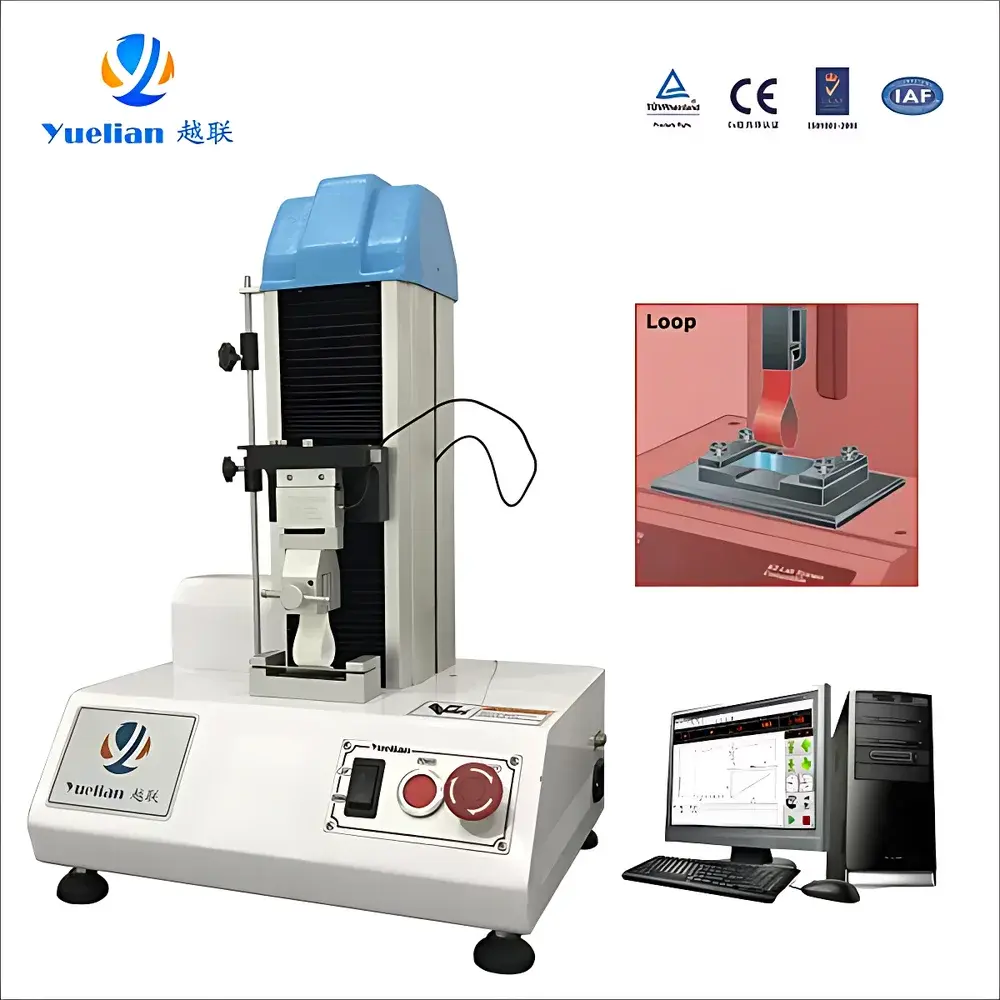
Yuelian/PW PW-US16 Loop Tack Adhesion Tester
| Brand | Yuelian/PW |
|---|---|
| Origin | Guangdong, China |
| Manufacturer Type | Authorized Distributor |
| Country of Origin | China |
| Model | PW-US16 |
| Price Range | USD 1,400 – 2,800 |
| Load Capacity | 50 N |
| Measurement Accuracy | ±1% FS |
| Resolution | 0.01 N |
| Test Speed | 0.5–500 mm/min |
| Stroke | 200 mm |
| Power | 40 W |
| Voltage/Frequency | 220 V, 50 Hz |
| Dimensions (W×L×H) | 360 × 380 × 520 mm |
| Net Weight | 17 kg |
| Standards Compliance | ASTM D6195-03 (2019), ASTM D2979-16, TLMI Loop Tack Method, FINAT FTMA 2-2018, GB/T 31125–2014 |
| Data Output Units | N, gf, kgf, lbf |
| Force Hold Function | Yes |
| Multi-test Storage | Yes |
| Control Interface | PC-based with USB connectivity |
| Sensor Accuracy | ±0.1% of reading (load cell certified per ISO 376 Class 0.5) |
Overview
The Yuelian/PW PW-US16 Loop Tack Adhesion Tester is a precision electromechanical instrument engineered for the quantitative measurement of initial tack—the instantaneous adhesive force developed upon brief, light contact between a pressure-sensitive adhesive (PSA) and a standard substrate under controlled dwell time and applied load. It operates on the principle of loop tack testing, wherein a standardized adhesive loop (typically 25 mm wide) is brought into contact with a rigid test surface (e.g., stainless steel or glass) at defined speed, dwell time, and separation rate. The peak separation force is recorded as the loop tack value, expressed in Newtons (N) or equivalent units. This method provides high reproducibility for comparative evaluation of PSA formulations, coating uniformity, and process consistency—critical parameters in label, tape, protective film, and medical adhesive manufacturing.
Key Features
- PC-controlled closed-loop servo system with programmable test speed (0.5–500 mm/min), enabling strict adherence to ASTM D6195-03 (2019) and FINAT FTMA 2-2018 velocity requirements.
- High-resolution load cell (±0.1% of reading, ISO 376 Class 0.5 certified) with 0.01 N resolution and ±1% full-scale accuracy—validated for traceable force metrology in QA/QC environments.
- Integrated force-hold functionality allowing sustained load application during dwell phase, essential for simulating real-world application conditions such as label press-on or tape hand-application.
- Modular sample stage accommodating standardized test plates (5 × stainless steel specimens included) and optional substrate holders for glass, PET, or coated paper substrates.
- Linear motion system driven by precision stepper motor and ground ball screw, ensuring minimal backlash and positional repeatability within ±0.02 mm over 200 mm stroke.
- Software-enabled unit conversion (N, gf, kgf, lbf) and automatic data logging with timestamped metadata—supporting audit-ready documentation per GLP and internal SOP requirements.
Sample Compatibility & Compliance
The PW-US16 is validated for use with pressure-sensitive adhesives across diverse carrier formats including acrylics, rubber-based, silicone, and hot-melt PSAs. Compatible samples include self-adhesive labels, masking tapes, transfer tapes, release liners, optical films, and medical-grade adhesive patches. All test configurations comply with internationally recognized standards: ASTM D6195-03 (2019) for loop tack, ASTM D2979-16 for Polyken probe tack, TLMI Standard Test Method for Loop Tack, FINAT FTMA 2-2018, and GB/T 31125–2014. Instrument design supports routine calibration verification using NIST-traceable deadweight sets and adheres to ISO/IEC 17025 calibration interval guidance when operated under documented environmental controls (23 ±2 °C, 50 ±5% RH).
Software & Data Management
The proprietary Windows-based control software provides intuitive test setup, real-time force-displacement curve visualization, and automated pass/fail threshold evaluation against user-defined specification limits. Raw data files (.csv) are exportable with full metadata—including operator ID, test date/time, sample ID, environmental conditions, and calibration certificate reference. Audit trail functionality records all parameter changes, test executions, and data exports—supporting compliance with FDA 21 CFR Part 11 requirements when deployed with electronic signature configuration and network-accessible server storage. Database archiving supports long-term trend analysis for SPC (Statistical Process Control) implementation in production environments.
Applications
- Formulation screening of PSA raw materials (monomer ratios, crosslinker levels, tackifier selection)
- In-process quality verification during coating, slitting, and die-cutting operations
- Supplier qualification and incoming material inspection per ISO 9001 Clause 8.4.2
- Regulatory submission support for medical device adhesives (ISO 10993-5 cytotoxicity correlation studies)
- R&D benchmarking of alternative substrates (e.g., biodegradable films, recycled papers)
- Root cause analysis of delamination failures in multi-layer laminates
FAQ
Does the PW-US16 meet ASTM D6195-03 (2019) mechanical specifications?
Yes—the instrument’s actuator speed range (0.5–500 mm/min), load cell resolution (0.01 N), and dwell time control (0.1–5.0 s adjustable) fully satisfy the apparatus requirements outlined in Section 7 of ASTM D6195-03 (2019).
Can test data be exported for statistical analysis in Minitab or JMP?
Yes—CSV-formatted output includes column headers for Force (N), Displacement (mm), Time (s), Peak Force, and Average Tack, enabling direct import into common SPC and DOE software platforms.
Is third-party calibration certification available?
Yes—factory calibration is performed using ISO/IEC 17025-accredited reference standards; optional UKAS or A2LA-certified calibration reports are available upon request with traceability to NPL or NIST.
What maintenance is required for long-term measurement stability?
Routine maintenance includes quarterly verification of load cell linearity using certified weights, annual mechanical alignment check of the traverse axis, and biannual firmware/software updates to maintain compatibility with current OS security protocols.



