
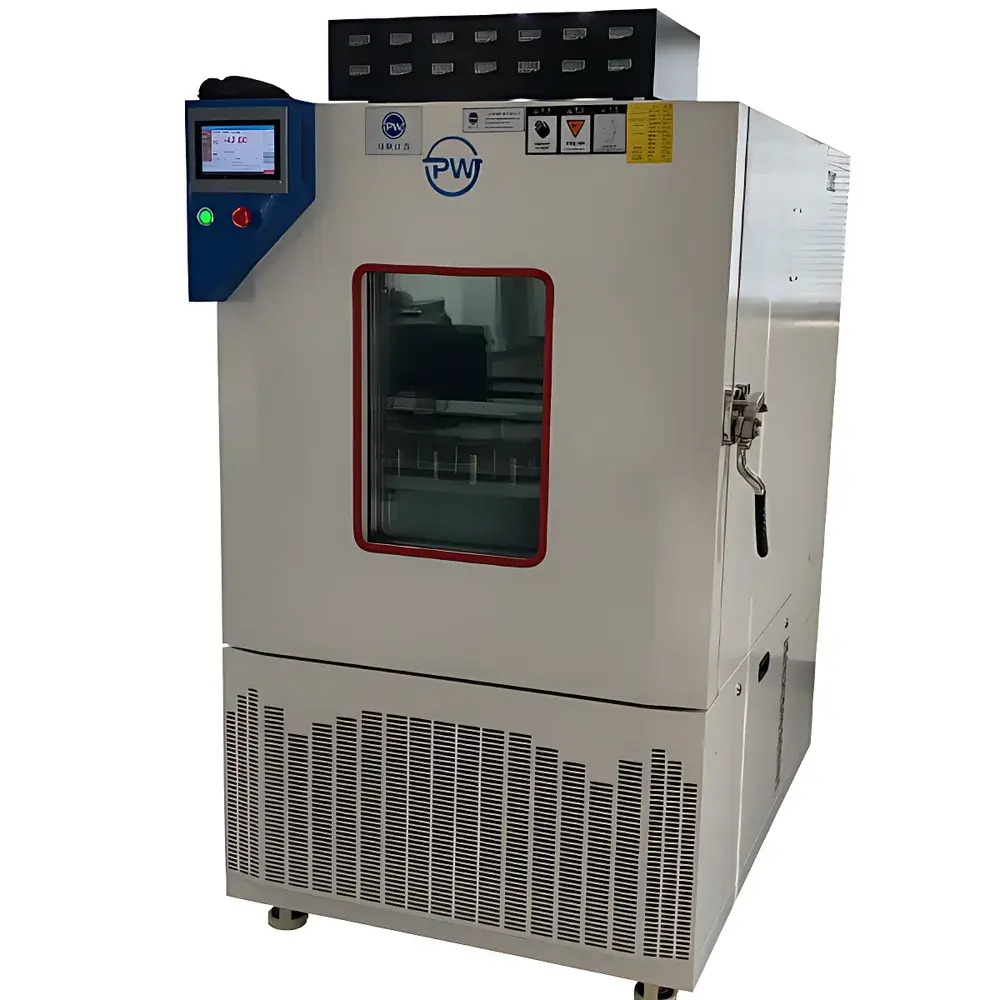
Yuelian PW-CSS14-40A Constant Temperature & Humidity Creep and Stress Rupture Testing Machine
| Brand | Yuelian / PW |
|---|---|
| Origin | Guangdong, China |
| Manufacturer Type | Authorized Distributor |
| Instrument Type | Mechanical Load-Driven Creep Tester with Integrated Environmental Chamber |
| Model | PW-CSS14-40A |
| External Dimensions | W100 × H168 × D150 cm |
| Internal Chamber Dimensions | W80 × H85 × D60 cm |
| Temperature Range | −40 °C to +150 °C |
| Humidity Range | 20–98% RH |
| Temperature Uniformity | ±2.0 °C |
| Humidity Uniformity | ±3.0% RH |
| Temperature Resolution | 0.01 °C |
| Humidity Resolution | 0.01% RH |
| Heating/Cooling Rate (Typical) | +3 °C/min (heat-up), −1 °C/min (cool-down) |
| Control System | 7-inch Color Touchscreen Controller with Graphical Program Curve Display |
| Max. Test Stations | 30 |
| Load Capacity per Station | 200–500 g (standard steel weights) |
| Total Power Consumption | ~6 kW, 380 V, 50/60 Hz |
| Safety Protections | Over-temperature, dry-burn, low-water, leakage, and compressor over-current protection |
| Compliance | Designed for ASTM D2990, ISO 899-1, and GB/T 20672 standards |
Overview
The Yuelian PW-CSS14-40A Constant Temperature & Humidity Creep and Stress Rupture Testing Machine is an integrated mechanical testing system engineered for long-term deformation analysis of polymeric, composite, elastomeric, and advanced material specimens under precisely controlled thermal and hygroscopic conditions. Unlike conventional static load testers, this instrument combines a high-stability environmental chamber—capable of simultaneous temperature and humidity regulation—with a modular, gravity-driven mechanical loading frame. It operates on the principle of uniaxial tensile or flexural creep under constant load, where specimen elongation or deflection is monitored over time (hours to months) while exposed to defined thermohygrometric profiles. The system supports both isothermal and isohumid creep testing, as well as stepped or ramped environmental profiles synchronized with mechanical loading sequences—enabling compliance with standardized test methods including ASTM D2990 (Creep Properties of Plastics), ISO 899-1 (Plastics — Determination of Creep Behaviour), and GB/T 20672 (Foamed Plastics — Compression Creep). Its dual-domain control architecture ensures that thermal drift and humidity-induced dimensional artifacts are minimized, delivering high reproducibility in modulus decay, strain accumulation, and time-to-failure measurements.
Key Features
- Integrated dual-zone design: A precision environmental chamber (−40 °C to +150 °C, 20–98% RH) co-located with a 30-station mechanical loading rack, eliminating inter-system thermal lag and cross-contamination.
- Electronically actuated expansion valve control (Sanyo compressor +鹭宫 Sanwa electronic expansion valve): Enables dynamic refrigerant flow modulation based on real-time chamber feedback—reducing heater and humidifier duty cycles by up to 35% versus fixed-orifice systems.
- 7-inch color touchscreen controller with graphical program curve visualization: Supports up to 12 program groups, 120 segments per group, and 999-cycle nesting; includes P.I.D. auto-tuning, alarm logging, and power-loss recovery with seamless program resumption.
- High-fidelity chamber uniformity: Achieves ±2.0 °C temperature uniformity and ±3.0% RH uniformity across the full internal volume (W80 × H85 × D60 cm), verified per IEC 60068-3-5.
- Modular mechanical loading: 30 independent test stations arranged in three rows; each accommodates standard SUS#304 steel loading plates and calibrated stainless-steel weights (200 g, 500 g nominal); optional extensometer integration available via 100 mm test port.
- Comprehensive safety architecture: Dual-stage compressor overheat protection, dry-burn prevention, low-water cutoff, ground-fault interruption, and high-pressure cutout—all compliant with IEC 61000-6-2 EMC and IEC 61000-6-4 emission requirements.
Sample Compatibility & Compliance
The PW-CSS14-40A accommodates flat, rod, or film specimens up to 200 mm in length and 20 kg per shelf (two-tier stainless-steel grid racks included). Common applications include thermoplastic sheets (PP, PE, PC), fiber-reinforced composites, PU foams, silicone elastomers, and biodegradable polymers. All chamber interior surfaces are fabricated from mirror-finish SUS#304 stainless steel to prevent corrosion and particulate shedding—critical for ISO 17025-accredited labs. The system is designed to meet the environmental conditioning prerequisites of ASTM D618 (Conditioning Plastics), ISO 291 (Standard Atmospheres), and USP (Packaging Integrity under Accelerated Aging). Optional validation documentation (IQ/OQ/PQ protocols) and calibration certificates traceable to NIM (China National Institute of Metrology) are available upon request.
Software & Data Management
The embedded controller provides native data logging at user-selectable intervals (1 s to 60 min), storing temperature, humidity, elapsed time, segment status, and cumulative runtime in non-volatile memory. USB export enables CSV-formatted datasets compatible with MATLAB, JMP, and Minitab. Optional PC-based software (supplied free) adds remote monitoring, multi-channel trend overlay, statistical outlier detection, and automated report generation per GLP/GMP requirements—including audit trails, electronic signatures, and 21 CFR Part 11-compliant user access controls. All firmware updates are delivered via secure HTTPS download with SHA-256 signature verification.
Applications
- Long-term creep compliance evaluation of automotive interior trim under elevated humidity (e.g., 85% RH / 85 °C per ISO 16750-4).
- Stress rupture life prediction of battery separator films in EV thermal management modules.
- Time-dependent modulus degradation studies of bioresorbable sutures under physiological humidity (60% RH / 37 °C).
- Accelerated aging of aerospace-grade adhesives under cyclic thermal-hygrometric stress (e.g., −40 °C ↔ +85 °C / 10% ↔ 95% RH).
- Quality assurance of medical device packaging seals per ASTM F1980 (Accelerated Aging of Sterile Barrier Systems).
FAQ
What standards does the PW-CSS14-40A support for creep testing?
It is configured to execute ASTM D2990, ISO 899-1, ISO 899-2, GB/T 20672, and DIN 53444 test protocols, with environmental chamber performance validated per IEC 60068-3-5 and IEC 60068-3-6.
Can the system perform humidity-controlled stress relaxation tests?
Yes—by configuring the controller to hold constant load while stepping through discrete humidity setpoints, users can generate humidity-dependent relaxation master curves. Extensometer integration is required for strain-rate quantification.
Is the chamber suitable for corrosive atmosphere testing?
The SUS#304 interior and sealed electrical compartment support mild acidic or saline vapor exposure (e.g., ASTM B117 salt fog preconditioning), but aggressive halogenated or sulfuric environments require optional Hastelloy-coated components.
What maintenance intervals are recommended for the refrigeration system?
Compressor oil and filter-drier replacement every 24 months; electronic expansion valve calibration annually; chamber seal inspection quarterly. Full service logs are retained in the controller’s maintenance history module.
Does the system include validation documentation for regulated industries?
Factory-issued IQ/OQ documentation is provided; PQ execution requires site-specific sensor mapping and load-cell calibration—support services and certified third-party validation partners are available through Yuelian’s global distributor network.



