
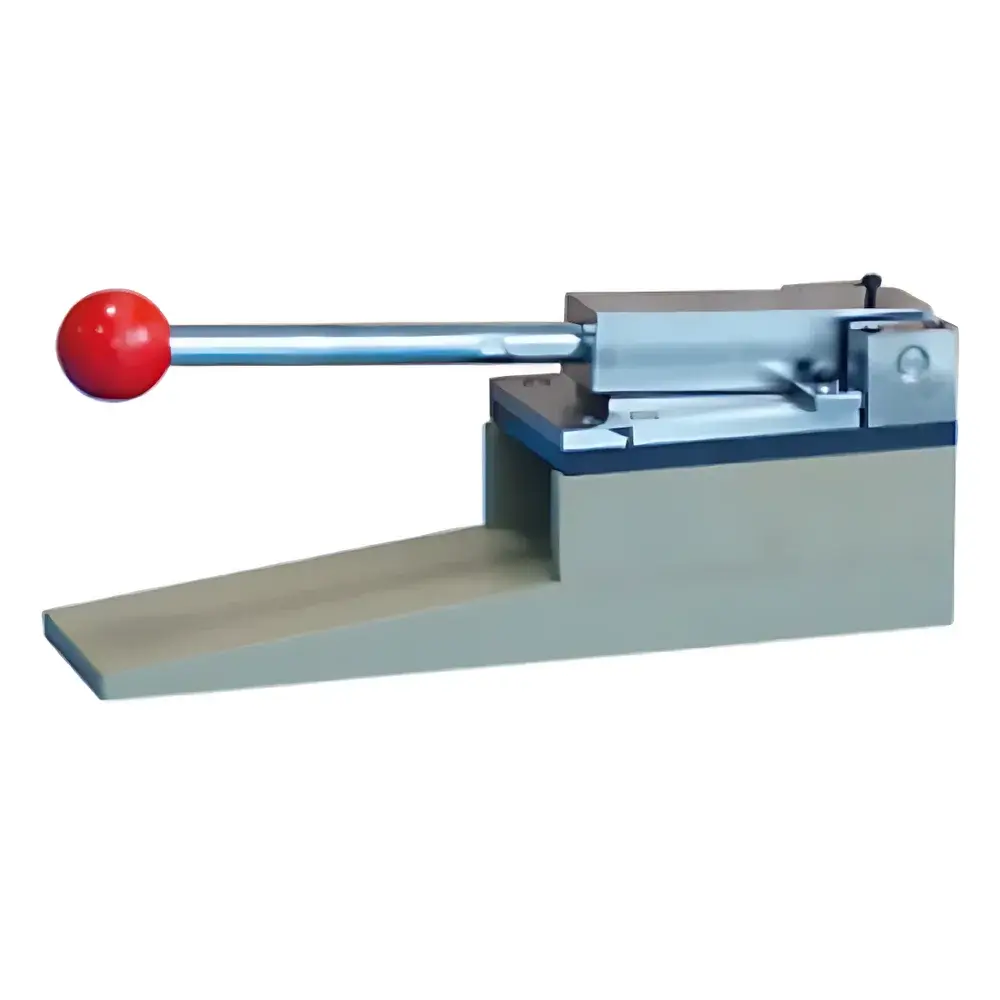
Yuelian PW-Q63 Dedicated Tear Resistance Sampler
| Brand | Yuelian / PW |
|---|---|
| Origin | Guangdong, China |
| Manufacturer Type | Authorized Distributor |
| Country of Origin | China |
| Model | PW-Q63 |
| Quotation | Available Upon Request |
| Sampling Dimensions | 50 × 63 mm |
| Thickness Range | 0.1–1.0 mm |
| Overall Dimensions | 320 × 115 × 110 mm |
| Weight | ~9 kg |
| Blade Material | Chromium steel alloy with molybdenum and vanadium |
| Sampling Accuracy | ≤ ±0.1 mm |
| Compliance | TAPPI T414, QB/T 1050, GB/T 455–2002 (sampling specifications) |
Overview
The Yuelian PW-Q63 Dedicated Tear Resistance Sampler is a precision mechanical sampling device engineered exclusively for preparing standardized test specimens in tear resistance evaluation of paper and paperboard. It operates on a controlled mechanical punch principle—utilizing a fixed-die shear mechanism—to deliver consistent, dimensionally accurate samples without deformation or fiber pull-out. Designed to meet the stringent geometric requirements of international tear testing standards, the PW-Q63 ensures specimen uniformity critical for reproducible results in Elmendorf-type and pendulum-type tear testers. Its function is not analytical but preparatory: it bridges the gap between raw sheet material and metrologically valid test input, directly influencing measurement traceability and inter-laboratory comparability.
Key Features
- Mechanically actuated punch system with zero operator-induced variability—eliminates manual cutting inconsistencies inherent in guillotine or die-cutting methods.
- Fixed-die geometry calibrated to produce specimens measuring precisely 50 mm × 63 mm, with dimensional tolerance maintained at ≤ ±0.1 mm across all operational cycles.
- High-hardness chromium-molybdenum-vanadium alloy blade, processed via wire electrical discharge machining (wire-EDM) and CNC surface grinding, followed by triple-stage vacuum quenching (≥58 HRC) for extended edge retention and minimal burr formation.
- Rigid cast-aluminum frame with reinforced base plate ensures structural stability during high-force punching, minimizing vibration-induced misalignment.
- Integrated depth-stop mechanism enables repeatable control over sample thickness within the 0.1–1.0 mm range—critical for calibrating tear resistance per unit mass or basis weight.
- Ergonomic lever design reduces required actuation force while maintaining full stroke repeatability—compliant with ISO 554 and ISO 187 ambient conditioning workflow integration.
Sample Compatibility & Compliance
The PW-Q63 accommodates flat, non-laminated paper and paperboard substrates with grammage ranging from 40 g/m² to 400 g/m², including kraft, bleached sulfate, corrugated medium, and coated board. It is incompatible with composite materials, metallized films, or multi-ply laminates where differential layer compliance may compromise cut integrity. The sampler conforms explicitly to specimen dimensional specifications defined in TAPPI T414 (Elmendorf tear test), QB/T 1050 (Chinese industry standard for paper physical testing equipment), and GB/T 455–2002 (National Standard of the People’s Republic of China for paper tear resistance determination). While the device itself is not certified to ISO/IEC 17025, its output specimens satisfy prerequisite sample preparation clauses referenced in ISO 1974, ASTM D689, and SCAN-T 24:02—enabling accredited laboratories to maintain documented chain-of-custody for tear test inputs.
Software & Data Management
The PW-Q63 is a fully manual, electromechanically passive instrument requiring no firmware, embedded software, or digital interface. As such, it introduces zero cybersecurity risk, eliminates calibration drift associated with sensor-based systems, and requires no validation under FDA 21 CFR Part 11 or EU Annex 11. All operational parameters—including punch count, maintenance logs, and blade replacement history—are recorded manually in laboratory notebooks or LIMS-integrated forms. This analog architecture aligns with GLP-compliant environments where audit trails rely on procedural documentation rather than electronic records, and supports seamless integration into paper physics testing workflows governed by ISO/IEC 17025 clause 7.7 (Sampling).
Applications
- Quality control laboratories in pulp & paper mills verifying conformance to internal tear strength specifications prior to shipment.
- Packaging R&D facilities evaluating substrate performance under dynamic stress conditions—e.g., box erection, palletization, and transit vibration.
- Third-party testing organizations conducting accredited tear assessments for certification bodies (e.g., SGS, BV, Intertek) under ISO/IEC 17025 scope.
- Academic research groups studying fiber orientation effects on tear propagation using microtomed vs. punched specimens—where edge quality directly affects crack initiation behavior.
- Regulatory compliance units validating packaging integrity for pharmaceutical secondary packaging per USP and ICH Q5C guidelines.
FAQ
Is the PW-Q63 compatible with Elmendorf tear testers from other manufacturers (e.g., Thwing-Albert, Testex, Lorentzen & Wettre)?
Yes—the 50 × 63 mm specimen dimensions comply universally with ISO 1974, ASTM D689, and TAPPI T414, making it interoperable with all major Elmendorf platforms.
How often should the blade be replaced under routine QC use?
Based on typical throughput of 500–800 punches per shift, blade service life exceeds 10,000 cycles before measurable degradation in edge sharpness or dimensional fidelity occurs.
Can the PW-Q63 process wet-strength or highly filled papers without edge delamination?
Yes—its high-pressure, low-shear punch geometry minimizes lateral fiber displacement, preserving specimen edge integrity even in papers with >25% mineral filler content or synthetic polymer reinforcement.
Does the device require periodic recalibration?
No—dimensional accuracy is mechanically fixed via hardened die-set assembly; verification is performed annually using certified gauge blocks per ISO 9001 clause 7.1.5.2.
Is technical support available for international users?
Yes—Yuelian provides English-language operation manuals, traceable calibration certificates, and remote troubleshooting assistance through authorized regional distributors.




