
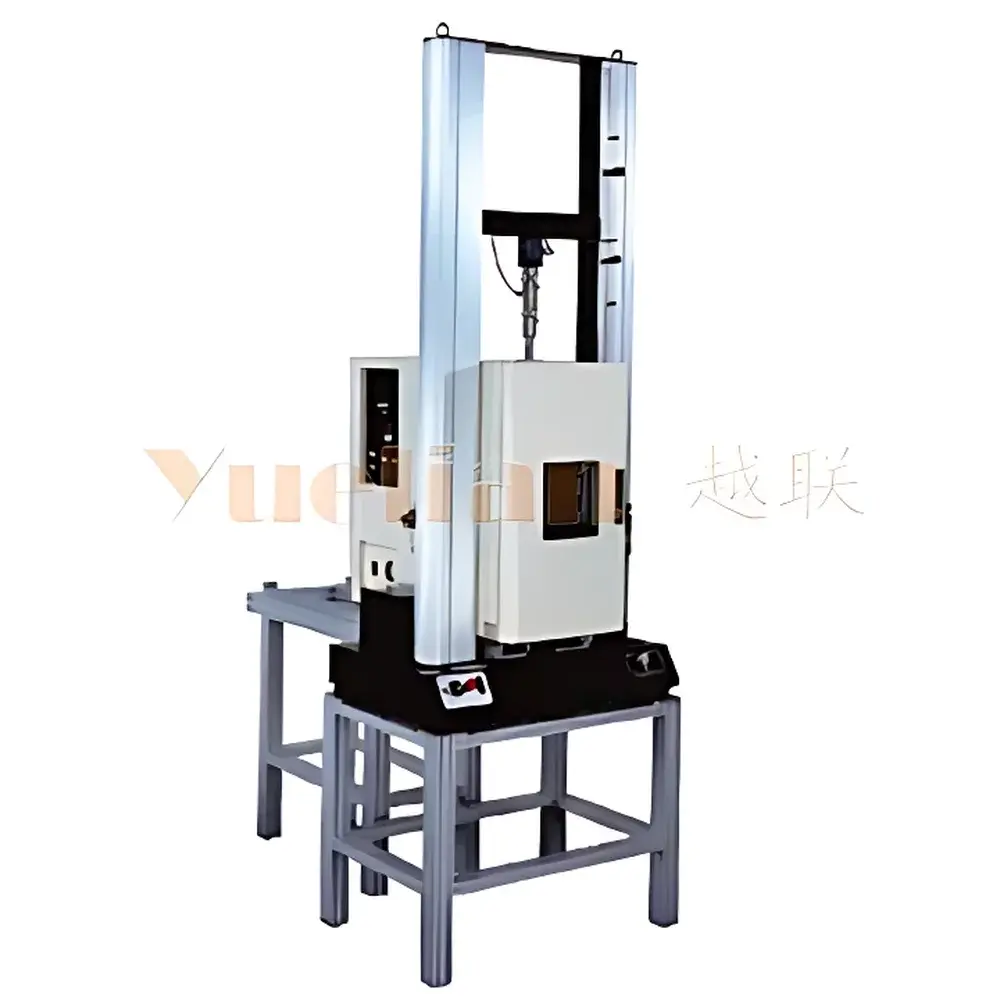
Yuelian YL-1161 Universal Testing Machine with Integrated Environmental Chamber
| Brand | Yuelian |
|---|---|
| Model | YL-1161 |
| Type | Electromechanical Universal Testing Machine with Modular Temperature-Controlled Chamber |
| Capacity Options | 10 N to 10 kN (dual-range configuration available) |
| Temperature Range | –70 °C to +150 °C |
| Force Resolution | 1/250,000 full scale |
| Force Accuracy | ≤ ±0.5% of reading |
| Displacement Resolution | 0.005 mm |
| Crosshead Speed | 0.5–500 mm/min (programmable) |
| Test Space (without chamber) | 720 mm (W) × 1300 mm (H) |
| Chamber Internal Dimensions | 500 × 480 × 650 mm (W×D×H) |
| Temperature Uniformity | ±1 °C |
| Temperature Display Resolution | 0.1 °C |
| Control Algorithm | PID auto-tuning |
| Cooling System | High-efficiency compressor with eco-friendly refrigerant |
| Heating System | SUS304 stainless steel finned heater |
| Air Circulation | Forced convection via axial fans |
| Structural Frame | Heavy-duty welded steel base with precision ball-screw and timing belt drive |
| Actuation | Servo motor |
| Power Supply | 220 V, 50/60 Hz, 30 A |
| Rated Power | 400 W |
| Net Weight | ~420 kg |
| Compliance | Designed for ASTM E8/E21, ISO 6892-1, GB/T 228.1, and JIS Z2241 test method execution |
Overview
The Yuelian YL-1161 Universal Testing Machine with Integrated Environmental Chamber is an electromechanical materials testing system engineered for high-reproducibility mechanical characterization under controlled thermal conditions. Unlike conventional ambient-only tensile testers, this platform integrates a modular, independently operable temperature chamber—enabling standardized uniaxial mechanical tests across a wide thermal spectrum from –70 °C to +150 °C. The system operates on the principle of servo-controlled displacement actuation, where load is measured via high-stability strain-gauge-based load cells and position via high-resolution optical encoders coupled to a preloaded ball-screw transmission. Its rigid frame architecture minimizes deflection during high-load testing, ensuring traceable force–displacement data acquisition per ISO 7500-1 Class 1 requirements. The chamber’s forced-air circulation, PID-regulated heating/cooling subsystem, and stainless-steel interior ensure uniform thermal distribution and minimal gradient-induced measurement artifacts—critical for evaluating temperature-dependent viscoelastic transitions, embrittlement thresholds, or polymer crystallinity effects.
Key Features
- Modular environmental chamber design: Detachable for standalone ambient testing—increasing workspace flexibility and reducing thermal cross-contamination risk during non-climate trials.
- Dual-range load cell support: Configurable capacity options from 10 N to 10 kN, including optional dual-sensor setups for extended dynamic range without manual recalibration.
- Precision motion control: Servo-driven crosshead with 0.005 mm displacement resolution and programmable speed profiles (0.5–500 mm/min), compliant with ramp-hold and cyclic loading protocols.
- Thermal performance validation: Chamber maintains ±1 °C stability at setpoint across full volume; real-time temperature logging synchronized with mechanical data at user-defined sampling intervals.
- Comprehensive safety architecture: Integrated overcurrent protection, compressor overheat cutoff, upper/lower thermal limit switches, emergency stop circuitry, and automatic load-unload upon specimen failure.
- Structural integrity: Heavy-gauge welded base, hardened ball-screw assembly, and reinforced column structure ensure long-term alignment stability and minimal compliance error (<0.15% of full-scale stroke).
Sample Compatibility & Compliance
The YL-1161 accommodates standard tensile bars (ASTM E8), dog-bone specimens (ISO 6892-1), peel strips (ASTM D903), shear coupons (ASTM D1002), and film/packaging substrates (ASTM F88, F904). Its 720 mm test width and 1300 mm vertical stroke support large-format composites, laminates, and elastomeric assemblies. Chamber internal dimensions (500 × 480 × 650 mm) permit multi-specimen batch testing under identical thermal history. The system supports GLP-compliant operation through audit-trail-enabled software (see Software section) and meets mechanical accuracy requirements per ISO 7500-1 Class 1 and force calibration traceability to national standards (e.g., NIST, NIM). It facilitates test execution aligned with ASTM D638 (plastics), ASTM D3039 (composites), ISO 527, and GB/T 1040 series—making it suitable for QC labs operating under ISO/IEC 17025 accreditation frameworks.
Software & Data Management
The embedded PC-based control suite provides ISO/IEC 17025-aligned data governance: all test parameters, raw sensor outputs, thermal logs, and operator actions are timestamped and stored in encrypted MS-ACCESS databases with immutable audit trails. The interface supports multi-channel synchronization (load, displacement, chamber temperature, ambient humidity if equipped), real-time curve overlay, and post-test calculation of ASTM/ISO-defined metrics—including ultimate tensile strength, yield offset (0.2%), Young’s modulus, elongation at break, and energy-to-break. Customizable report templates export to PDF, Excel, or XML formats with configurable headers, footers, and digital signature fields. Optional 21 CFR Part 11 compliance packages include electronic signatures, role-based access control, and revision-controlled method files—enabling deployment in regulated pharmaceutical, medical device, or aerospace QA environments.
Applications
This system serves laboratories requiring thermomechanical property mapping of polymeric films, adhesives, thermoplastic elastomers, battery separator membranes, automotive gaskets, and cryogenic sealants. It enables low-temperature ductility assessment of PVC formulations, high-temperature creep resistance evaluation of engineering resins (e.g., PEEK, PEI), and humidity-coupled peel strength quantification in packaging R&D. In academic research, it supports fundamental studies on glass transition shifts under stress (stress-DSC correlation), cold-drawing behavior of semi-crystalline polymers, and interfacial debonding kinetics in fiber-reinforced composites. Industrial users deploy it for incoming material verification against supplier specifications, accelerated aging protocol validation, and failure root-cause analysis of field returns exhibiting temperature-dependent fracture modes.
FAQ
Can the environmental chamber be operated independently of the testing frame?
Yes—the chamber is mechanically decoupled and features its own power input, controller, and safety interlocks, allowing standalone thermal cycling or conditioning without actuating the load frame.
Is third-party calibration certification included with shipment?
Calibration certificates traceable to national metrology institutes (e.g., CNAS-accredited labs) are available as an optional add-on; factory verification reports covering force, displacement, and temperature subsystems are standard.
What specimen grips are supplied by default?
One set of pneumatic or mechanical wedge-action grips (user-selectable jaw profile) is included; additional fixtures—such as compression platens, bend fixtures, or peel test adapters—are available as catalog options.
Does the system support closed-loop strain control?
Strain-controlled testing requires external extensometry (e.g., clip-on or video extensometer); the base configuration supports load- and displacement-controlled modes only.
How is thermal soak time validated prior to mechanical testing?
The software includes a “soak stabilization monitor” that confirms temperature uniformity across three internal probe points for ≥5 minutes before enabling test initiation—configurable per internal SOPs.



