
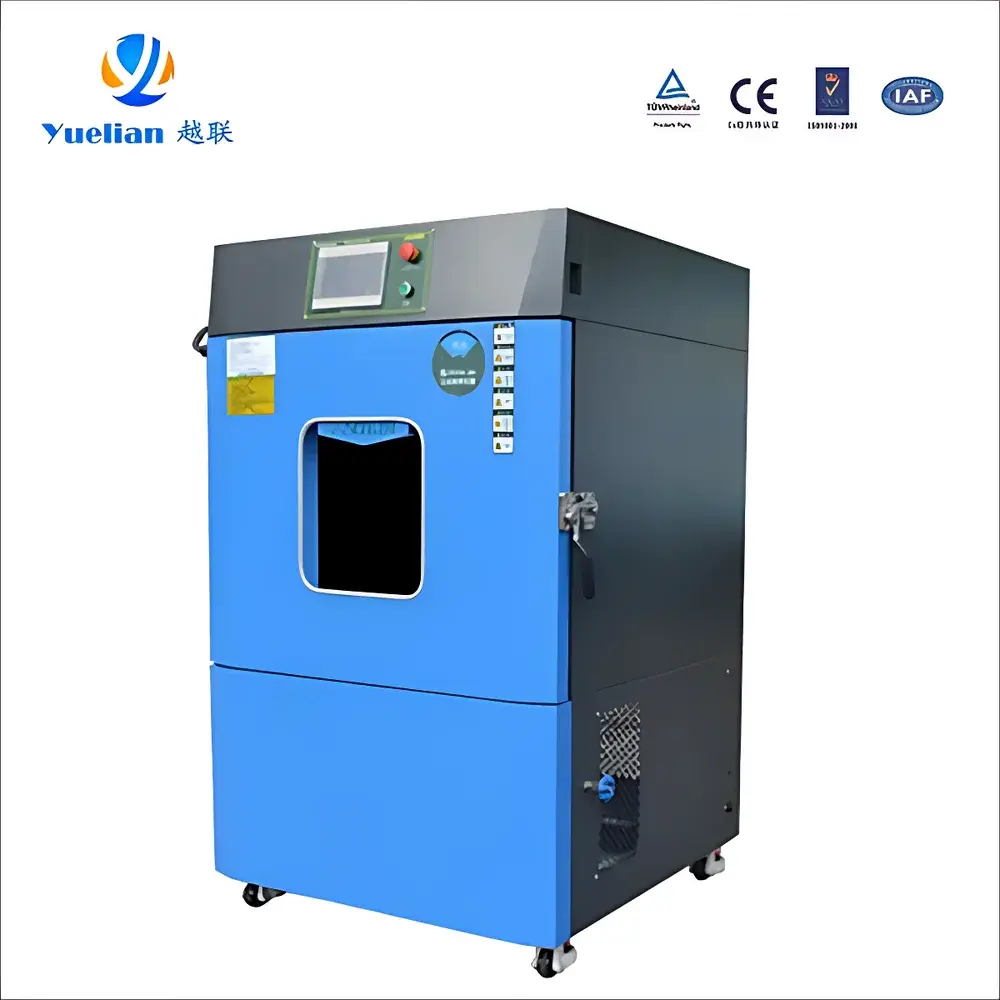
YL-RS-01 Battery Flame Ejection Test Chamber
| Brand | Yuelian |
|---|---|
| Model | YL-RS-01 |
| Origin | Guangdong, China |
| Construction | Integrated chamber with cold-rolled steel outer shell and thickened stainless steel inner chamber |
| Internal Dimensions | W600 × D600 × H700 mm |
| External Dimensions | W1150 × D1100 × H1660 mm |
| Observation Window | 350 × 400 mm double-layer tempered blast-resistant glass |
| Flame Source | Bunsen burner (inner tube diameter 9.5 mm, length 100 mm) |
| Flame Height Adjustment Range | 10–75 mm (±5 mm accuracy) |
| Flame Application Time | 0–999.9 s (±0.1 s resolution) |
| Afterflame Time Measurement | 0–999.9 s (±0.1 s) |
| Test Orifice Diameter | 102 mm ± 2 mm |
| Steel Wire Mesh | 20 mesh, wire diameter 0.45 mm (aperture ≈ 800 µm per GB/T 6005-2008 R20) |
| Aluminum Enclosure Mesh | Octagonal, opposing sides 610 ± 10 mm, height 305 ± 5 mm, wire diameter 0.25 mm, 16–18 mesh (aperture ≈ 1.12 mm per GB/T 5330-2003 R20) |
| Ignition System | Automatic electronic ignition |
| Gas Supply | High-purity LPG (user-supplied) |
| Exhaust System | Forced-air exhaust with ducting interface |
| Pressure Relief | Integrated automatic pressure relief port |
| Control System | PLC-based HMI touchscreen interface |
| Power Supply | AC 220 V, 50 Hz |
Overview
The YL-RS-01 Battery Flame Ejection Test Chamber is an engineered safety validation system designed to evaluate the thermal runaway propagation resistance and flame ejection behavior of lithium-ion and other rechargeable battery cells under controlled open-flame exposure. It implements the test methodology specified in international standards including IEC 62133-2:2017 Annex E (Flame Exposure Test), UN Manual of Tests and Criteria Part III, subsection 38.3.2 (Fire Exposure), and GB 31241–2014 Clause 4.5.1 and Appendix E.2. The chamber subjects a fully charged battery cell to direct flame impingement on a standardized steel wire support grid, while enclosing the test zone within an octagonal aluminum mesh containment structure. This configuration enables quantitative assessment of flame jetting directionality, ejection velocity, particle dispersion, and structural integrity retention — critical parameters for evaluating fire containment design in battery modules, energy storage systems, and portable electronics.
Key Features
- Integrated structural architecture with cold-rolled steel exterior (gray + blue epoxy finish) and high-grade 304 stainless steel interior chamber for corrosion resistance and thermal stability
- Double-layer tempered blast-resistant observation window (350 × 400 mm) with integrated LED illumination for real-time visual monitoring without compromising operator safety
- Precision-engineered Bunsen burner assembly featuring 9.5 mm inner-diameter stainless steel tube, adjustable flame height (10–75 mm), and ±5 mm positional repeatability
- PLC-controlled HMI touchscreen interface supporting programmable flame application duration (0–999.9 s, ±0.1 s resolution) and afterflame timing measurement
- Standardized test orifice (102 mm ± 2 mm diameter) and calibrated support grid: 20-mesh steel wire mesh (0.45 mm wire, ~800 µm aperture per GB/T 6005-2008 R20)
- Octagonal aluminum containment enclosure (610 ± 10 mm opposing width, 305 ± 5 mm height) constructed from 0.25 mm diameter wire, 16–18 mesh (1.12 mm aperture per GB/T 5330-2003 R20)
- Forced-air exhaust system with dedicated duct interface and automatic pressure relief port to manage rapid gas expansion during thermal runaway events
- Compliance-ready mechanical design accommodating standard sample fixtures and optional custom mounting adapters per customer-defined cell formats (prismatic, cylindrical, pouch)
Sample Compatibility & Compliance
The YL-RS-01 accommodates single-cell testing across common form factors — including 18650, 21700, 26650 cylindrical cells; 50–100 mm wide prismatic cells; and flexible pouch cells up to 150 mm × 150 mm. Sample positioning follows ISO/IEC 17025-aligned procedures: cells are preconditioned per manufacturer specifications (typically charged to 100% SOC at 23 ± 2 °C), placed centrally on the steel mesh support without mechanical restraint unless slippage occurs, and oriented to replicate worst-case thermal exposure geometry. The system supports traceable test execution required under GLP and GMP environments, with audit-ready event logs capturing ignition timestamp, flame-on duration, visual observations, and chamber pressure excursions. While not certified to UL 2580 or IEEE 1625 by default, its physical configuration and procedural fidelity align with the apparatus requirements referenced in those standards’ flame exposure clauses.
Software & Data Management
The embedded PLC controller records all operational parameters—including flame activation time, elapsed burn duration, ambient temperature, and manual operator annotations—into a non-volatile internal memory buffer. Export is supported via USB 2.0 interface to CSV format for integration into laboratory information management systems (LIMS) or quality documentation workflows. No cloud connectivity or remote access capability is included, preserving data sovereignty and ensuring compliance with internal IT security policies common in regulated manufacturing and R&D facilities. All timing functions are hardware-synchronized using industrial-grade quartz oscillators, meeting traceability requirements for ISO/IEC 17025 Clause 6.5.2 (measurement uncertainty of timekeeping).
Applications
- Evaluation of cell-level flame ejection thresholds for hazard classification per UN 38.3 and transport safety assessments
- Comparative analysis of electrolyte formulation, separator shutdown behavior, and vent design efficacy under forced thermal stress
- Validation of fire-retardant module enclosures and thermal barrier materials in early-stage battery pack development
- Root-cause investigation of field failure incidents involving thermal runaway propagation
- Supporting technical documentation for CE marking, KC certification, and CCC conformity assessments in APAC markets
- Internal safety gate review testing prior to cell qualification for automotive (GB/T 31485), energy storage (NB/T 42091), and medical device applications
FAQ
What gas fuel is required for operation?
High-purity liquefied petroleum gas (LPG) with ≥95% propane/butane content is mandatory. Natural gas or hydrogen must not be used due to incompatible combustion kinetics and flame geometry.
Is the chamber suitable for testing battery modules or only single cells?
The YL-RS-01 is configured for single-cell evaluation per standardized test protocols. Module-level testing requires custom fixture engineering and is outside the scope of this model’s validated operating envelope.
Does the system include flame temperature calibration tools?
No built-in thermocouple or pyrometer is integrated; users must employ external Class K or S thermocouples positioned at the specified flame impingement plane per GB/T 5169.17 or IEC 60695-11-20 for temperature verification.
Can test data be exported in PDF or XML format?
Data export is limited to timestamped CSV files containing raw control timestamps and user-entered metadata. Conversion to PDF/XML is performed externally using validated third-party software.
What maintenance intervals are recommended for the burner assembly?
Visual inspection and nozzle cleaning with stainless steel wire brush are required before each test series. Full burner calibration (flow rate, stoichiometry verification) is advised every 200 operational hours or quarterly, whichever occurs first.



