
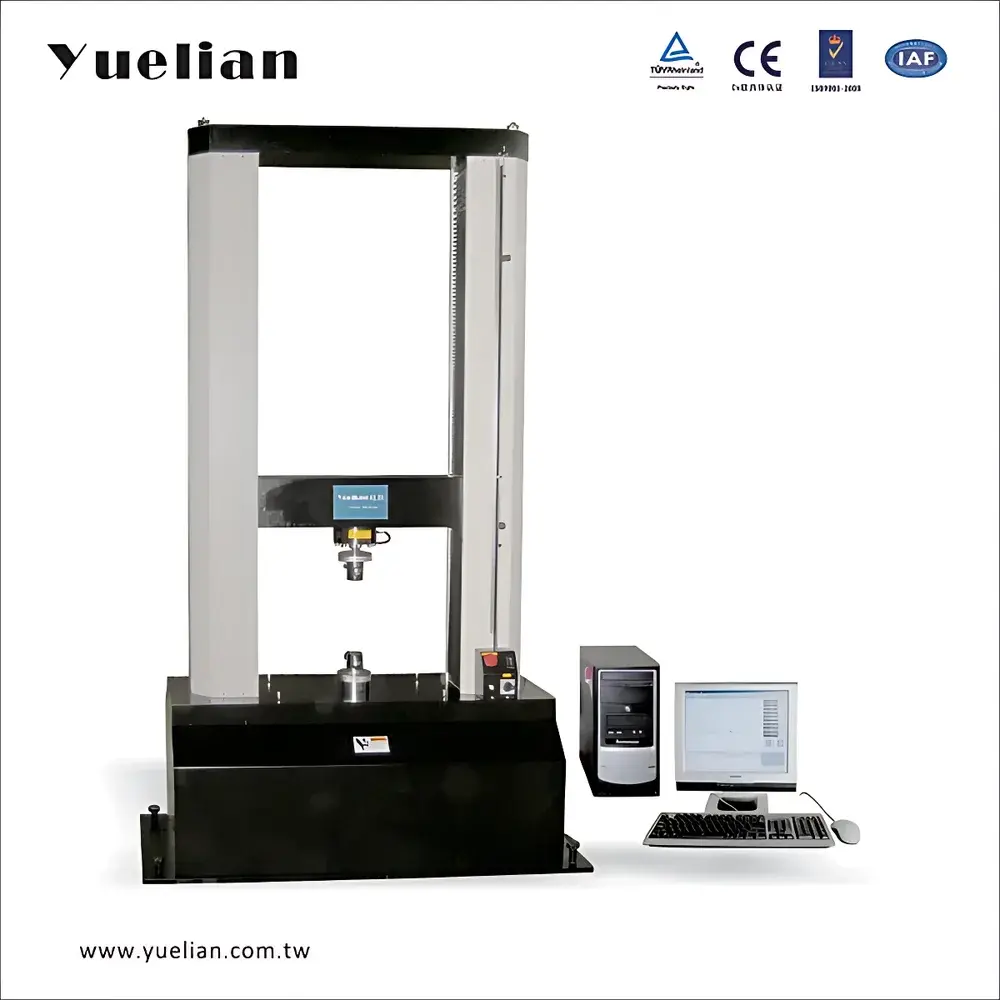
YL-1151 Yuelian Electronic Universal Tensile Testing Machine for Low-Carbon Steel and General Materials
| Brand | Yuelian |
|---|---|
| Model | YL-1151 |
| Type | Electronic Universal Tensile Testing Machine |
| Capacity Options | 1 kN, 2 kN, 5 kN, 10 kN, 20 kN, 50 kN, 100 kN (dual-range configuration available) |
| Force Resolution | 1/250,000 full scale |
| Force Accuracy | ≤ ±0.5% of reading |
| Displacement Resolution | 0.005 mm |
| Test Speed Range | 0.5–500 mm/min (software-controlled) |
| Maximum Travel | 1000 mm |
| Test Width | 550 mm |
| Drive System | Servo motor with precision ball screw and synchronous belt transmission |
| Power Supply | 220 V, 50/60 Hz, 10 A |
| Rated Power | 1800 W |
| Dimensions (W×D×H) | 92 × 75 × 199 cm |
| Weight | ~800 kg |
| Compliant Standards | ISO 7500-1, ASTM E4, EN 10002-1, EN 10002-2, DIN 51221, JIS B7721/B7733, GB/T 228.1, JJG 475 |
Overview
The YL-1151 Yuelian Electronic Universal Tensile Testing Machine is a statically calibrated, microprocessor-controlled mechanical testing system engineered for high-reproducibility uniaxial mechanical characterization of metallic and non-metallic materials—including low-carbon steel, aluminum alloys, polymers, elastomers, composites, textiles, paper, and adhesives. Based on the fundamental principles of Hooke’s law and standardized axial load application, the system applies controlled tensile, compressive, flexural, shear, peel, tear, and剥离 (peel/adhesion) forces to specimens while continuously recording force-displacement data. Its rigid C-frame architecture, coupled with a precision ground ball screw actuator and closed-loop servo control, ensures minimal frame compliance and consistent loading rates across the full speed range—critical for accurate determination of yield strength, ultimate tensile strength (UTS), elongation at break, Young’s modulus, and proof stress in accordance with ISO 6892-1 and ASTM E8/E21.
Key Features
- High-resolution force measurement with ≤ ±0.5% accuracy traceable to ISO 7500-1 Class 1 calibration requirements
- Adjustable dual-capacity load cell options (e.g., 10 kN / 100 kN) enabling seamless transition between low-force polymer testing and high-force structural metal evaluation
- Software-defined test speed control from 0.5 to 500 mm/min, supporting both quasi-static and intermediate-rate mechanical response assessment
- Integrated emergency stop circuitry, overload protection, specimen rupture auto-stop, and programmable upper/lower displacement limits for operator safety and test integrity
- Modular夹具 (gripping) system compatible with wedge-action, pneumatic, hydraulic, and custom-designed fixtures for flat, round, or irregular cross-sections
- Full PC-based operation with real-time curve plotting, multi-channel sensor support (load, extensometer, environmental chamber feedback), and MS Access–backed database architecture for audit-ready data storage
Sample Compatibility & Compliance
The YL-1151 accommodates standard tensile specimens per ISO 6892-1 (Type 2, 5 mm gauge width), ASTM E8M (flat and round bars), and GB/T 228.1, including sheet, rod, wire, and stamped components up to 550 mm wide and 1000 mm stroke length. It supports optional clip-on or contacting extensometers for strain measurement compliant with ISO 9513 Class 1 accuracy. The system meets mechanical verification requirements of ISO 7500-1, calibration traceability standards per JJG 475, and international metrological equivalence under ASTM E4 and EN 10002-1. When configured with validated software and electronic signature protocols, it supports GLP/GMP-aligned workflows and satisfies FDA 21 CFR Part 11 requirements for electronic records and signatures in regulated QC environments.
Software & Data Management
The embedded Windows-based test control software provides ISO/IEC 17025–compatible test method templates, automatic parameter calculation (yield point Rp0.2, UTS, A5, E-modulus, n-value), and post-test curve analysis (true stress–strain, tangent modulus, uniform elongation). Raw data exports to CSV, XML, and PDF formats; graphical overlays enable comparative analysis across batches or material grades. Database schema includes timestamped operator ID, environmental conditions (optional temperature/humidity input), calibration history, and instrument configuration logs—enabling full traceability for internal audits or third-party certification reviews.
Applications
This system serves as a primary tool in metallurgical QA laboratories for verifying low-carbon steel grade conformity (e.g., Q235, SS400, ASTM A36) against yield strength ≥235 MPa and tensile strength 370–500 MPa specifications. It is equally deployed in polymer R&D for creep compliance profiling, in packaging labs for seal strength validation per ASTM F88, and in aerospace component suppliers for fastener pull-out and composite laminate interlaminar shear testing. Academic institutions utilize its open API and scriptable interface for custom protocol development in fracture mechanics and viscoelastic modeling.
FAQ
What standards does the YL-1151 comply with for low-carbon steel tensile testing?
It fully supports ISO 6892-1, ASTM E8/E21, GB/T 228.1, and EN 10002-1 for specimen preparation, testing procedure, and result reporting.
Can the system be integrated into an existing LIMS or MES environment?
Yes—via OPC UA or TCP/IP socket interface, with configurable data fields mapped to LIMS identifiers such as sample ID, batch number, and test method code.
Is extensometer support included in the base configuration?
No—extensometers are optional accessories; however, the controller features dedicated analog/digital inputs and firmware-level compatibility with major brands (e.g., MTS, Zwick, Instron).
Does the software meet FDA 21 CFR Part 11 requirements?
Out-of-the-box compliance requires installation of validated software version with role-based access control, electronic signature capture, and audit trail generation—available upon request with IQ/OQ documentation.
What maintenance intervals are recommended for long-term accuracy retention?
Annual force calibration verification per ISO 7500-1 is mandatory; biannual mechanical inspection of ball screw preload, guide rail lubrication, and drive belt tension is advised for continuous operation environments.



