
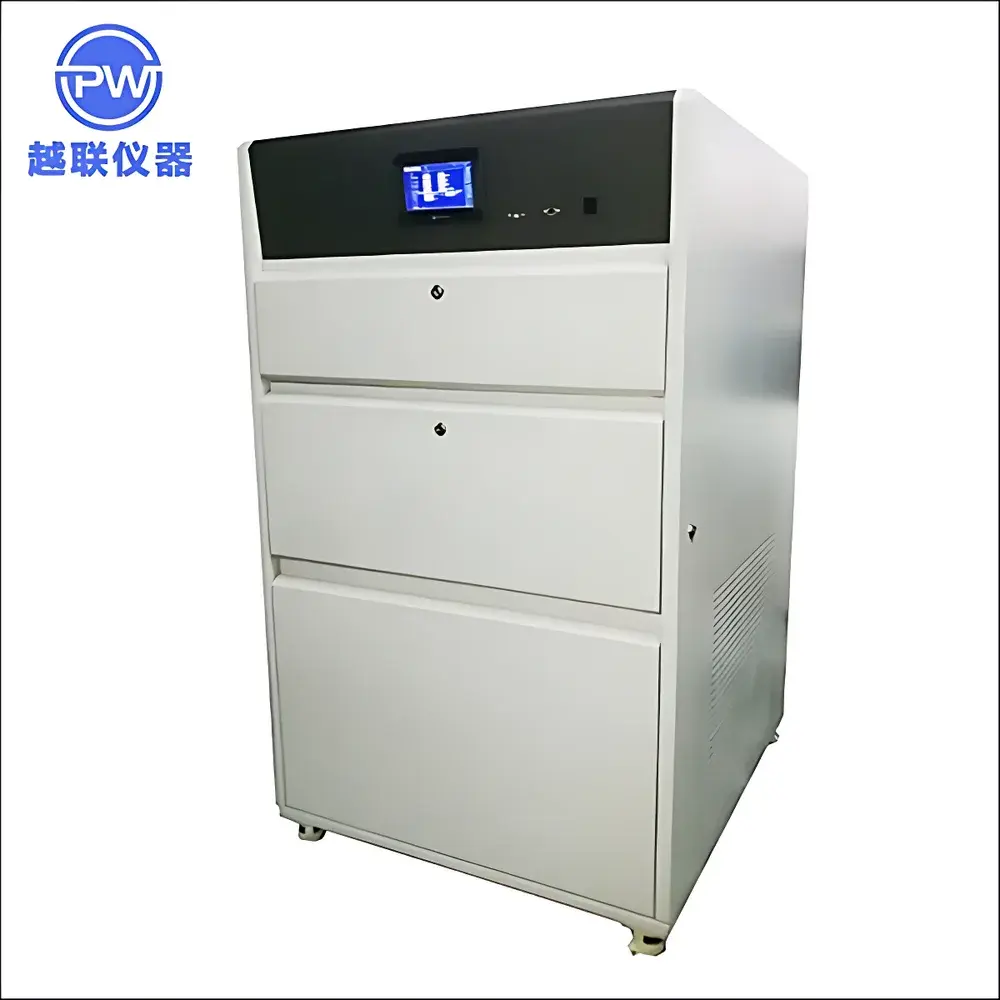
Yuelian / PW PW-CX1800C Xenon Arc Weathering Test Chamber
| Brand | Yuelian / PW |
|---|---|
| Origin | Guangdong, China |
| Manufacturer Type | Authorized Distributor |
| Country of Origin | China |
| Model | PW-CX1800C |
| Internal Dimensions (D×W×H) | 490 × 790 × 400 mm |
| External Dimensions (D×W×H) | 1130 × 1020 × 1800 mm |
| Lamp Power | 1.8 kW (Air-Cooled Long-Arc Xenon Lamp, X-1800 Type) |
| Lamp Life | ≥1500 h |
| Irradiance Control Points | 340 nm, 420 nm, 300–400 nm, 300–800 nm |
| Irradiance Range | 0.25–1.10 W/m² @340 nm |
| Irradiance Stability | Closed-loop control via fiber-optic solar eye with IPD auto-regulation |
| Filter System | Custom multi-layer glass filter assemblies compliant with ISO 4892-2, ISO 11341, AATCC TM16, GB/T 16422.2, JIS D 0205 |
| Chamber Temperature (CHT) | 35–80 °C |
| Black Panel Temperature (BPT) | 35–100 °C |
| Black Standard Temperature (BST) | 35–110 °C |
| Temperature Uniformity | ±3 °C |
| Temperature Fluctuation | ±0.5 °C |
| Humidity Range (Light Cycle) | 20–75 %RH |
| Humidity Range (Dark Cycle) | 45–100 %RH |
| Humidity Accuracy | ±5 %RH |
| Spray Rate | 0.2–0.4 L/min |
| Spray Mode | Surface-directed high-pressure deionized water spray |
| Sample Tray | 750 × 480 mm stainless steel, adjustable tilt angle of 10° |
| Dark/Light Cycle | 0–9999 h programmable |
| Spray Cycle | 0–9999 min programmable |
| Display | 7-inch WEINVIEW color touchscreen HMI (bilingual: English/Chinese) |
| Data Export | USB port for CSV/Excel export |
| Remote Monitoring | Web-enabled Ethernet + mobile app support |
| Compliance Standards | ISO 4892-2, ISO 11341, ASTM G155, AATCC TM16, AATCC 169, GB/T 8427-2008, GB/T 16422.2-2014, JIS D 0205 |
Overview
The Yuelian / PW PW-CX1800C Xenon Arc Weathering Test Chamber is an engineered laboratory-grade instrument designed to replicate the photothermal and hygrothermal stressors of natural outdoor exposure under controlled, repeatable, and standardized conditions. It employs a high-intensity, air-cooled long-arc xenon lamp system—spectrally filtered to match terrestrial solar irradiance (AM1.5G) with >98% spectral fidelity—to accelerate material degradation mechanisms including photooxidation, hydrolysis, pigment fading, polymer chain scission, surface embrittlement, and chromatic shift. Unlike UV fluorescent or metal halide sources, xenon arc technology delivers full-spectrum irradiation (300–800 nm), enabling accurate simulation of daylight-driven aging across polymers, coatings, textiles, automotive interiors, elastomers, and composite materials. The chamber integrates real-time monitoring of irradiance (at user-selectable wavelengths), black panel temperature (BPT), black standard temperature (BST), chamber air temperature (CHT), relative humidity, and spray dynamics—ensuring traceable, audit-ready test execution aligned with international exposure protocols.
Key Features
- Triple-lamp xenon arc source (1.8 kW each, imported long-arc X-1800 type) with intelligent electronic ballast for stable ignition and luminous output consistency.
- Modular optical filtration system using precision-ground borosilicate and quartz glass filters—configurable to meet spectral requirements of ISO 4892-2 (Daylight, Window Glass, Extended UV), ISO 11341, ASTM G155, and AATCC TM16.
- Closed-loop irradiance control via embedded fiber-optic solar eye (IPD sensor) with automatic lamp power modulation—maintaining setpoint stability within ±5% over extended cycles.
- Dual temperature sensing architecture: simultaneous BPT/BST/CHT measurement at sample-level position, processed in real time and visualized as digital values, trend curves, and tabular logs on the 7-inch HMI.
- Nano-enhanced PTC humidification system with SUS316 stainless steel evaporator—achieving ≤0.2 L/min water consumption at 38 °C / 95 %RH, reducing operational cost and maintenance frequency by >60% versus conventional steam-based systems.
- High-precision spray subsystem delivering uniform deionized water mist (0.2–0.4 L/min) directly onto specimen surfaces during light or dark phases—enabling thermal shock simulation and condensation formation per ISO 4892-2 Annex C.
- 10° tiltable stainless steel sample tray (750 × 480 mm) supporting planar and three-dimensional specimens without pooling—compatible with standard ISO, ASTM, and AATCC specimen holders.
- Comprehensive safety architecture: interlocked lamp cooling circuit, dry-run protection for humidifier and water reservoir, phase-loss/leakage detection, overtemperature cutoffs (lamp, chamber, BST/BPT), and motor thermal overload relays.
- Embedded data logging with ≥6-month local storage capacity; export via USB to Excel-compatible CSV files; optional remote access via encrypted web interface or native iOS/Android application.
Sample Compatibility & Compliance
The PW-CX1800C accommodates flat coupons (e.g., ISO 105-B02, ASTM D2244), molded automotive trim parts, textile swatches (AATCC EP1, ISO 105-B01), coated metal panels, rubber gaskets, and laminated composites. Its modular irradiance control, dual-temperature sensing, and programmable spray/dark cycles ensure conformance with regulatory and industry-standard test methods—including ISO 4892-2 (Plastics – Laboratory light exposure – Part 2: Xenon-arc method), ISO 11341 (Paints and varnishes – Artificial weathering and exposure to radiation), ASTM G155 (Standard Practice for Operating Xenon Arc Equipment), AATCC TM16 (Colorfastness to Light), AATCC 169 (Weatherometer Testing), GB/T 8427-2008 (Textiles – Color fastness to artificial light), and GB/T 16422.2-2014 (Plastics – Methods of exposure to laboratory light sources – Part 2: Xenon-arc lamps). All control parameters—including irradiance setpoints, temperature ramps, humidity profiles, and cycle sequencing—are fully configurable and retainable across power cycles, supporting GLP-compliant documentation and FDA 21 CFR Part 11–ready audit trails when integrated with validated LIMS environments.
Software & Data Management
The embedded controller firmware supports 11 preloaded test programs conforming to major standards (ISO, ASTM, AATCC, GB, JIS), plus user-defined custom protocols with up to 99 segments per program. Real-time data—including irradiance (W/m²), BPT/BST/CHT (°C), RH (%), elapsed time, and lamp operating hours—is logged at 1-second intervals and rendered in three synchronized display modes: numeric readouts, dynamic XY trend plots (e.g., irradiance vs. time), and scrollable tabular history. Alarm events (e.g., low water, lamp overheat, phase loss) trigger on-screen diagnostics with actionable remediation guidance and automatic safety shutdown. Data export generates timestamped, comma-separated files compatible with Microsoft Excel, MATLAB, and statistical process control (SPC) platforms. Remote operation enables start/stop command issuance, live parameter adjustment, and historical log retrieval via secure HTTP(S) or MQTT protocol—facilitating centralized fleet management in multi-chamber QA laboratories.
Applications
This chamber serves quality assurance and R&D laboratories in automotive OEMs and Tier-1 suppliers for evaluating dashboard materials, seat fabrics, sealants, and exterior trim under SAE J2412/J2527 simulated sunlight. It supports coating formulators in validating UV resistance of architectural paints (per ISO 11341) and industrial powder coatings (ASTM D4587). Textile manufacturers use it for AATCC 169-compliant climate testing of performance apparel, upholstery, and military-spec fabrics. Polymer compounders rely on its reproducible irradiance control to assess stabilizer package efficacy in polyolefins and engineering resins per ISO 4892-2. Additionally, it fulfills accelerated corrosion testing needs for photovoltaic encapsulants (IEC 61215), medical device packaging (ISO 11607), and aerospace interior materials (SAE ARP4754A), where correlation between accelerated exposure and field service life is critical for design validation and regulatory submission.
FAQ
What spectral ranges can be monitored and controlled?
Irradiance is actively regulated at four selectable bands: 340 nm (UV-B dominant), 420 nm (near-UV/visible transition), 300–400 nm (full UV), and 300–800 nm (broadband solar). Each uses dedicated optical sensors and closed-loop feedback.
Is the chamber suitable for testing 3D components?
Yes—the 10° inclined sample tray and vertical lamp array allow uniform irradiation of non-planar parts such as automotive grilles, lighting housings, and molded plastic assemblies without shadowing artifacts.
How does the system ensure humidity accuracy during dark cycles?
A dual-mode humidification strategy combines nano-evaporative PTC heating with precise PID-controlled steam injection, maintaining ±5 %RH tolerance even during high-humidity dark phases (up to 100 %RH) without condensation on optics or sensors.
Can test data be integrated into enterprise LIMS or QMS platforms?
Yes—CSV exports are structured for direct ingestion into common laboratory information management systems. Optional OPC UA or REST API modules enable real-time telemetry integration for automated compliance reporting.
What maintenance intervals are recommended for lamp and filter replacement?
Xenon lamps require replacement after ≥1500 hours of cumulative operation; filter sets should be inspected every 500 hours and replaced if spectral transmission deviates >5% from baseline calibration—typically every 1,000–1,200 hours under continuous use.



