
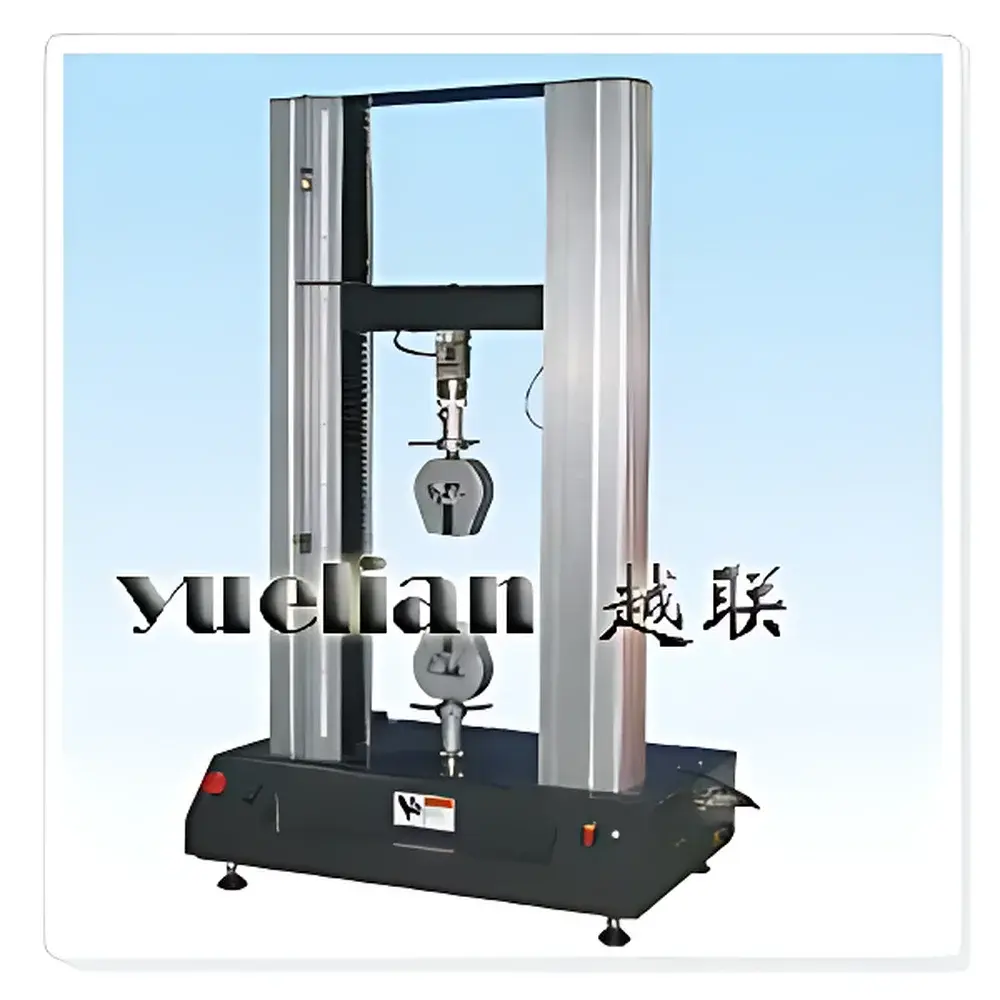
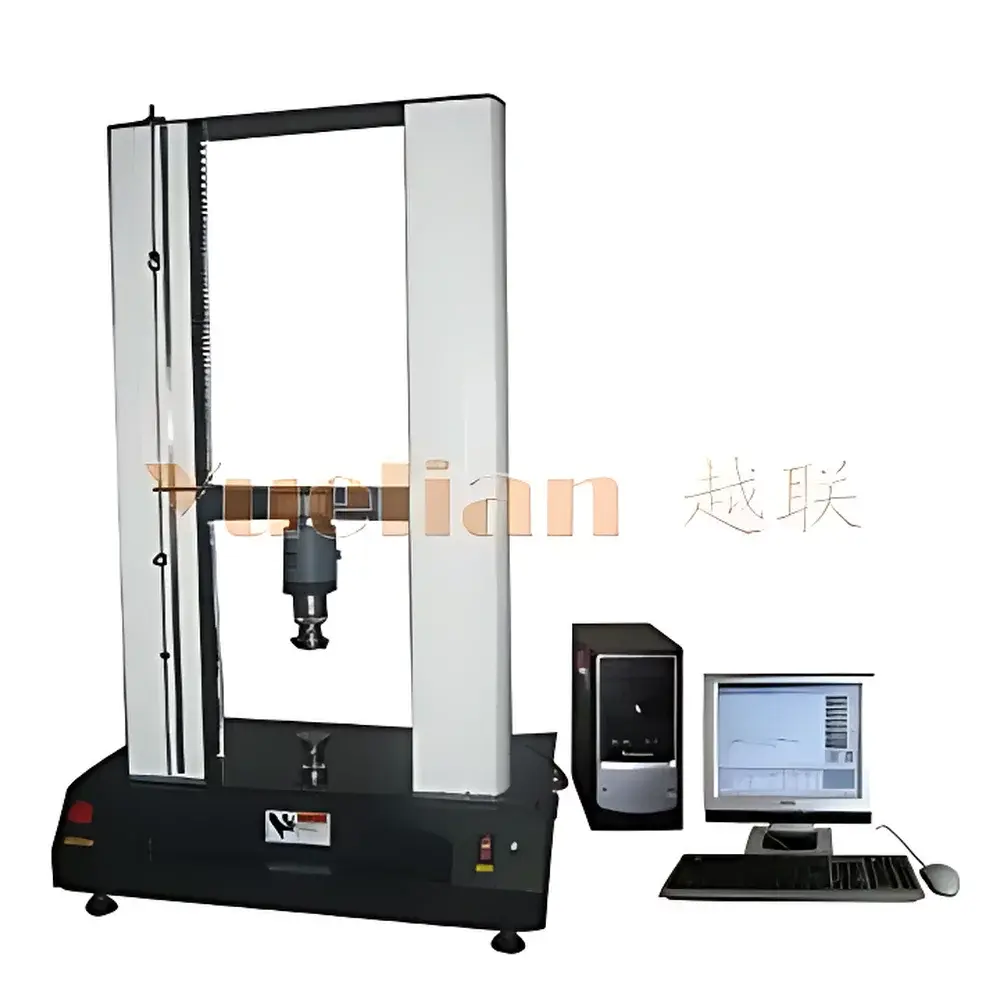
Yuelian YL-1123 Universal Testing Machine
| Brand | Yuelian |
|---|---|
| Origin | Guangdong, China |
| Model | YL-1123 |
| Force Capacity Range | Not specified |
| Test Speed Range | Not specified |
| Load Cell Options | Interchangeable |
| Control Mode | Computer-servo controlled or standalone operation |
| Compliance | Designed for ASTM D638, D790, D412, ISO 527, ISO 178, ISO 37, GB/T 1040, GB/T 9341, GB/T 528 |
| Sample Holders | Modular fixture system (tensile grips, compression platens, bending fixtures) |
| Environmental Integration | Compatible with environmental chambers (e.g., temperature-controlled ovens) |
| Data Output | Stress–strain curves, peak load, yield strength, modulus, elongation at break, fracture energy |
Overview
The Yuelian YL-1123 Universal Testing Machine is an electromechanical static testing system engineered for precision measurement of mechanical properties across a broad spectrum of solid materials—including polymers, metals, elastomers, composites, textiles, and fasteners. Operating on the principle of controlled displacement or load application via a servo-controlled AC motor-driven crosshead, the system applies uniaxial tensile, compressive, flexural, peel, shear, or tear forces to standardized specimens in accordance with internationally recognized test methods. Its dual-test-space architecture—featuring upper and lower loading zones—enables seamless transition between low-force characterization (e.g., thin films or elastomeric strips) and high-force evaluation (e.g., steel wires or structural components), eliminating the need for multiple dedicated machines in mid-volume QC laboratories.
Key Features
- Modular force capacity configuration: Supports interchangeable load cells (e.g., 100 N to 50 kN range options) to maintain optimal signal-to-noise ratio across diverse material classes.
- Dual-zone test frame design: Independent upper and lower test spaces allow concurrent setup of tensile and compression configurations—reducing changeover time and improving throughput in production environments.
- Servo-controlled actuation: High-resolution rotary encoder feedback ensures precise displacement control (±0.01 mm repeatability) and constant-rate loading profiles compliant with ASTM E4 and ISO 7500-1 calibration standards.
- Fixture agnosticism: Standard M6 and M8 threaded mounting interfaces accommodate third-party and custom-engineered grips—including pneumatic tensile clamps, wedge-action grips, compression platens, three-point bend fixtures, and peel test fixtures.
- Environmental adaptability: Structural frame and crosshead geometry permit integration with external environmental chambers (−70 °C to +300 °C), enabling temperature-dependent mechanical property assessment per ASTM D618 and ISO 291 conditioning protocols.
- Compliance-ready architecture: Firmware supports audit-trail logging, user-level access control, and electronic signature capture—facilitating alignment with GLP, GMP, and FDA 21 CFR Part 11 requirements when paired with validated software modules.
Sample Compatibility & Compliance
The YL-1123 accommodates specimen geometries conforming to ISO 527–1 (plastics), ASTM D638 (tensile bars), ASTM D790 (flexural bars), ISO 178 (flexure), ISO 37 (vulcanized rubber), and GB/T 1040 series (Chinese national standards). Specimen thickness up to 50 mm and length up to 300 mm are supported within standard configurations. Optional accessories—including air-powered die-cutters (for ASTM D624 dumbbell specimens), hot-press molding units (for thermoplastic sheet preparation), and extensometers (contact and non-contact)—extend metrological rigor for strain-sensitive measurements. All mechanical calibrations follow ISO/IEC 17025 traceable procedures, and system validation reports include linearity, hysteresis, and zero-drift assessments per ISO 7500-1 Class 1 certification criteria.
Software & Data Management
The system operates with Yuelian’s proprietary UTM Control Suite v3.x—a Windows-based application supporting real-time load-displacement acquisition at ≥1 kHz sampling rate. Software features include automated test sequencing, multi-curve overlay, modulus calculation (secant, tangent, chord), yield point detection (0.2% offset method), and fracture energy integration under the stress–strain curve. Raw data exports to CSV, Excel, and XML formats; PDF test reports embed metadata (operator ID, timestamp, calibration certificate ID, environmental conditions). For regulated environments, optional 21 CFR Part 11 add-on enables role-based permissions, electronic signatures, and immutable audit logs with SHA-256 hash verification of all data modifications.
Applications
- Quality control of metal wire and cable products (ASTM A370, ISO 6892-1): tensile strength, yield point, elongation, reduction of area.
- Mechanical validation of injection-molded plastic components (ISO 10350, ASTM D4000): modulus, brittle-ductile transition, creep resistance indicators.
- Textile and nonwoven performance assessment (ISO 9073-3, ASTM D5035): breaking strength, elongation at break, tear propagation resistance.
- Fastener and small-part mechanical verification (ISO 898-1, ASTM F606): proof load, ultimate tensile strength, thread stripping behavior.
- Rubber compound development (ISO 37, ASTM D412): tensile set, resilience, stress relaxation profiling under sustained load.
- Adhesive bond strength evaluation (ASTM D1876, ISO 11339): peel, lap shear, and cleavage testing with synchronized video recording capability (optional).
FAQ
What standards does the YL-1123 support out-of-the-box?
It natively supports test method templates for ASTM D638, D790, D412, ISO 527, ISO 178, ISO 37, and GB/T 1040 series—configurable via software wizard.
Can the machine perform cyclic or fatigue testing?
No—this is a static-load universal tester. Fatigue applications require dedicated servo-hydraulic or electromagnetic systems with closed-loop waveform control.
Is third-party calibration certification included?
Factory calibration is performed per ISO 7500-1; full traceable calibration certificates (with uncertainty budgets) are available as a billable option.
What is the maximum specimen height accommodated in compression mode?
Standard compression space allows specimens up to 250 mm in height; extended-height columns are available upon request.
Does the system support extensometer integration?
Yes—both clip-on axial extensometers (ASTM E83 Class B-1) and non-contact video extensometers (with sub-pixel edge detection) are supported via analog/digital I/O interface.



