
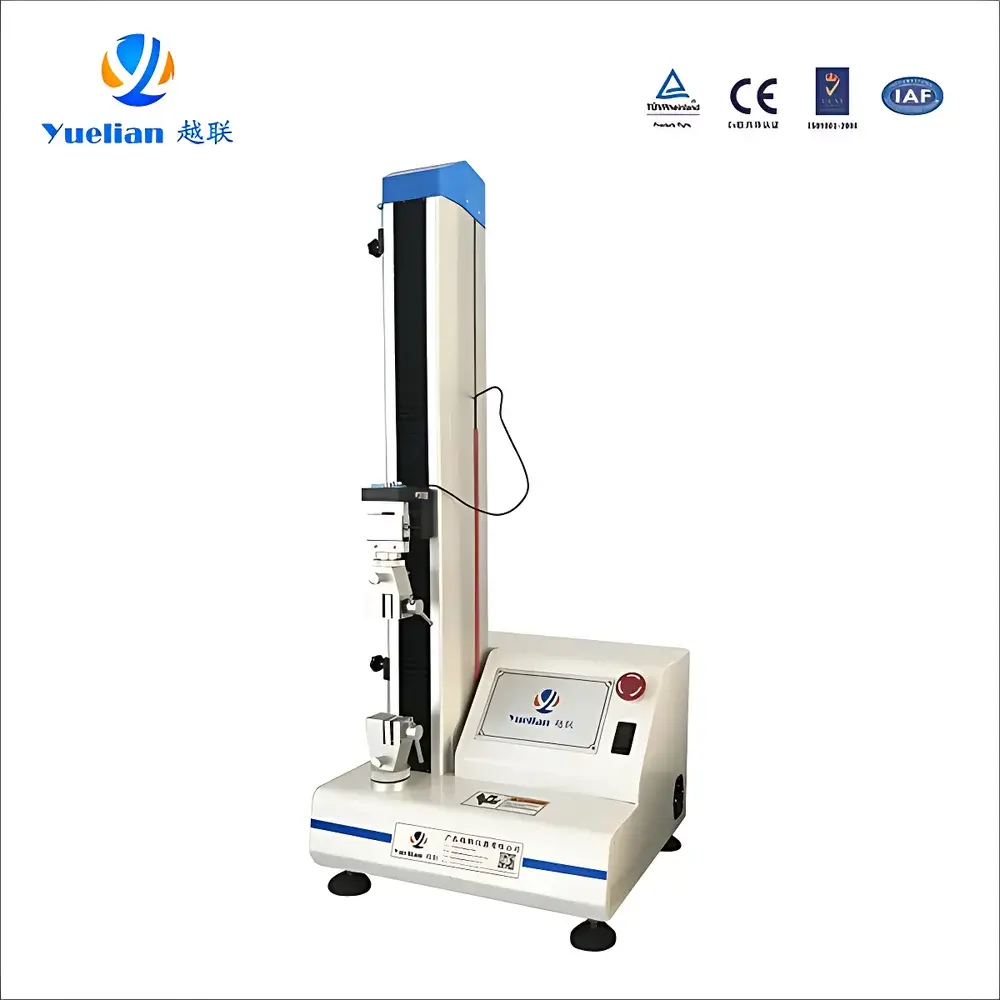
Yuelian YL-S91 Universal Testing Machine for Mask Tensile Strength Testing
| Brand | Yuelian |
|---|---|
| Origin | Guangdong, China |
| Model | YL-S91 |
| Instrument Type | Electromechanical Universal Testing Machine |
| Load Capacity Options | 10N, 20N, 50N, 100N, 200N, 500N, 1 kN (dual-range configuration available) |
| Force Resolution | 1/500,000 full scale |
| Force Accuracy | ±0.3% of reading |
| Displacement Resolution | 1/500,000 full scale |
| Test Speed Range | 0.1–500 mm/min (computer-controlled, programmable) |
| Maximum Travel | 500 mm / 800 mm (depending on configuration) |
| Test Width | 110 mm |
| Drive System | Stepper motor + precision preloaded ball screw |
| Transmission Efficiency | >85% |
| Power Supply | 220 V, 50/60 Hz, 3 A |
| Power Consumption | 180 W |
| Dimensions (W×D×H) | 40×37×92 cm or 40×37×120 cm |
| Weight | 28 kg / 35 kg |
| Compliance Standards | GB/T 2792, ASTM D3330, GB/T 12914–1991, GB 13022–91, GB/T 1040–92, GB 2792–81, GB/T 14344–9, GB/T 2191–95, QB/T 2171–95, GB/T 10003–2008 |
Overview
The Yuelian YL-S91 Universal Testing Machine is an electromechanical tensile and compression testing system engineered for high-precision mechanical property evaluation of medical face masks, filtration materials, nonwovens, and related layered composites. Designed in accordance with ISO 13934-1 (tensile properties of textiles) and aligned with regulatory requirements for personal protective equipment (PPE) validation, the YL-S91 applies controlled uniaxial force to specimen strips under standardized grip conditions, measuring load-displacement response in real time. Its core architecture integrates a stepper motor-driven, preloaded ball screw transmission system—delivering >85% mechanical efficiency and minimal hysteresis—enabling repeatable force application across low-load regimes critical for mask strap integrity, earloop attachment strength, and fabric seam resistance. The machine operates within a defined test speed range (0.1–500 mm/min), supporting both quasi-static and dynamic loading profiles required by GB/T 2792 (peel adhesion) and ASTM D3330 (pressure-sensitive tape peel testing), making it suitable for R&D labs, quality control departments, and third-party certification bodies conducting ISO 17025-accredited testing.
Key Features
- Programmable test speed control via USB-connected PC interface or standalone operation using integrated firmware
- Dual-range load cell options (10 N to 1 kN) with 1/500,000 internal resolution and ±0.3% force accuracy per ASTM E4 calibration traceability
- High-rigidity frame with quick-release modular夹具 mounting system—compatible with pneumatic, wedge, and custom-designed grips for mask straps, earloops, and layered laminates
- Automatic return-to-initial-position function post-test, reducing operator intervention and cycle time
- Real-time dual-channel display of applied force (in selectable units: N, kgf, lbf, MPa) and axial displacement (mm)
- Multi-mode stop logic: overload cutoff, emergency stop, specimen rupture detection, user-defined upper/lower limit triggers, and hold-force/hold-strain capability
- Integrated USB 2.0 port and RS-232 serial interface for direct connection to Windows-based analysis software and external thermal printers
Sample Compatibility & Compliance
The YL-S91 accommodates standard specimen geometries per GB/T 2792 (180° peel), ASTM D3330 (T-peel), GB/T 1040 (tensile bars), and GB/T 12914 (tensile testing of paper and board). It supports flat specimens up to 110 mm wide and 500/800 mm travel height, enabling full-stroke characterization of elastic recovery, yield point, elongation at break, and ultimate tensile strength for melt-blown polypropylene layers, spunbond nonwovens, and thermoplastic elastomer earloops. All mechanical and software functions comply with GLP documentation requirements, including audit-trail-enabled test parameter logging, timestamped result export, and electronic signature readiness for FDA 21 CFR Part 11–aligned environments. Calibration certificates are issued per ISO/IEC 17025 guidelines, referencing national metrology institute standards.
Software & Data Management
The included Windows-compatible software provides ISO/IEC 17025-compliant data acquisition, visualization, and reporting. Users define multi-step test protocols—including preload conditioning, ramp-to-load, dwell periods, and cyclic loading—with automatic curve smoothing and statistical post-processing (mean, SD, CV%, min/max). Raw force-displacement datasets export in CSV, Excel, and PDF formats; graphical overlays support comparative analysis across material batches or supplier qualifications. Audit trails record operator ID, test date/time, calibration status, environmental metadata (optional sensor integration), and any parameter modifications—ensuring full traceability during regulatory inspections. Software updates are distributed via secure vendor portal with version-controlled release notes.
Applications
- Tensile strength and elongation testing of mask body materials (e.g., PP nonwoven, PET laminates)
- Peel adhesion assessment of ultrasonic-welded seams and hot-melt adhesive bonds
- Earloop retention force measurement per ISO 13485 and YY/T 0969–2013 specifications
- Compression resilience evaluation of nose bridge foams and molded thermoplastic components
- Shear and tear resistance quantification of multi-layer filtration media
- Quality conformance verification against GB 19083–2010 (medical surgical masks) and EN 14683:2019
FAQ
What standards does the YL-S91 directly support for mask testing?
It natively implements test methods referenced in GB/T 2792, ASTM D3330, GB/T 12914, and YY/T 0969, with software templates preconfigured for specimen dimensions, speed profiles, and pass/fail criteria.
Can the system perform cyclic fatigue testing on earloop attachments?
Yes—via programmable multi-cycle mode with user-defined load amplitude, frequency, and dwell duration; displacement feedback ensures consistent stroke control over 10,000+ cycles.
Is force calibration traceable to national standards?
All load cells ship with factory calibration certificates traceable to CNAS-accredited reference standards; field recalibration tools and procedures are provided per ISO 7500-1.
Does the software meet FDA 21 CFR Part 11 requirements?
The software supports role-based access control, electronic signatures, and immutable audit logs—fully configurable to satisfy Part 11 Annex 11 and EU GMP Annex 11 compliance frameworks.
What maintenance is required for long-term accuracy?
Annual verification of force transducer linearity and displacement encoder fidelity is recommended; no lubrication or mechanical adjustment is needed due to sealed ball screw and stepper motor design.



