
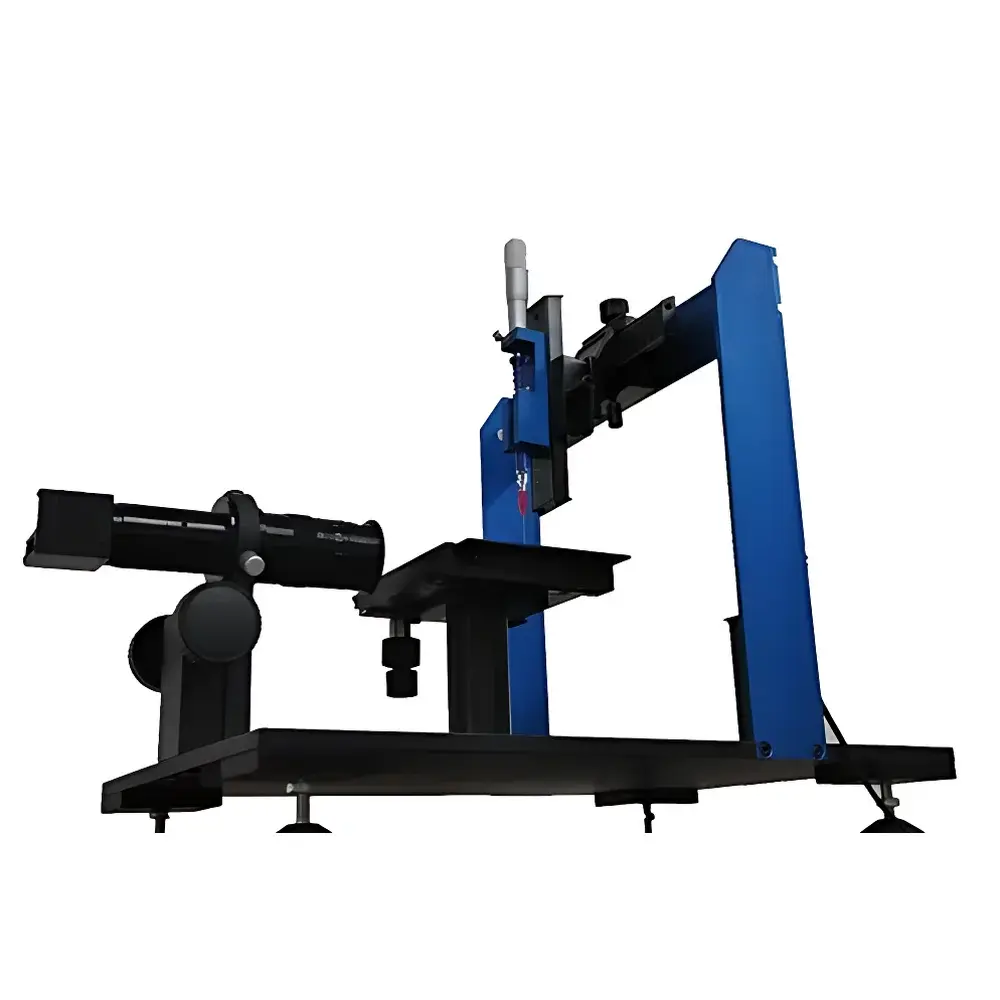
Yuelian YL-9980 Contact Angle Goniometer
| Brand | Yuelian |
|---|---|
| Origin | Guangdong, China |
| Manufacturer Type | Authorized Distributor |
| Country of Origin | China |
| Model | YL-9980 |
| Price | Upon Request |
| Contact Angle Measurement Range | 0–180° |
| Accuracy | ±0.1° |
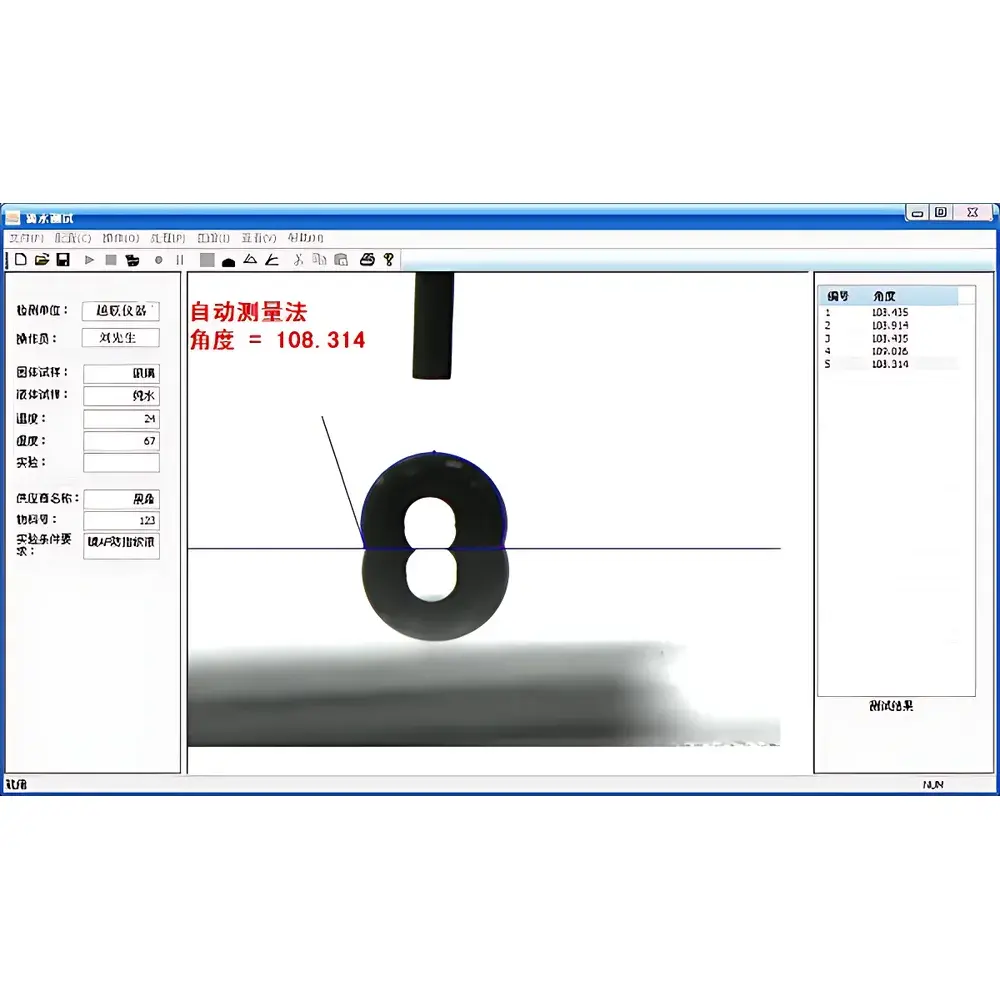
| Measurement Methods | Automatic Circle Fitting, Automatic Ellipse Fitting, Manual Tangent, Dynamic Advancing/Receding Angle Analysis, Spherical Cap, Height-Width, Curved Surface, and Inclined Plane Methods |
| Optical System | 2× Fixed-Magnification High-Definition Microscope with Adjustable LED Backlight |
| Imaging | High-Resolution CMOS Digital Camera with Video Capture, Frame-by-Frame Export, and Real-Time Snapshot |
| Sample Stage | 3-Axis Motorized Translation (X/Y/Z), Vertical Extension Rail (±30 mm), Adjustable Base Plate Travel (150 mm depth), Stage Dimensions: 240 × 120 mm |
| Dispenser Positioning | 2-Axis Precision Movement (100 mm vertical, 100 mm horizontal) |
| Microscope Adjustment | 80 mm coarse + 3 mm fine depth travel |
| Max Sample Thickness | ≤80 mm |
| Overall Dimensions | 360 × 480 × 460 mm (W × L × H) |
Overview
The Yuelian YL-9980 Contact Angle Goniometer is a precision optical instrument engineered for quantitative characterization of solid–liquid interfacial wettability. It operates on the principle of sessile drop analysis, where a controlled volume of liquid (typically deionized water or standardized test fluids) is deposited onto a solid substrate, and the contact angle—the angle formed between the liquid–vapor interface and the solid surface at the three-phase boundary—is measured via high-resolution digital imaging and geometric fitting algorithms. This measurement serves as a direct indicator of surface energy heterogeneity, chemical functionality, and physical topography. The system supports static, advancing, and receding contact angle determinations—critical parameters for evaluating hysteresis, surface homogeneity, and dynamic wetting behavior in industrial R&D and quality control environments.
Key Features
- High-fidelity optical path: 2× fixed-magnification HD microscope coupled with uniform, intensity-tunable LED backlighting ensures consistent edge contrast for robust droplet contour detection.
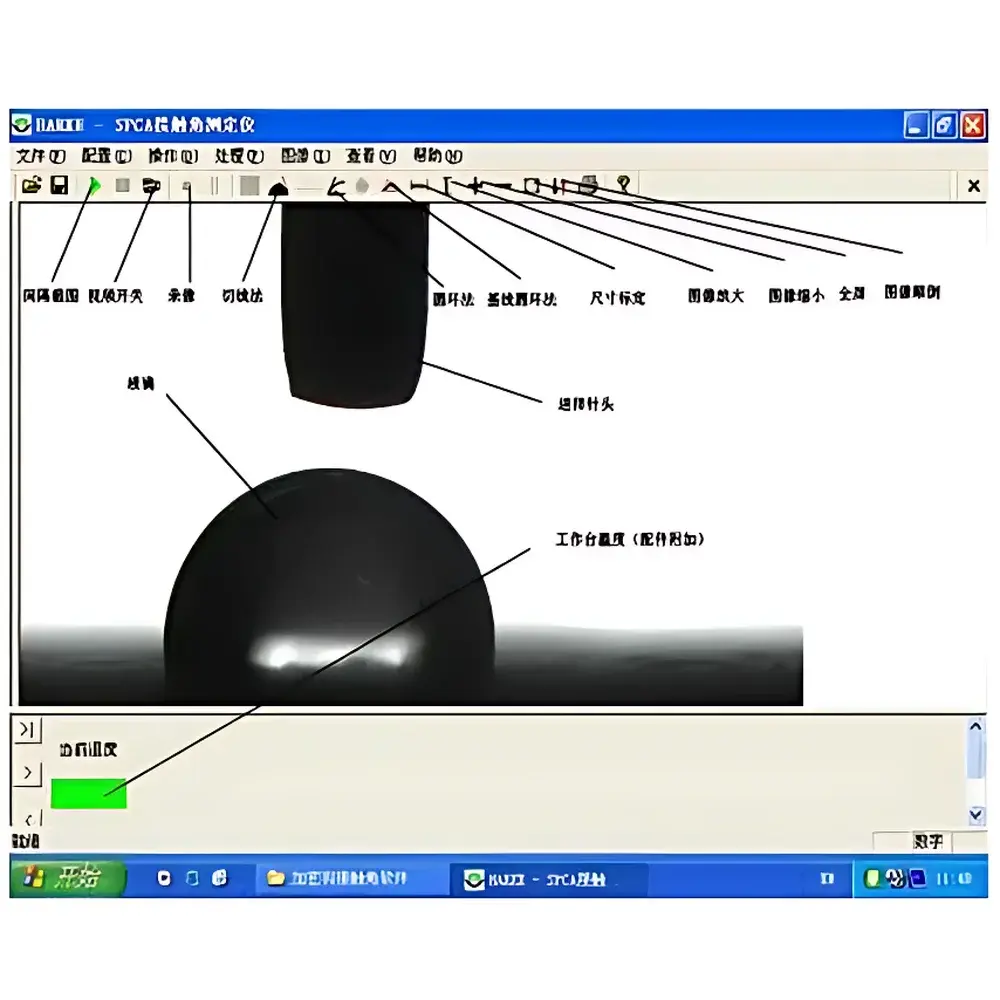
- Multi-algorithm contact angle analysis engine: Includes automatic circle and ellipse fitting, manual tangent placement, spherical cap modeling, height-width method, inclined plane correction, and dynamic contact angle tracking during automated dispensing cycles.
- Motorized 3-axis sample stage with extended vertical travel: X/Y/Z translation (50 mm × 50 mm × 30 mm), plus an auxiliary telescoping rail (±30 mm) and base plate adjustment (150 mm depth) to accommodate irregular or thick specimens up to 80 mm in thickness.
- Programmable microdispenser positioning: Independent vertical and horizontal movement (100 mm each) enables precise alignment of the needle tip relative to the region of interest, minimizing parallax and deposition variability.
- Real-time imaging suite: Integrated CMOS camera supports video recording (up to 60 fps), frame-by-frame playback, single-frame export (TIFF/PNG), and time-stamped snapshot capture synchronized with stage/dispenser motion.
- Surface energy calculation module: Based on Owens–Wendt, Wu, Fowkes, or van Oss–Chaudhury–Good models, using dual-liquid (e.g., water + diiodomethane) contact angle inputs to derive dispersive and polar surface energy components.
Sample Compatibility & Compliance
The YL-9980 accommodates flat, curved, porous, or textured substrates—including polymer films, metal foils, paperboard, ceramic coatings, and nanocomposite surfaces—within dimensional limits of 100 mm width and up to 80 mm thickness. Its mechanical adaptability and software-based calibration routines ensure reliable measurements across diverse material classes without hardware modification. The instrument complies with internationally recognized test standards governing wettability assessment, including ASTM D724 (paper surface wettability), ASTM D5946-2004 (corona-treated polymer film evaluation), and ISO 15989 (water contact angle measurement on treated plastic films). All measurement workflows support traceable documentation required under GLP and internal QA protocols; raw image files, parameter logs, and analysis metadata are stored with immutable timestamps for audit readiness.
Software & Data Management
The proprietary acquisition and analysis software provides a structured workflow from image capture to report generation. Users can define multi-step measurement sequences—e.g., sequential droplet deposition, timed aging intervals, or cyclic advancing/receding angle acquisition—and store all associated images, fitted contours, numerical results, and operator annotations within a single project file. Batch processing allows comparative analysis across sample sets, while customizable report templates export data in PDF or Excel format with embedded images, statistical summaries (mean, SD, CV%), and pass/fail thresholds aligned with internal specifications. Audit trail functionality records user login events, parameter changes, and result modifications—supporting compliance with FDA 21 CFR Part 11 requirements when deployed in regulated pharmaceutical or medical device manufacturing settings.
Applications
- Corona and plasma treatment validation of polyolefin films and packaging laminates
- Quality assurance of aluminum foil hydrophilicity in lithium-ion battery separator production
- Adhesive formulation development via solid–liquid interfacial energy mapping
- Wettability screening of printed circuit board (PCB) solder masks and conformal coatings
- Surface functionalization verification of biomedical implants and surgical textiles
- Dynamic contact angle profiling during enhanced oil recovery (EOR) surfactant screening
- Hydrophobic/hydrophilic transition monitoring in stimuli-responsive smart materials
- Research-grade surface energy decomposition of nanocellulose, graphene oxide, and MOF-coated substrates
FAQ
What types of liquids can be used for contact angle measurement on the YL-9980?
Deionized water is standard for routine hydrophilicity/hydrophobicity assessment; however, the system supports any low-volatility, non-corrosive liquid—including ethylene glycol, formamide, diiodomethane, and custom solvent blends—for surface energy component analysis.
Does the instrument support automated advancing and receding angle measurement?
Yes—via programmable syringe pump integration (optional accessory), the YL-9980 enables continuous volume modulation to record dynamic contact angle evolution, with real-time fitting and hysteresis quantification.
Is calibration traceable to national standards?
While the YL-9980 does not include NIST-traceable angle standards out-of-the-box, it supports external calibration using certified spherical lens artifacts (e.g., 30°, 60°, 90°, 120° reference angles) and includes software-assisted pixel-to-angle conversion verification tools.
Can the software export data compatible with statistical process control (SPC) platforms?
Yes—CSV and Excel exports contain full metadata (timestamp, operator ID, sample ID, raw angle values, confidence metrics), enabling direct import into JMP, Minitab, or custom MES/QMS dashboards.
What maintenance is required for long-term optical accuracy?
Routine cleaning of the microscope objective, LED diffuser, and sample stage with lint-free wipes and isopropyl alcohol is recommended; annual verification of dispenser needle alignment and stage encoder linearity is advised for GMP-aligned operations.



