
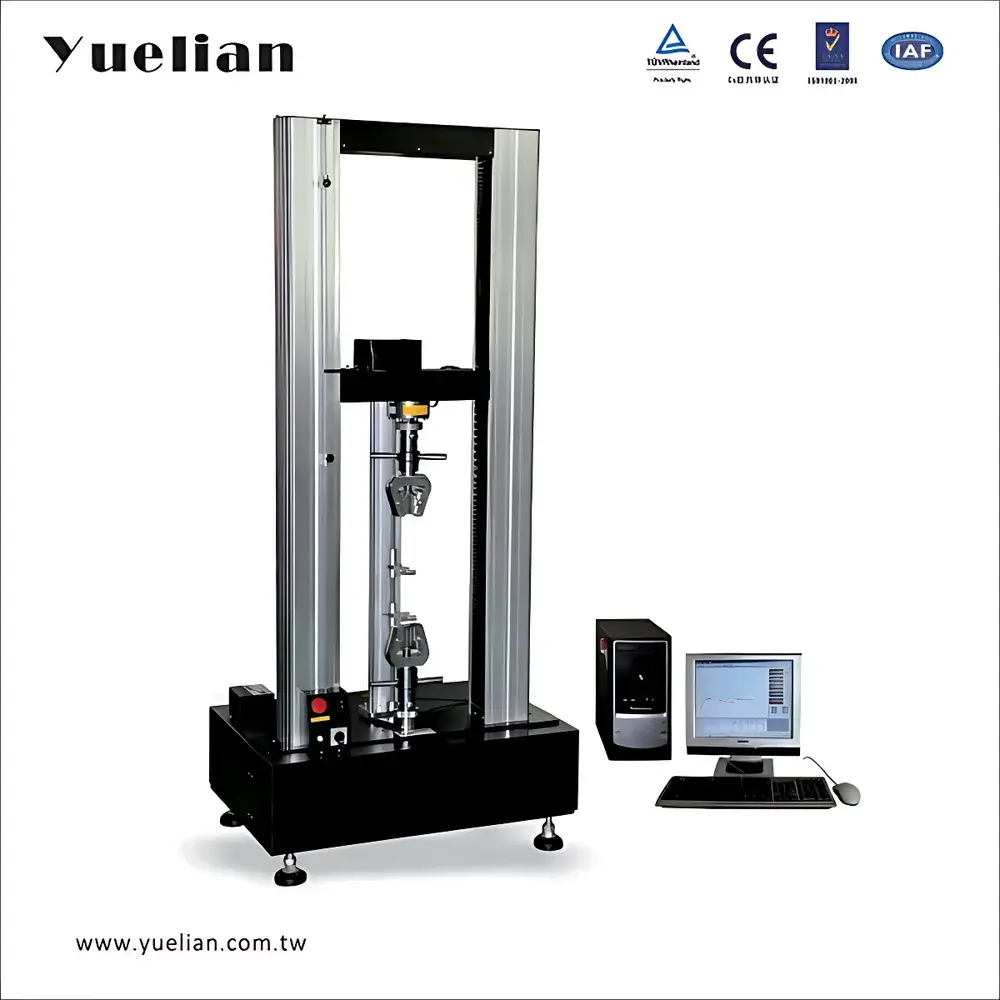
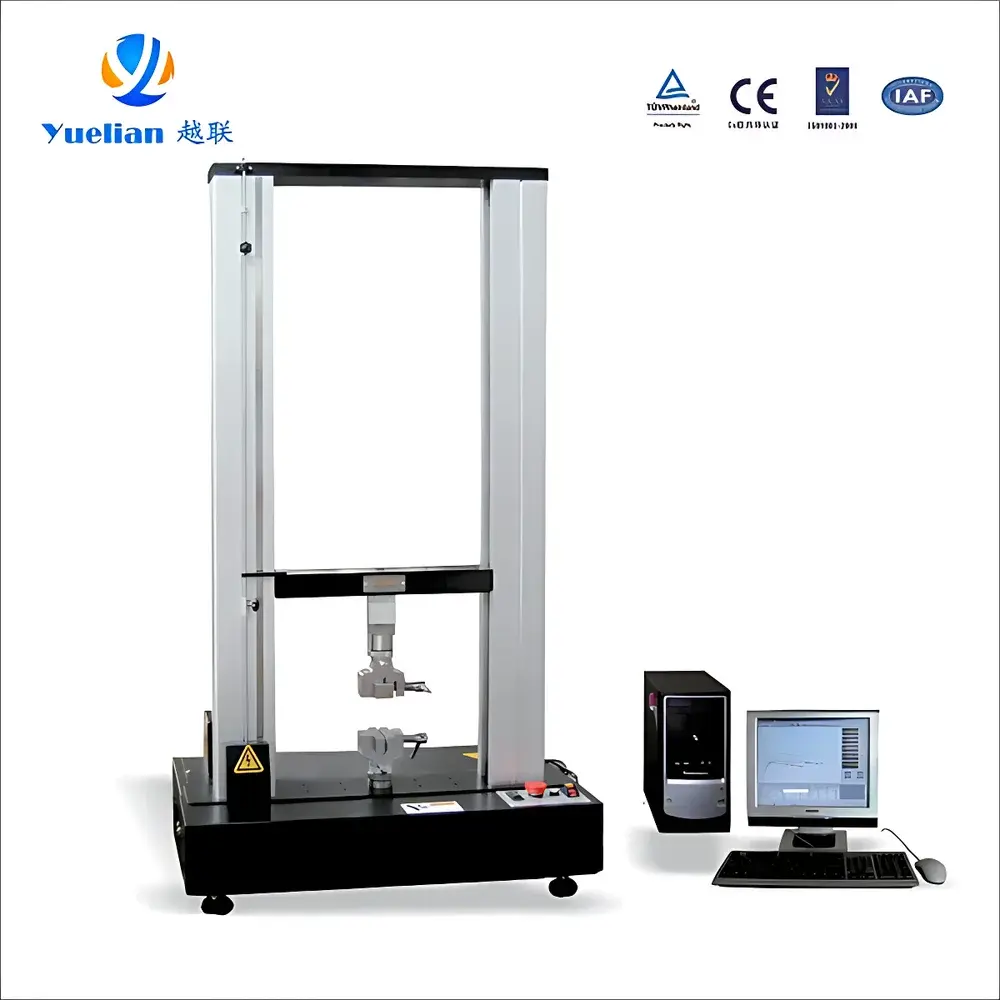
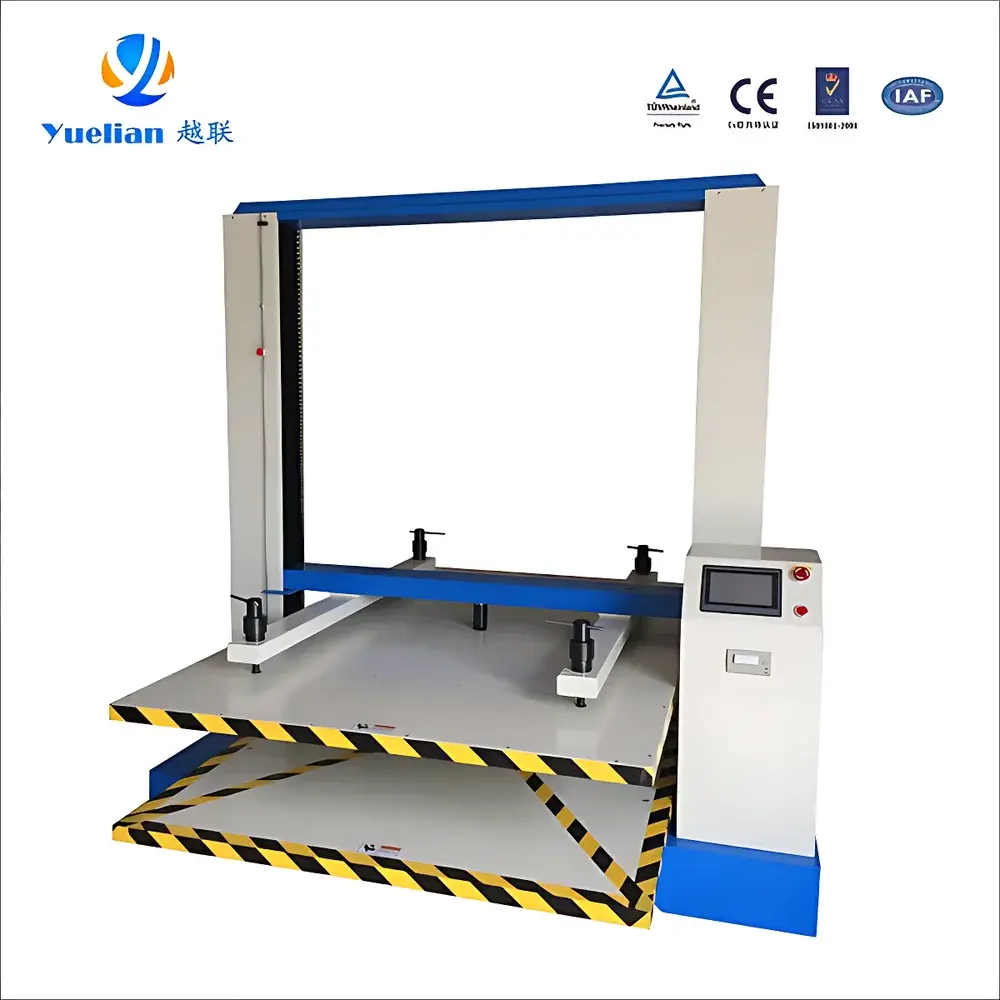
Yuelian YL-1125 Universal Tensile Testing Machine
| Brand | Yuelian |
|---|---|
| Origin | Guangdong, China |
| Model | YL-1125 |
| Maximum Test Load | 50 kN |
| Load Range | 1–50 kN (Full Scale) |
| Load Accuracy | ±0.3% of reading |
| Test Stroke | 800 mm |
| Displacement Resolution | 0.1 mm |
| Control System | PC-based closed-loop servo control |
| Drive System | Servo motor + precision ball screw |
| Standards Compliance | ISO 7500-1, ASTM E4, GB/T 228.1–2021, GB/T 1449–2005, GB/T 9341–2008, ASTM D6109–2010, EN 10002-1, JIS B7721/B7733 |
Overview
The Yuelian YL-1125 Universal Tensile Testing Machine is a high-precision electromechanical system engineered for static mechanical property evaluation of structural adhesives, polymers, metals, composites, textiles, and other engineering materials. It operates on the principle of controlled uniaxial force application—measuring load response via a calibrated load cell and displacement via high-resolution linear encoders—enabling quantification of tensile strength, yield point, elongation at break, modulus of elasticity, flexural strength, and interfacial bond performance under standardized loading conditions. Designed for laboratory and quality assurance environments, the YL-1125 supports both routine compliance testing and advanced material characterization workflows, delivering repeatable, traceable, and audit-ready results in accordance with international mechanical testing standards.
Key Features
- Robust dual-column frame with reinforced aluminum alloy crosshead and precision-ground ball screw transmission system, ensuring minimal deflection and long-term dimensional stability during high-load cycling.
- High-fidelity 50 kN load cell with ±0.3% full-scale accuracy, certified to ISO 7500-1 Class 0.5 and ASTM E4 requirements for force measurement traceability.
- Displacement sensing with 0.1 mm resolution and real-time position feedback, synchronized with load acquisition at up to 1 kHz sampling rate for accurate stress–strain curve reconstruction.
- Programmable speed range from 0.01 to 1000 mm/min, enabling precise control over strain rate for quasi-static and slow-rate dynamic tests per ISO 527, ASTM D638, and GB/T 1040.
- Integrated safety architecture including overload cutoff, emergency stop circuit, automatic specimen rupture detection, and programmable upper/lower travel limits compliant with EN ISO 12100 functional safety principles.
- Modular fixture interface compatible with standard wedge-action grips, pneumatic clamps, bend test fixtures (3-point/4-point), peel jigs, and shear adapters—supporting rapid reconfiguration across test types.
Sample Compatibility & Compliance
The YL-1125 accommodates specimens ranging from thin adhesive films (e.g., structural epoxy bonds per ASTM D1002 or ISO 4587) to thick metallic coupons (up to 25 mm thickness), fiber-reinforced laminates, elastomeric seals, and multi-layer packaging substrates. Its mechanical design and software logic fully support test protocols defined in GB/T 228.1–2021 (metal tensile), GB/T 1449–2005 (flexure of fiber-reinforced plastics), GB/T 9341–2008 (plastic flexural properties), ASTM D6109–2010 (wood-based composites), and ISO 179–1 (impact-modified thermoplastics). All calibration and verification procedures align with national metrological verification regulation JJG 475–2008 and international reference standards for universal testing machines.
Software & Data Management
The embedded PC-based control and analysis platform provides ISO/IEC 17025-aligned data integrity through timestamped audit trails, user-level access control, electronic signature capability, and 21 CFR Part 11-compliant optional modules. Raw force–displacement data are acquired at configurable rates and stored in native binary format with metadata tagging (operator ID, sample ID, environmental conditions, calibration certificate ID). Post-test processing includes automated calculation of tensile strength (MPa), yield stress (MPa), Young’s modulus (GPa), fracture toughness indices, and statistical reporting per batch. Export options include CSV, PDF test reports, and MS Access-compatible databases. Graphical overlays support comparative analysis across multiple specimens or material batches, with customizable curve smoothing, tangent modulus derivation, and offset yield point detection (0.2% strain offset per ASTM E8).
Applications
- Structural adhesive qualification: lap-shear strength (ASTM D1002), peel resistance (ASTM D903), and cleavage testing of epoxy, polyurethane, and acrylic bonding systems.
- Composite laminate validation: tensile modulus and strength of carbon-fiber-reinforced polymer (CFRP) panels per ISO 527-4 and ASTM D3039.
- Automotive component testing: tensile behavior of gaskets, hoses, interior trim substrates, and battery module encapsulation materials under thermal preconditioning.
- Packaging R&D: seal strength (ASTM F88), tear propagation (ASTM D1938), and puncture resistance of multilayer barrier films and laminated foils.
- Electrical insulation verification: mechanical integrity of silicone rubber insulators, epoxy potting compounds, and flexible printed circuit substrates under tensile and flexural loads.
- Academic and industrial research: constitutive modeling input generation, creep and relaxation studies (with optional environmental chamber integration), and fatigue pre-screening via cyclic loading sequences.
FAQ
What standards does the YL-1125 comply with for tensile testing of adhesives?
It supports ASTM D1002, ISO 4587, GB/T 7124–2008, and ASTM D3330 for lap-shear, peel, and cleavage configurations, with hardware and software validation aligned to ISO 7500-1 and JJG 475–2008.
Can the system perform both tensile and flexural tests without hardware modification?
Yes—the modular fixture mount and programmable crosshead positioning allow seamless switching between tensile grips, 3-point/4-point bending fixtures, and compression platens using standard ISO-compliant tooling.
Is the software capable of generating GLP/GMP-compliant test reports?
Standard software includes electronic signatures, audit logs, and version-controlled report templates; optional 21 CFR Part 11 modules provide full electronic record and signature compliance for regulated pharmaceutical and medical device QA labs.
What is the maximum specimen width accommodated by the standard test zone?
The effective test width is 420 mm, sufficient for ASTM D638 Type I–V specimens, ISO 527 multipurpose bars, and full-width packaging laminate samples.
Does the system support real-time data export to LIMS or MES platforms?
Yes—via TCP/IP API and configurable CSV/XML output hooks, enabling direct integration with laboratory information management systems and enterprise manufacturing execution systems for automated result ingestion and traceability.



