
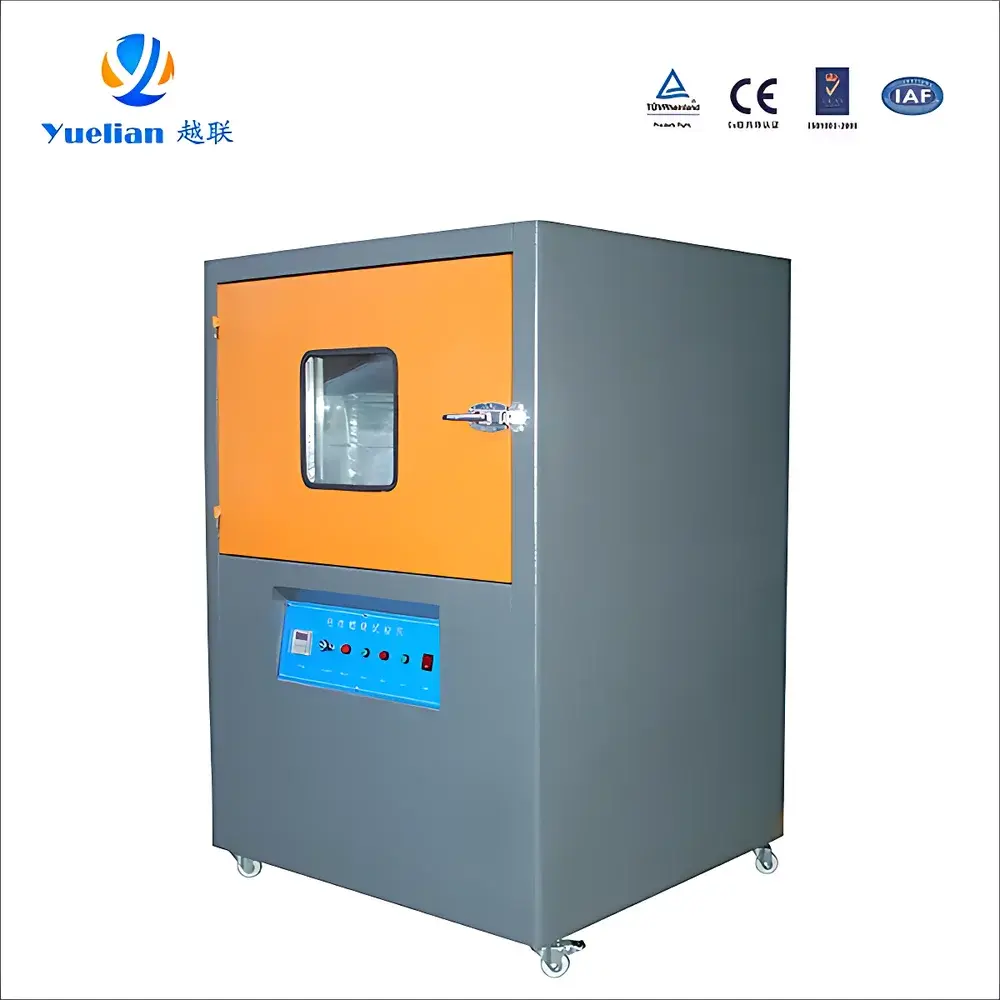
Yuelian YLB-302C Battery Fire Resistance Test Chamber
| Brand | Yuelian |
|---|---|
| Origin | Guangdong, China |
| Manufacturer Type | Authorized Distributor |
| Country of Origin | China |
| Model | YLB-302C |
| Control Method | Push-button Interface |
| Burner | Bunsen burner with 9.5 mm inner diameter tube, ~100 mm length |
| Flame Application Time | 0–999.9 s ±0.1 s |
| Test Aperture Diameter | 102 mm |
| Test Sieve | Stainless steel wire mesh, 0.43 mm wire diameter, 20 meshes per linear inch |
| Vertical Distance from Flame Tip to Sieve Surface | 38 mm |
| Octagonal Enclosure | Aluminum wire mesh, 0.25 mm wire diameter, 16–18 meshes per linear inch |
| opposing face distance | 610 mm (24″), height: 305 mm (12″) |
| Test Chamber Construction | Stainless steel frame and interior |
| Internal Chamber Dimensions | 730 × 740 × 500 mm (W × D × H) |
| Fuel Supply | Methane or LPG (user-supplied) |
| Electrical Supply | 1-phase, 220 V, 50/60 Hz |
| Net Weight | ~100 kg |
Overview
The Yuelian YLB-302C Battery Fire Resistance Test Chamber is an engineered safety evaluation system designed for standardized thermal abuse testing of lithium-based cells and battery packs. It implements the controlled open-flame exposure protocol defined in major international safety standards—including UL 2271 (for batteries used in personal e-mobility devices), UL 2272 (for hoverboards and self-balancing scooters), and multiple Chinese national standards (GB/T 31241, GB/T 31485, GB/T 18287, GB/T 8897.4, and YD/T 2344.1). The apparatus subjects specimens to direct flame impingement under reproducible geometric and temporal conditions, simulating worst-case ignition scenarios during thermal runaway propagation. Its core measurement principle is not quantitative calorimetry but rather pass/fail behavioral observation: whether the test sample sustains combustion, vents violently, explodes, or exhibits flame persistence beyond defined thresholds after flame removal. This functional assessment supports compliance verification for product certification, internal safety R&D, and quality assurance workflows in battery manufacturing and third-party testing laboratories.
Key Features
- Standard-compliant mechanical configuration: Precision-drilled 102 mm aperture platform with calibrated stainless-steel sieve (0.43 mm wire, 20 mesh/inch) ensures consistent specimen elevation and airflow dynamics.
- Dedicated Bunsen burner assembly: 9.5 mm ID stainless-steel burner tube, 100 mm length, optimized for stable blue-flame generation using methane or LPG—fuel flow rate and pressure are user-adjusted per standard requirements.
- Precise flame timing control: Digital timer with ±0.1 s resolution enables strict adherence to mandated exposure durations (e.g., 60 s per UL 2271 Section 15.2).
- Modular octagonal aluminum containment hood: 610 mm face-to-face width and 305 mm height; constructed from 0.25 mm aluminum wire (16–18 mesh/inch); features hinged, tool-free disassembly for rapid cleaning and maintenance.
- Robust test enclosure: 730 × 740 × 500 mm stainless-steel chamber with dual-layer 5 mm tempered glass viewing door—provides structural integrity, thermal shielding, and real-time visual monitoring without compromising operator safety.
- Integrated ventilation interface: Rear-mounted exhaust fan with standardized duct collar (Ø100 mm) allows connection to facility fume hoods or dedicated exhaust systems, ensuring safe removal of combustion byproducts and thermal effluents.
Sample Compatibility & Compliance
The YLB-302C accommodates single cells (cylindrical, prismatic, pouch), multi-cell modules, and assembled battery packs within dimensional and mass limits compatible with the 102 mm aperture and sieve load capacity. It is explicitly validated for use with lithium-ion (LiCoO₂, NMC, LFP), lithium-polymer, and legacy Li-metal chemistries. All mechanical dimensions, material specifications (e.g., sieve wire gauge, aluminum mesh density), and procedural parameters align with the physical test setup clauses in UL 2271–2013 (Section 15), UL 2272–2016 (Annex A), GB/T 31485–2015 (Clause 7.4), and GB/T 31241–2014 (Section 8.3). The system does not include automated data logging or flame temperature validation sensors; users must verify burner calibration (e.g., flame height, thermocouple verification per ASTM E176) prior to each test series to meet GLP audit requirements.
Software & Data Management
The YLB-302C operates via a discrete push-button control panel with LED time display—no embedded firmware, no network connectivity, and no proprietary software stack. All operational parameters (flame duration, start/stop actuation) are manually initiated and recorded externally by the operator. This architecture eliminates cybersecurity risks and simplifies 21 CFR Part 11 compliance for regulated labs: raw test logs—including operator ID, date/time stamp, specimen ID, observed failure mode (fire, explosion, venting), and elapsed flame-on time—are maintained in paper-based or LIMS-integrated electronic records. No audit trail is generated internally; however, the deterministic mechanical design ensures high inter-lab reproducibility when procedures are followed per standard annexes.
Applications
- Pre-certification fire resistance screening for UN 38.3 Clause 6.3 (though not a substitute for full UN testing)
- Design validation of cell-level flame barriers and pack-level thermal isolation strategies
- Root-cause analysis of thermal runaway initiation in failure investigation labs
- Supplier qualification testing per OEM battery specification documents (e.g., Tesla SAI-001, Apple Spec-BAT-002)
- Training and demonstration of NFPA 855-compliant battery energy storage system (BESS) hazard response protocols
- Academic research on combustion kinetics of electrolyte formulations under forced-flame conditions
FAQ
Does the YLB-302C include flame temperature monitoring?
No. Temperature measurement requires external calibrated thermocouples (e.g., Type K, 1 mm sheath) placed per UL 2271 Figure 15.2. The unit provides only timed flame application.
Can propane be used instead of methane or LPG?
Propane is not recommended. UL and GB standards specify methane or LPG due to consistent stoichiometric ratios and flame velocity profiles. Propane may produce excessive sooting and non-uniform heating.
Is the octagonal hood supplied with mounting hardware?
Yes—pre-installed threaded inserts and alignment pins ensure repeatable positioning relative to the sieve platform.
What is the maximum battery pack thickness supported?
Specimens must fit within the 500 mm chamber height and clear the 38 mm flame-to-sieve gap. Typical limit is ≤120 mm for vertical orientation; consult your lab’s risk assessment for oversized configurations.
Does the unit comply with CE or UKCA marking requirements?
The YLB-302C is supplied without CE/UKCA marking. Users must perform their own EMC and Low Voltage Directive conformity assessment if deploying in EEA/UK markets.



