
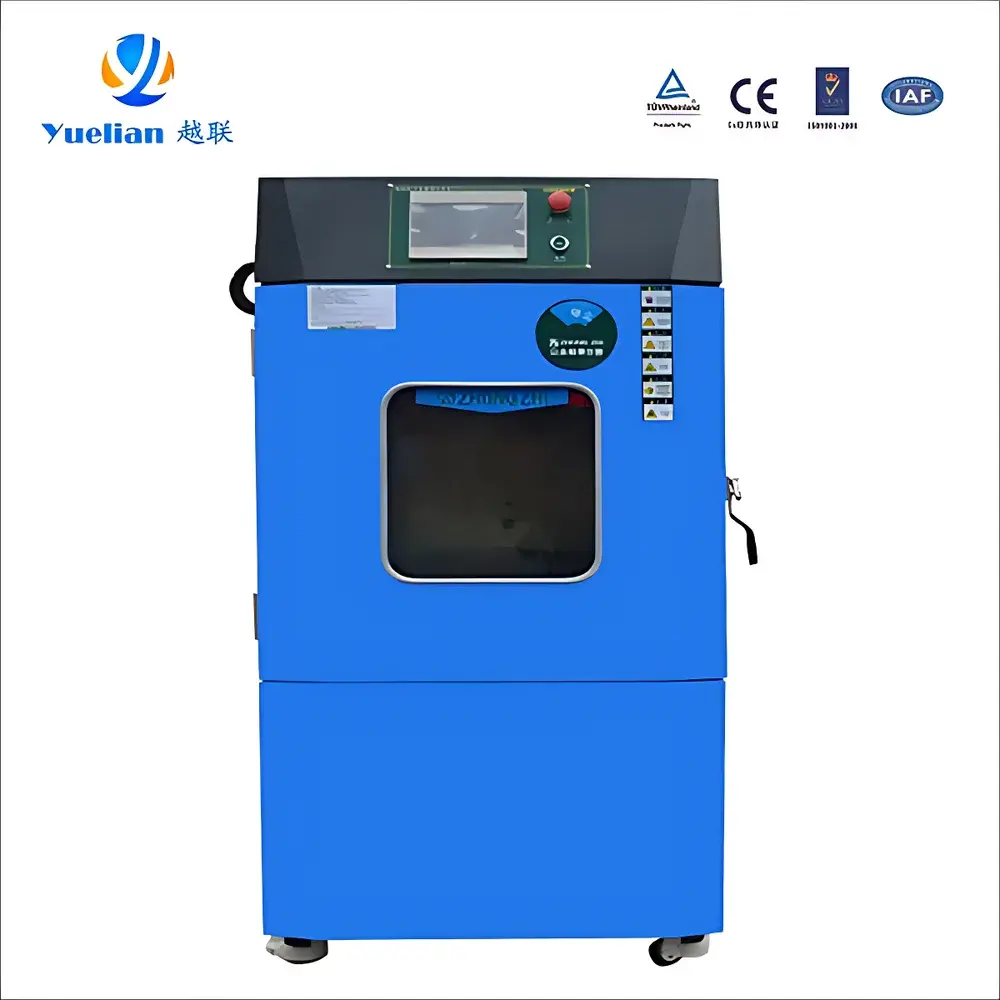
Thermal Abuse (Thermal Shock) Test Chamber – Yuelian YL-RL-01
| Brand | Yuelian |
|---|---|
| Model | YL-RL-01 |
| Origin | Guangdong, China |
| Internal Volume | 175 L |
| Workspace Dimensions | W50 × H70 × D50 cm |
| External Dimensions | W88 × H168 × D73 cm |
| Construction | Monolithic design with outer casing of thickened cold-rolled steel (gray + blue powder-coated), inner chamber of thickened stainless steel |
| Viewing Window | Dual-layer tempered safety glass (350 × 400 mm), explosion-resistant |
| Illumination | LED interior lighting |
| Ventilation | Forced-air exhaust system |
| Pressure Relief | Automatic pressure relief port |
| Temperature Range | RT+10 °C to +150 °C (customizable) |
| Heating Rate | ≤5 °C/min (average from ambient to 150 °C) |
| Temperature Resolution | 0.1 °C |
| Temperature Uniformity | ≤2.0 °C |
| Temperature Fluctuation | ±0.5 °C |
| Temperature Deviation | ≤2.0 °C |
| Control System | PLC-based touchscreen interface |
| Standard Accessories | Main unit, two sample racks, epoxy resin insulating sample trays |
| Power Supply | AC 220 V / 50 Hz or AC 380 V / 50 Hz |
Overview
The Yuelian YL-RL-01 Thermal Abuse (Thermal Shock) Test Chamber is an engineered environmental test system designed specifically for evaluating the thermal safety response of lithium-ion and other rechargeable electrochemical cells under controlled, accelerated thermal stress conditions. It implements standardized thermal abuse protocols—most notably those defined in UN Manual of Tests and Criteria Part III, subsection 38.3.5; IEC 62133-2:2017 Clause 8.5; and GB/T 31241–2014 Section 7.7—to assess whether a cell undergoes thermal runaway, fire, or explosion when subjected to rapid, sustained heating. The chamber operates on a programmable ramp-and-soak thermal profile: starting from ambient temperature, it elevates internal air temperature at a controlled average rate of ≤5 °C/min to a target setpoint of 130 °C ±2 °C, holds for 30 minutes, and monitors real-time behavioral response. Its monolithic structural architecture, dual-layer safety glazing, and integrated automatic pressure relief mechanism ensure operator safety and containment integrity during high-risk testing scenarios.
Key Features
- Robust monolithic construction with exterior housing of thickened cold-rolled steel (powder-coated gray/blue) and interior chamber fabricated from corrosion-resistant, thick-gauge stainless steel for long-term thermal stability and chemical inertness.
- Dual-layer tempered safety observation window (350 × 400 mm) rated for thermal and mechanical impact resistance—designed to withstand transient overpressure events without shattering.
- PLC-based control system with intuitive 7-inch color touchscreen HMI, supporting user-defined multi-step thermal profiles, real-time data logging, and alarm-triggered emergency shutdown sequences.
- Forced-air circulation with optimized airflow distribution ensures uniform thermal exposure across the full 175 L working volume (W50 × H70 × D50 cm), validated to ≤2.0 °C spatial uniformity per IEC 60068-3-5.
- Integrated automatic pressure relief port activates at predefined differential pressure thresholds, mitigating risk of catastrophic chamber rupture during unexpected exothermic events.
- LED interior lighting and sealed cable entries maintain operational visibility and environmental integrity without compromising safety-rated sealing.
Sample Compatibility & Compliance
The YL-RL-01 accommodates cylindrical, prismatic, and pouch-format battery cells up to 200 mm in height and 150 mm in width—compatible with standard industry fixtures including insulated epoxy resin sample trays and adjustable stainless-steel rack systems. All thermal control parameters—including ramp rate (≤5 °C/min), soak tolerance (±2 °C), and stability (±0.5 °C fluctuation)—are traceably verifiable per ISO/IEC 17025-accredited calibration practices. The system supports audit-ready documentation workflows aligned with GLP and GMP requirements, including timestamped temperature logs, operator identification, and event-triggered annotations. While not pre-certified to UL or CE as a standalone appliance, its design principles conform to essential safety clauses of IEC 61000-6-2 (immunity) and IEC 61000-6-4 (emissions), and it is routinely deployed in third-party testing laboratories performing UN 38.3 certification campaigns.
Software & Data Management
The embedded PLC controller records temperature data at 1-second intervals to non-volatile memory and exports time-stamped CSV files via USB interface. Optional RS485 or Ethernet connectivity enables integration into centralized laboratory information management systems (LIMS) or SCADA platforms for remote monitoring and automated report generation. Data output includes absolute temperature, setpoint deviation, elapsed soak time, and status flags for door interlock, exhaust activation, and pressure relief actuation. Audit trails comply with FDA 21 CFR Part 11 requirements when paired with validated user authentication and electronic signature modules—supporting regulatory submissions for battery safety validation dossiers.
Applications
- Thermal runaway propagation studies in single-cell and small-module configurations.
- Validation of thermal barrier materials, flame-retardant electrolytes, and cell-level safety vent designs.
- Pre-compliance screening for UN 38.3, IEC 62133, UL 1642, and GB/T 31241 certification pathways.
- QC/QA release testing for production batches in battery manufacturing and R&D facilities.
- Accelerated aging correlation studies linking thermal abuse response to calendar/cycle life degradation mechanisms.
FAQ
Is the YL-RL-01 suitable for testing battery modules or only individual cells?
Yes—it supports both single cells and compact modules (up to 15 kg total mass) when mounted on provided insulated trays and racks. Module-level testing requires additional thermal isolation planning to avoid localized hot spots.
Can temperature ramp rates be customized below 5 °C/min?
The standard configuration achieves ≤5 °C/min average heating; slower ramps (e.g., 1–3 °C/min) are achievable via firmware parameter adjustment and require verification using NIST-traceable thermocouples placed at multiple chamber locations.
Does the system include data export compliance with ISO/IEC 17025 reporting requirements?
Raw temperature logs meet minimum metadata requirements (time stamp, sensor ID, units); full ISO/IEC 17025 conformance depends on laboratory-specific validation of the entire measurement chain—including probe calibration certificates and uncertainty budgets.
What maintenance is required to sustain thermal accuracy over time?
Annual recalibration of the PT100 sensor array and verification of heater/cooler performance against reference standards are recommended. Air filter replacement for the forced-air blower should occur every 6 months under continuous operation.
Is external exhaust ducting mandatory?
While the built-in forced exhaust handles nominal off-gas dispersion, connection to a dedicated fume hood or scrubber system is strongly advised when testing high-nickel or LFP chemistries known to generate HF or CO under thermal abuse.



