
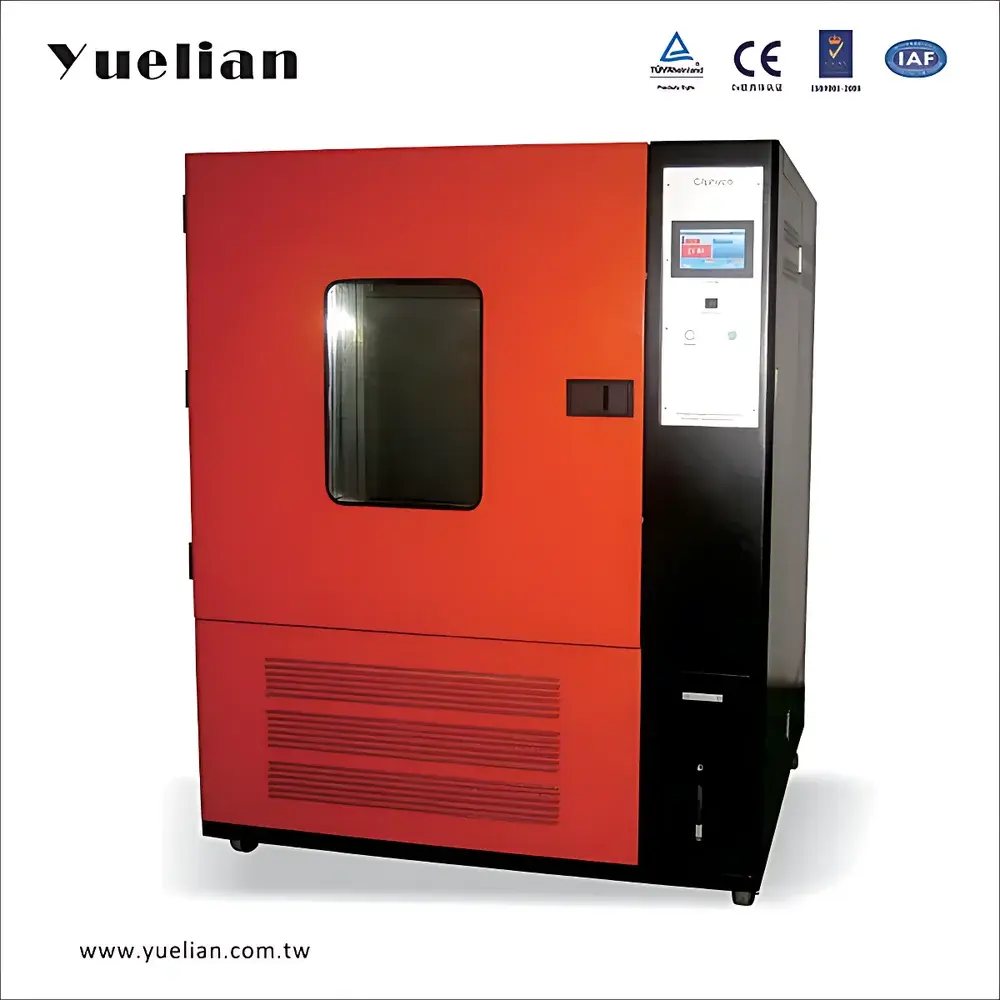
Yuelian TS-Series High-Low Temperature & Humidity Environmental Test Chamber
| Brand | Yuelian |
|---|---|
| Model | TS-Series |
| Type | Climatic Environmental Test Chamber |
| Internal Volume Options | 80 L, 150 L, 225 L, 408 L, 800 L, 1000 L |
| Temperature Range | −70 °C to +150 °C |
| Humidity Range | 20–98 % RH (optional low-humidity configuration down to 5 % RH) |
| Temp. Uniformity | ±0.5 °C |
| Humidity Uniformity | ±3 % RH |
| Temp. Stability | ±0.3 °C |
| Humidity Stability | ±2.5 % RH |
| Heating Rate | −70 °C → +100 °C in ≤60 min |
| Cooling Rate | +20 °C → −70 °C in ≤90 min |
| Control System | PID + SSR/SCR bidirectional synchronous output with slope logic |
| Programmability | 150 programs × 1500 segments, 9999 cycles × 999 repeats, 5 independent sub-cycles |
| Safety Monitoring | 15-point real-time fault detection with auto-diagnostic display |
| Refrigeration | Twin-stage air-cooled system (R404A/R507) for ≤−40 °C |
| Construction | SUS#304 stainless steel interior and exterior |
| Insulation | Rockwool + rigid polyurethane foam |
| Humidification | Surface evaporation type with auto-refill and dry-run protection |
| Dehumidification | Refrigerant-based latent heat removal |
| Power Supply | AC 220 V / 380 V ±10 %, 50/60 Hz |
Overview
The Yuelian TS-Series High-Low Temperature & Humidity Environmental Test Chamber is an engineered climatic simulation platform designed to replicate dynamic thermal and hygrothermal stress conditions encountered during product development, qualification, and reliability validation. Operating on the principle of forced-air convection combined with precision refrigeration and steam-based humidification, the chamber subjects test specimens—particularly printed circuit boards (PCBs), electronic assemblies, and embedded components—to controlled, repeatable environmental profiles per international standards including IEC 60068-2-1 (cold), IEC 60068-2-2 (dry heat), IEC 60068-2-14 (thermal shock), and IEC 60068-2-78 (damp heat). Its dual-range capability—from −70 °C to +150 °C and 20–98 % RH—enables accelerated life testing, solder joint fatigue analysis, conformal coating integrity assessment, and evaluation of material coefficient-of-thermal-expansion (CTE) mismatch under cyclic thermal load.
Key Features
- Robust dual-stage refrigeration architecture: Uses environmentally compliant R404A/R507 refrigerants and a hermetic Tecumseh (France) compressor, integrated with oil-separation technology to ensure long-term evaporator efficiency and consistent low-temperature performance.
- Advanced PID + SSR/SCR control logic: Implements bidirectional synchronous output with programmable ramp rates and soak dwell times, minimizing overshoot and enabling precise thermal transition fidelity across multi-step profiles.
- High-fidelity chamber uniformity: Achieves ±0.5 °C temperature distribution and ±3 % RH spatial homogeneity through optimized airflow design, calibrated ducted recirculation, and thermally shielded observation windows with anti-condensation heating.
- Intelligent safety architecture: Monitors 15 critical parameters—including refrigerant pressure, heater current, chamber overtemp, humidity sensor drift, and water supply status—with automatic fault logging, root-cause tagging, and real-time mitigation guidance displayed on the controller interface.
- Modular program structure: Supports up to 150 user-defined programs, each containing 1500 segments, with nested loop capabilities (9999 × 999 cycles), segment linking, and five independently triggerable sub-cycles for complex reliability protocols such as HALT/HASS pre-conditioning sequences.
Sample Compatibility & Compliance
The TS-Series accommodates PCBs up to 40 cm × 30 cm (in the TS-408 model) with standardized 50 mm diameter test ports (ISO 22810-compliant), adjustable stainless-steel shelves, and optional grounding terminals for ESD-safe operation. It meets structural and operational requirements for ISO/IEC 17025-accredited laboratories conducting environmental qualification per IPC-J-STD-004 (solder paste), IPC-A-610 (acceptability), and JEDEC JESD22-A104 (temperature cycling). The chamber’s construction—SUS#304 interior/exterior, PU+rockwool insulation, and non-outgassing internal finishes—ensures compatibility with cleanroom-grade electronics testing environments and supports GLP-compliant documentation workflows when paired with external data acquisition systems.
Software & Data Management
Equipped with RS-232 serial interface and optional Ethernet module, the TS-Series integrates with third-party SCADA platforms and laboratory information management systems (LIMS). Controller firmware supports time-stamped data logging at configurable intervals (1 s to 60 min), with built-in audit trail functionality for temperature/humidity setpoints, actual readings, alarm events, and operator actions—aligning with FDA 21 CFR Part 11 requirements when used in regulated medical device or pharmaceutical packaging validation. Optional PC-based software enables remote monitoring, automated report generation (PDF/CSV), and deviation alerting via email/SMS.
Applications
- Thermal cycling validation of automotive ECUs per AEC-Q200 stress categories.
- Moisture sensitivity level (MSL) testing of surface-mount devices (SMDs) in accordance with JEDEC J-STD-020.
- Accelerated aging of conformal coatings (acrylic, silicone, urethane) under combined high-humidity and elevated-temperature exposure.
- Qualification of flex-rigid PCBs for aerospace avionics under extended −55 °C to +125 °C cycling.
- Stress screening of battery management systems (BMS) and power modules operating in hybrid vehicle thermal envelopes.
FAQ
What temperature and humidity ranges are supported across the TS-Series models?
All TS-Series chambers operate from −70 °C to +150 °C and 20–98 % RH; low-humidity variants (5–98 % RH) are available upon request.
Is the chamber suitable for testing populated PCBs with active components?
Yes—the chamber includes dedicated power feedthroughs, ESD-grounded shelves, and low-EMI thermal cycling profiles compatible with functional testing of live assemblies.
How is traceability maintained during qualification runs?
Each cycle generates a timestamped log file containing setpoint history, measured values, alarm triggers, and operator ID; optional digital signature and electronic lock features support 21 CFR Part 11 compliance.
Can the TS-Series be integrated into an automated test cell?
Yes—RS-232 and optional Ethernet interfaces support Modbus RTU/TCP protocol communication for PLC synchronization and MES-level process integration.
What maintenance intervals are recommended for long-term reliability?
Compressor oil inspection every 12 months, refrigerant leak check annually, and humidity sensor calibration every 6 months—full service schedule provided in the OEM technical manual.



