
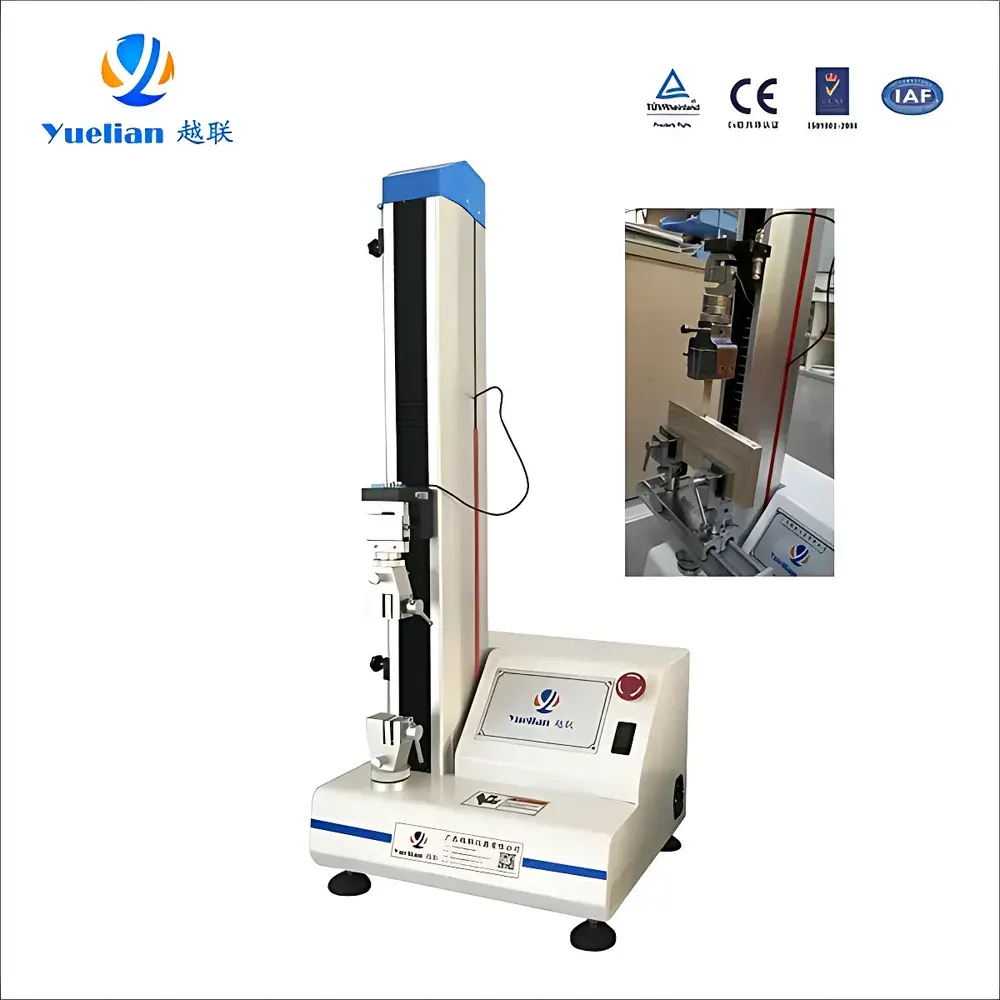
English Product Name
| Origin | Guangdong, China |
|---|---|
| Manufacturer Type | Authorized Distributor |
| Origin Category | Domestic (China) |
| Model | YL-S90 |
| Quotation | Upon Request |
| Load Capacity Options | 10 N, 20 N, 50 N, 100 N, 200 N, 500 N, 1 kN (dual-range configuration available) |
| Force Resolution | 1/500,000 full scale |
| Force Accuracy | ±0.3% of reading |
| Displacement Resolution | 1/500,000 full scale |
| Test Stroke | 500 mm / 800 mm (selectable) |
| Test Width | 110 mm |
| Speed Range | 0.1–500 mm/min (computer-programmable) |
| Drive System | Stepper motor + precision ground ball screw |
| Power Supply | 220 V, 50/60 Hz, 3 A |
| Power Consumption | 180 W |
| Dimensions (W×D×H) | 40 × 37 × 92 cm or 40 × 37 × 120 cm |
| Net Weight | 28 kg / 35 kg |
| Standard Accessories | One set of quick-release grips, PC software, USB-to-serial interface cable |
Overview
The Yilong YL-S90 Universal Adhesion Peel Tester is an electromechanical tensile and peel testing system engineered for precise quantification of interfacial adhesion strength in edge banding applications—particularly between thermoplastic or PVC edging tapes and engineered wood substrates (e.g., MDF, particleboard, plywood). Operating on the principle of controlled uniaxial force application via stepper-motor-driven ball-screw actuation, the instrument delivers high-fidelity load-displacement data under standardized peel geometries (e.g., 90° and 180° peel configurations). Its modular mechanical architecture supports both standalone operation and synchronized data acquisition via USB-connected host computers, enabling compliance with internationally recognized test methodologies for adhesive bond integrity assessment in furniture manufacturing, cabinetry, and architectural panel production.
Key Features
- High-efficiency mechanical transmission: >85% energy transfer efficiency achieved through precision-ground ball screws and synchronous timing belts, minimizing thermal drift and hysteresis during extended testing cycles.
- Dual-mode control interface: Integrated B-type display panel for rapid parameter setup (speed, stroke, trigger thresholds), complemented by full PC-based control via dedicated software for advanced protocol sequencing and multi-step test definition.
- Modular gripping system: Quick-connect couplings accommodate interchangeable fixtures—including pneumatic edge-band clamps, T-peel jaws, loop tack holders, and shear plates—ensuring adaptability across ASTM D3330, GB/T 2792, and ISO 8510-2 compliant configurations.
- Precision motion control: Programmable speed range (0.1–500 mm/min) with real-time feedback; micro-adjustment buttons for fine vertical positioning of upper crosshead prior to test initiation.
- Comprehensive safety logic: Dual-stage overload protection, emergency stop circuitry, specimen rupture auto-halt, programmable upper/lower displacement limits, and automatic return-to-start functionality post-test.
- Multi-unit force reporting: Real-time conversion among N, kgf, lbf, g, ton, and MPa (for normalized stress calculation when cross-sectional area is input).
Sample Compatibility & Compliance
The YL-S90 accommodates a broad spectrum of flexible and semi-rigid laminates, including ABS, PP, PVC, and melamine-faced edge bands bonded to wood-based composites, as well as pressure-sensitive adhesives used in label and film applications. It supports standardized peel angles per GB/T 2792 (180° peel for rigid substrates), ASTM D3330 (90° peel for flexible backing), and GB/T 12914-1991 (tensile bonding strength of decorative veneers). All mechanical and software functions are traceable to ISO/IEC 17025 calibration practices; raw data files include timestamped metadata required for GLP/GMP audit trails. The system satisfies essential requirements of China’s GB 13022-91 (plastic film tensile properties) and QB/T 2171-95 (adhesive tape peel strength), and its digital output architecture is compatible with 21 CFR Part 11-compliant electronic signature workflows when deployed with validated software modules.
Software & Data Management
The included Windows-compatible software provides full test method library management, real-time graphing of load vs. displacement curves, and automated calculation of key metrics: peak peel force (N), average peel force (N), peel energy (J/m), and coefficient of variation (%). Raw ASCII data exports (.csv, .txt) support third-party statistical analysis (e.g., JMP, Minitab). Audit-ready features include user-access logs, version-controlled test protocols, and immutable data file hashing. Optional integration with LIMS platforms is supported via ODBC drivers and XML-based data exchange schemas. All software modules undergo annual verification against NIST-traceable reference standards.
Applications
- Quantitative evaluation of edge band adhesion durability under thermal cycling and humidity exposure (pre- and post-conditioning tests).
- Quality assurance screening of hot-melt and PUR adhesive performance across batch lots in OEM furniture component manufacturing.
- R&D validation of novel substrate surface treatments (e.g., plasma activation, corona discharge) for improved bond formation.
- Comparative analysis of peel resistance between conventional EVA and next-generation reactive adhesives.
- Regulatory submission support for CE-marked panel products requiring documented peel strength conformity per EN 438-2.
FAQ
What peel angles does the YL-S90 support, and how are they configured?
The system natively supports 90° and 180° peel geometries via fixture orientation and software-defined test direction. Custom angular setups (e.g., 45°) require optional jigs and manual alignment verification per ISO 8510-1 Annex A.
Is the force transducer calibrated to national metrological standards?
Yes—the load cell is factory-calibrated against CNAS-accredited reference standards (GB/T 16825.1-2008), with certificate-of-conformance supplied. Annual recalibration is recommended using certified deadweight kits.
Can the YL-S90 perform constant-load hold tests?
Yes—via software-defined “force hold” mode, supporting dwell durations from 1 second to 99 hours at user-specified load levels, with real-time creep displacement logging.
Does the system meet electromagnetic compatibility (EMC) requirements for laboratory use?
It complies with GB/T 18268.1-2010 (IEC 61326-1) Class A emission limits and immunity thresholds for industrial environments, including electrostatic discharge (±8 kV contact) and fast transient burst (±2 kV) resilience.
How is data integrity ensured during long-duration peel tests?
All acquired data points are timestamped with microsecond resolution and stored redundantly—on-device flash memory and host PC—using cyclic buffer architecture to prevent loss during unexpected power interruption.



