
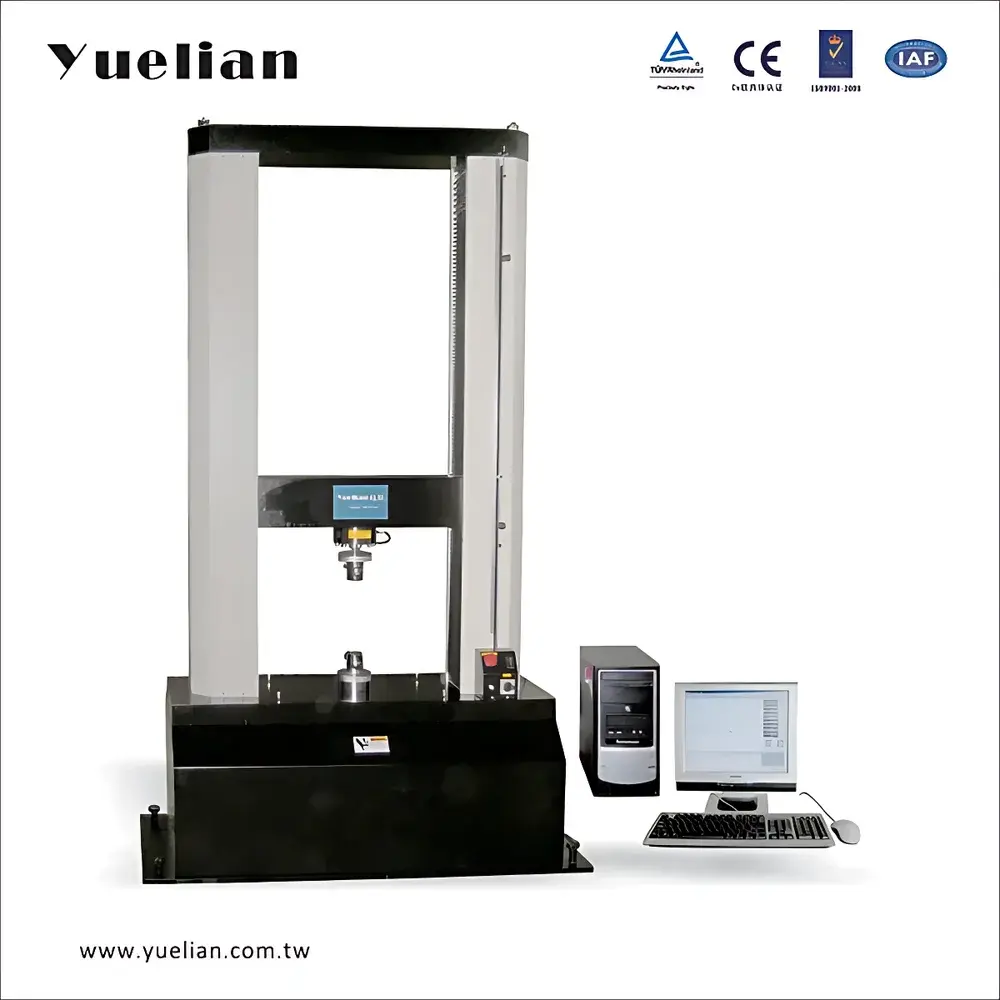
Yuelian YL-1152 Universal Testing Machine for Conveyor Belt Tensile Strength Testing
| Brand | Yuelian |
|---|---|
| Origin | Guangdong, China |
| Model | YL-1152 |
| Instrument Type | Electromechanical Universal Testing Machine |
| Load Capacity Options | 1 kN, 2 kN, 5 kN, 10 kN, 20 kN, 50 kN, 100 kN, 200 kN (dual-range configuration available) |
| Force Resolution | 1/500,000 full scale |
| Force Accuracy | ±0.3% of reading |
| Crosshead Travel | 1000 mm |
| Test Width | 420 mm |
| Speed Range | 0.5–500 mm/min (programmable via PC) |
| Displacement Resolution | 1/500,000 full scale |
| Control Interface | PC-based with USB connectivity |
| Data Acquisition & Analysis | Real-time force/displacement curve plotting, yield strength, ultimate tensile strength, elongation at break, modulus of elasticity, peel strength, tear strength, and shear strength calculation |
| Compliance Standards | ISO 7500-1, ASTM E4, ASTM D3330, EN 10002-1, GB/T 228.1, GB/T 2792, GB/T 7124, JJG 475 |
| Power Supply | 380 V, 50 Hz, 2 kW |
| Dimensions (W×D×H) | 108 × 85 × 205 cm |
| Weight | ~950 kg |
| Drive System | Servo motor + precision ball screw + synchronous timing belt |
| Standard Accessories | One set of universal grips, proprietary test software, USB interface cable |
Overview
The Yuelian YL-1152 Universal Testing Machine is an electromechanical static materials testing system engineered for high-reproducibility mechanical characterization of conveyor belts and other structural polymeric, metallic, composite, and fibrous materials. It operates on the principle of controlled uniaxial force application—measuring load response under precisely regulated displacement or strain rate—to determine fundamental mechanical properties including tensile strength, yield point, elongation at break, Young’s modulus, and fracture behavior. Designed to meet international metrological traceability requirements, the system conforms to ISO 7500-1 (static calibration of force-measuring systems) and ASTM E4 (practices for force verification of testing machines), ensuring measurement integrity across R&D labs, QC laboratories, and third-party certification facilities.
Key Features
- High-precision dual-range load cell architecture supporting selectable capacities from 1 kN to 200 kN—enabling consistent resolution across low-force peel tests and high-load belt tensile validation.
- Servo-controlled actuation with precision ball screw transmission delivers stable, noise-free motion across the full speed range (0.5–500 mm/min), critical for capturing viscoelastic transitions in rubberized conveyor belt compounds.
- Real-time 1/500,000 full-scale force and displacement resolution ensures detection of subtle yielding events and micro-fracture initiation in multi-layered belt carcasses.
- Integrated PC-based control interface supports automated test sequencing, parameter scripting, and synchronized data capture—eliminating manual intervention during multi-specimen qualification runs.
- Comprehensive safety architecture includes overload cutoff, emergency stop circuitry, specimen rupture-triggered halt, and programmable upper/lower travel limits compliant with EN ISO 13857 and ANSI B11.19.
- Modular grip mounting system accommodates standardized tensile tabs, peel fixtures, and custom-designed clamping solutions for non-standard belt geometries (e.g., cleated, sidewall-reinforced, or modular plastic belts).
Sample Compatibility & Compliance
The YL-1152 is validated for testing ASTM D3330-compliant pressure-sensitive adhesive bonds on belt splice interfaces, ISO 2286-2–specified rubber conveyor belt tensile specimens, and EN 14971–aligned risk-assessed mechanical validation of food-grade and mining-duty belt materials. Its mechanical design adheres to ISO 12100 (safety of machinery) and incorporates GLP/GMP-ready audit trails—including user login logs, test method versioning, and electronic signature support—facilitating FDA 21 CFR Part 11–compliant documentation in regulated manufacturing environments. Calibration certificates are traceable to NIM (China National Institute of Metrology) and internationally recognized NMIs via ISO/IEC 17025–accredited providers.
Software & Data Management
The embedded Windows-native test software provides ISO 17025–aligned data governance: all raw force-displacement time-series data are stored in encrypted MS-ACCESS databases with immutable timestamps, operator IDs, environmental metadata (temperature/humidity if external sensors are connected), and instrument configuration snapshots. Curve analysis modules compute ASTM D638–defined tensile parameters (Et, σy, σu, εb) and generate PDF reports with embedded digital signatures, revision-controlled templates, and customizable headers for internal QA or external accreditation submissions. Export formats include CSV, XML, and ASTM E1434–compliant .tdf files for interoperability with LIMS platforms.
Applications
- Tensile strength and elongation assessment of EPDM, PVC, PU, and NR-based conveyor belt top covers and carcass fabrics per ISO 2286-1 and DIN 22102.
- Adhesion strength evaluation of vulcanized splices and cold-bonded overlaps using ASTM D903 peel protocols.
- Compression resilience testing of impact-absorbing belt underlay layers under ASTM D3574 conditions.
- Mechanical aging studies tracking modulus degradation after accelerated thermal/ozone exposure (ASTM D1149, ISO 1431).
- Quality conformance verification against OEM specifications for mining, port handling, and food processing belt suppliers.
- Root cause analysis of field failures—including ply separation, cover delamination, and edge raveling—via comparative mechanical fingerprinting.
FAQ
What standards does the YL-1152 comply with for conveyor belt testing?
It meets ISO 2286-1/2 (rubber conveyor belts), ASTM D3330 (adhesive peel strength), GB/T 7984 (Chinese conveyor belt specification), and ISO 7500-1 for force measurement accuracy.
Can the system perform cyclic loading or fatigue tests?
No—the YL-1152 is a static loading system optimized for monotonic tensile, compression, bend, and peel tests; it does not support dynamic or high-cycle fatigue protocols.
Is third-party calibration documentation included?
Yes—a factory-issued calibration certificate traceable to national metrology institutes is provided; optional ISO/IEC 17025–accredited recalibration services are available.
How is data integrity maintained for regulatory audits?
All test sessions generate tamper-evident audit logs with electronic signatures, versioned test methods, and encrypted database storage aligned with FDA 21 CFR Part 11 and EU Annex 11 requirements.
What grip types are recommended for textile-reinforced conveyor belts?
Pneumatic side-action grips with serrated tungsten-carbide faces and adjustable clamping pressure (0.5–10 MPa) are standard; custom mandrel fixtures for curved belt sections can be supplied upon request.
Related Products



